
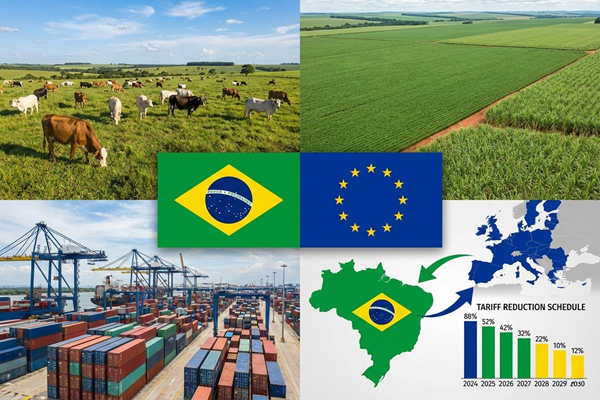
EU and Mercosur Finalize Landmark Trade Pact After 25 Years
On January 17, 2026, the European Union and Mercosur (Brazil, Argentina, Paraguay, and Uruguay) signed the long-negotiated EU-Mercosur Trade Agreement, concluding talks that began in 1999
EU-Mercosur Trade Agreement – T…
Agriculture was one of the most politically sensitive elements of the agreement. The final deal includes phased tariff reductions, tariff-rate quotas (TRQs), and safeguard mechanisms designed to protect sensitive sectors.
The agreement covers 31 countries and a combined population of roughly 700 million people.
Brazil Expected to Gain USD 6.2 Billion in Agricultural Exports
According to Brazil’s Institute of Applied Economic Research (IPEA), the agreement could increase Brazilian agricultural exports to the EU by USD 6.2 billion cumulatively by 2040 once fully implemented
EU-Mercosur Trade Agreement – T…
Largest Projected Gains (by Value)
-
Vegetable oils and fats: +USD 1.9 billion (+41%)
-
Pork and poultry: +USD 1.6 billion (+227%)
-
Other food products: +USD 1.1 billion (+70%)
Notable Gains (by Percentage)
-
Beef: +USD 531 million (+101%)
-
Sugar: +USD 300 million (+64%)
-
Rice: +USD 9 million (+304%)
-
Dairy: +USD 3.6 million (+255%)
The beef sector alone could contribute an additional USD 521 million to Brazil’s trade balance, while pork and poultry exports could generate approximately USD 2.57 billion.
How Market Access Changes Under the Agreement
🇪🇺 EU Concessions to Mercosur
Key agricultural TRQs include:
-
Beef: 99,000 tons (7.5% in-quota tariff) phased in over 5 years
-
Poultry: 180,000 tons at zero in-quota tariff
-
Pork: 25,000 tons at reduced tariff
-
Sugar: 180,000 tons duty-free
-
Ethanol:
-
450,000 tons (industrial use) duty-free
-
200,000 tons (including fuel) at one-third of standard EU tariff
-
-
Rice: 60,000 tons duty-free
-
Corn and sorghum: 1 million tons duty-free
Brazil is expected to receive roughly 42 percent of the new beef quota allocation.
Currently, Brazilian beef exports face tariffs of 12.8% plus €221.10 per 100 kg outside existing quotas. The agreement replaces this with the new shared quota system.
🇧🇷 Mercosur Concessions to the EU
Mercosur will reduce or eliminate tariffs on:
-
Wine (currently 27%)
-
Chocolate (20%)
-
Olive oil (10%)
-
Whiskey and spirits (20–35%)
Wine tariffs will be phased out over 8–12 years. Chocolate tariffs will be eliminated in 10–15 years.
The European Commission estimates EU agricultural exports to Mercosur could increase by approximately USD 1.43 billion (49%) by 2040, particularly in beverages, fruits and vegetables, vegetable oils, and dairy.
Brazil’s Current Trade Structure with the EU
In 2025:
-
Brazil exported USD 25 billion in agricultural goods to the EU
-
Top exports:
-
Coffee (USD 7.3 billion)
-
Soybean products (USD 6.4 billion)
-
Forest products (USD 3 billion)
-
EU agricultural exports to Brazil totaled USD 3.1 billion, led by:
-
Olive oil (USD 458 million)
-
Wine (USD 199 million)
-
Bottled water (USD 190 million)
More than 82% of Brazilian exports to the EU will become duty-free immediately once the agreement enters into force.
Brazil, meanwhile, will eliminate tariffs on 15% of EU imports immediately, with longer phase-out periods extending up to 15 years for sensitive goods.
Commodity Highlights
🥩 Beef
Brazilian beef gains improved quota access but faces safeguard triggers if imports rise 5% above the three-year average.
🐔 Poultry
Quota expands significantly from 15,050 tons currently to 180,000 tons annually across Mercosur.
☕ Coffee
Green coffee (97% of exports) already enters tariff-free.
Instant and roasted coffee tariffs (9% and 7.5%) will be eliminated within four years.
🌱 Soybeans
No major change — soybeans and soybean meal already enter duty-free.
🍇 Fruit
Immediate tariff elimination for table grapes (11% currently).
Avocados (4%) phased out in four years.
Lemons, melons, and watermelons phased out within seven years.
🧃 Sugar
EU grants 180,000 tons duty-free quota — small relative to Brazil’s USD 12 billion annual sugar exports.
♻️ Biofuels
Two ethanol quotas created (450,000 MT industrial, 200,000 MT fuel).
Biodiesel tariffs eliminated over 11 years.
Safeguards and Trade Protection
The EU strengthened safeguard mechanisms in December 2025:
-
If sensitive imports rise 5% above the three-year average, the EU may suspend tariff benefits.
-
Mercosur exporters must comply with EU-equivalent standards for food safety, animal health, and pesticide use.
Brazilian industry has expressed concern that safeguards should remain strictly technical and not evolve into disguised barriers.
Geographical Indications (GI) Expansion
The agreement significantly expands GI protection:
-
EU recognizes 195 Mercosur products, including 37 Brazilian products (e.g., cachaça, Canastra cheese).
-
Mercosur recognizes 344 EU products, including champagne, parmesan, and prosciutto.
This strengthens branding protection but may require product name adjustments in some cases.
Ratification: Fast in Mercosur, Uncertain in EU
Brazil’s Chamber of Deputies received the agreement text on February 2, 2026, with ratification expected quickly
EU-Mercosur Trade Agreement – T…
The EU ratification process is more complex:
-
The Interim Trade Agreement (ITA) requires European Parliament approval.
-
The broader Partnership Agreement (EMPA) requires approval by all 27 EU member states.
-
On January 21, 2026, the European Parliament requested a European Court of Justice review, potentially delaying full implementation for several years.
However, the EU Commission could provisionally apply trade liberalization measures once at least one Mercosur country ratifies the agreement.
🔎 CMB Outlook
The EU-Mercosur agreement represents one of the most significant agricultural trade liberalization efforts in decades.
For Brazil:
-
Major gains expected in meat, vegetable oils, and processed foods.
-
Coffee and soy remain structurally strong but unchanged.
-
Sugar and ethanol quotas provide incremental access but limited volume expansion.
For the EU:
-
Stronger positioning in beverages, dairy, and processed foods.
-
Safeguard mechanisms provide political reassurance for European farmers.
The ultimate economic impact will depend heavily on:
-
EU ratification timelines
-
Safeguard activation thresholds
-
Compliance with EU sustainability and pesticide standards
If implemented smoothly, the agreement could reshape transatlantic agricultural trade flows over the next 15 years.