
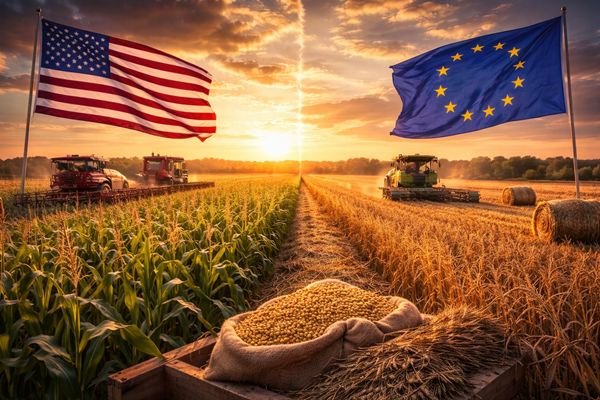
U.S. Deregulates, EU Tightens Standards – Is Global Agriculture Heading for a Trade Shock?
CMB News | Global Trade & Commodities | February 2026
A widening regulatory divide between Washington and Brussels is emerging as a new variable in global agricultural markets — one that could reshape trade flows as profoundly as weather or geopolitics.
The U.S. administration has embarked on a broad deregulatory push across agriculture, energy and environmental policy, aiming to reduce compliance burdens, accelerate processing capacity and lower input costs . At the same time, the European Union is moving in the opposite direction, debating stricter pesticide residue thresholds and tighter import standards.
The result is not merely a policy contrast. It is a structural divergence in how two of the world’s largest agricultural blocs define competitiveness.
Lower Costs, Higher Output?
The U.S. deregulatory agenda targets environmental review procedures, biotechnology approvals, energy policy and processing efficiencies. Supporters argue that reducing administrative burdens will lower production costs, accelerate investment and enhance productivity .
If that proves correct, the implications are straightforward: greater supply elasticity and stronger export competitiveness.
For commodities such as soybeans, corn and animal protein, lower structural costs could translate into:
- More aggressive export pricing
- Improved crush and processing margins
- Expanded acreage or intensified production
- Greater resilience to cyclical downturns
In global grain and oilseed markets, where margins are often measured in cents per bushel, regulatory cost differentials can be decisive.
Europe’s Counter-Model
Brussels, by contrast, is emphasising consumer protection, environmental safeguards and alignment between domestic standards and imports. Stricter residue limits and tighter regulatory screening aim to reinforce trust in food systems and ensure a level playing field for European farmers.
Yet higher standards also carry economic consequences.
Compliance costs rise. Import flexibility narrows. Supply chains become more selective.
In commodities where the EU remains structurally import-dependent — notably soybeans and feed ingredients — tighter standards risk creating friction between regulatory ambition and supply reality.
The EU must therefore balance three objectives: consumer protection, domestic farm viability and price stability.
Competitive Advantage or Market Fragmentation?
The central question is whether the U.S. gains a structural cost advantage or whether the EU’s higher standards create a differentiated premium market.
A deregulatory environment may favour volume expansion and price competitiveness. But it can also invite scrutiny from trade partners and raise questions about sustainability credentials in markets where environmental criteria influence procurement.
Conversely, stricter standards can protect domestic producers and sustain higher price levels, but risk increasing input costs for feed manufacturers and food processors.
The divergence may ultimately lead to market segmentation:
- A cost-driven supply bloc centred on North and South America
- A standards-driven consumption bloc within Europe
Such fragmentation could alter long-standing trade patterns.
Soybeans at the Fault Line
The soy complex illustrates the tension.
The EU depends heavily on imported soybeans and meal, largely from the Americas. If U.S. producers benefit from lower compliance costs while EU import thresholds tighten, trade flows could shift toward Asia or other emerging markets.
At the same time, higher EU standards could bolster domestic oilseed production incentives, albeit within structural land and yield constraints.
In this scenario, arbitrage spreads and basis differentials become increasingly sensitive to regulatory signals rather than solely to crop size.
Who Ultimately Prevails?
It remains premature to declare a winner.
If deregulation leads to sustained productivity gains without reputational cost, U.S. exporters may strengthen their global position.
If EU standards command a price premium and secure consumer loyalty without undermining affordability, Brussels’ model may prove resilient.
More likely, the outcome will depend on execution — and on whether regulatory divergence amplifies volatility in an already fragile global food system.
Markets Watching Policy
For traders and investors, the divergence introduces a new axis of risk.
Alongside weather patterns, currency movements and geopolitics, regulatory alignment — or misalignment — may increasingly shape:
- Soybean and meal spreads
- Protein export flows
- Feed cost dynamics
- Arbitrage between U.S., Brazilian and EU markets
The transatlantic policy split does not yet constitute a trade shock.
But it is evolving into a structural force that markets can no longer ignore.