
Strait of Hormuz Crisis: Oil Surges as Iran Escalation Threatens Global Energy Supply
Since Friday, military developments involving the United States, Israel and Iran have fundamentally altered global energy markets within a matter of days.
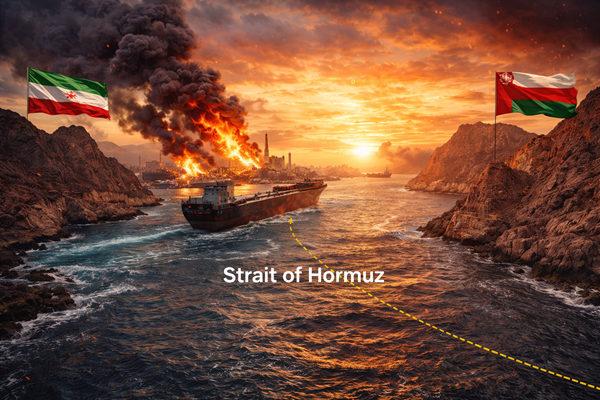
The trigger: coordinated airstrikes on Iranian targets, followed by immediate security responses from Tehran in the Persian Gulf. At the center of the market reaction stands one of the most critical chokepoints in global trade — the Strait of Hormuz, the world’s most important maritime corridor for energy transport.
A De Facto Maritime Freeze
Following the first wave of strikes, Iranian security authorities warned international shipping against transiting the narrow waterway. In response, several major shipping companies and energy firms either suspended or delayed tanker movements. At the same time, large insurers partially withdrew war-risk coverage or sharply increased premiums.
While no formal blockade has been declared, operational reality tells a different story. Without sufficient security guarantees, commercial passage through the Strait has become economically and logistically unviable.
In practical terms, Hormuz is heavily restricted — if not effectively frozen.
Why This Matters: A Fifth of Global Oil at Risk
Roughly 20 percent of globally traded crude oil, along with substantial volumes of liquefied natural gas, normally pass through the Strait of Hormuz.
Crucially, no significant production outages have occurred so far. The market reaction is not driven by actual supply loss — but by the risk of transport disruption and the possibility of future outages.
That distinction matters.
Energy markets are pricing uncertainty, not scarcity.
Oil Reacts: The War Premium Returns
Brent crude initially edged higher on Friday before surging overnight into Monday above $80 per barrel. U.S. WTI climbed sharply to above $75, after closing Friday at $67, before easing slightly to around $73 by morning trading.
The move reflects a clear geopolitical risk premium.
Traders are hedging deliveries. Importing nations are reviewing strategic reserves. Speculative participants are building protection positions.
Within days, the oil market has shifted from a largely fundamentals-driven environment to a geopolitically dominated risk market.
Three Scenarios Now Define the Outlook
1️⃣ Controlled Disruption – Elevated but Stable
In the first and currently most widely expected scenario, shipping through Hormuz remains possible but under heightened military risk. Transport capacity is constrained, insurance and logistics costs stay elevated, and a structural risk premium persists.
Physical supply disruptions would remain limited.
In this environment, oil prices would likely stabilize within a higher trading range between $80 and $95 per barrel.
This scenario reflects both ongoing uncertainty and the stabilizing role of international naval presence.
2️⃣ Escalation and Extended Blockade – Energy Shock
A more severe scenario would involve a prolonged effective closure of the Strait or direct attacks on Gulf energy infrastructure.
In that case, significant export volumes from multiple Gulf states could be simultaneously impaired. Strategic reserves would need to be deployed. Physical shortages could emerge.
Under such conditions, oil prices above $100 per barrel become realistic — with potential short-term spikes toward $150 or beyond.
Such an energy shock would:
-
Reignite global inflation pressure
-
Increase recession risks
-
Strain emerging markets
-
Disrupt global trade flows
This is the tail risk — but not one markets can ignore.
3️⃣ Rapid De-escalation – Risk Premium Unwinds
The third scenario assumes swift political or military de-escalation. Mediation efforts or informal arrangements could restore sufficient security confidence within days.
If tankers resume transit and insurers reinstate coverage, the current geopolitical premium would unwind quickly.
Given that global oil supply fundamentals remain broadly adequate — and non-OPEC production continues to expand — prices could retreat toward $70 per barrel or lower.
History shows that geopolitical spikes often correct rapidly when no physical supply shortage materializes.
The Core Question: Trust in Safe Passage
The events since Friday have once again turned the Strait of Hormuz into the central vulnerability of global energy markets.
The current oil rally is driven primarily by transport and security uncertainty — not actual production loss.
Therefore, the decisive variable is not the military confrontation itself, but how quickly confidence in secure maritime passage can be restored.
As long as uncertainty dominates, a geopolitical risk premium will shape oil markets.
If confidence returns, prices may fall just as swiftly as they rose.
For now, however, the market trades risk — and risk is back in command.