


Oil Markets Caught Between War Premium and Political Pressure: Brent, WTI and Gasoil React Nervously to Iran Conflict
CMB News | Energy Markets | March 10, 2026
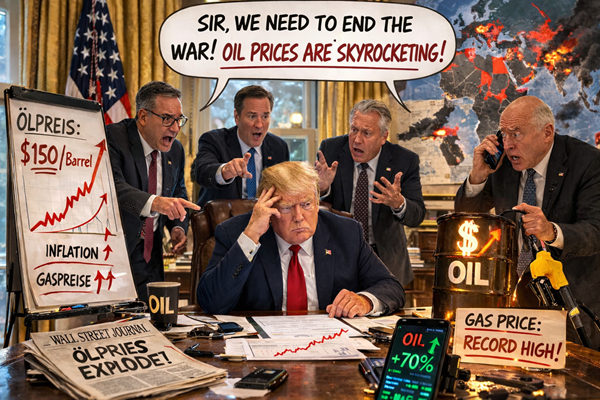
International oil markets delivered a highly volatile performance at the start of the week. While the geopolitical risk premium linked to the Iran conflict was clearly reflected in front-month crude oil and gasoil contracts, it also became evident that political pressure is mounting in Washington to formulate an exit strategy. This tension — military escalation on one side and economic and electoral constraints on the other — is currently shaping price action in Brent, WTI, and ICE Gasoil.
What stands out most is that the strength is concentrated in the nearby part of the curve. This points to an acute geopolitical risk shock rather than a permanently changed long-term supply outlook. The forward structure makes that clear: the market is pricing immediate uncertainty, while remaining far more cautious about later years.
📈 Prices
ICE Gasoil LS (USD/t)
The gasoil market moved sharply higher across the front part of the curve. Summer and early autumn contracts posted particularly strong daily gains:
- March 2026: USD 1,166.00/t (+7.75 / +0.66%)
- April 2026: USD 1,079.00/t (+21.25 / +1.97%)
- May 2026: USD 980.25/t (+29.25 / +2.98%)
- June 2026: USD 902.00/t (+30.75 / +3.41%)
- July 2026: USD 851.25/t (+30.75 / +3.61%)
- August 2026: USD 826.75/t (+32.25 / +3.90%)
- September 2026: USD 813.00/t (+31.75 / +3.91%)
The center of the move was therefore clearly in the nearby and mid-front section. At the same time, the curve from 2028/29 onward remained significantly flatter, showing that the market is pricing disruption, but not yet a structural long-term shortage.
ICE Brent (USD/bl)
Brent showed a more mixed pattern. The nearest liquid contract came under pressure, while later contracts posted strong gains:
- May 2026: USD 90.25/bl (-2.44 / -2.70%)
- June 2026: USD 86.50/bl (-0.70 / -0.81%)
- July 2026: USD 83.10/bl (+0.22 / +0.26%)
- August 2026: USD 80.88/bl (+1.02 / +1.26%)
- September 2026: USD 82.40/bl (+4.58 / +5.56%)
- October 2026: USD 80.15/bl (+3.88 / +4.84%)
- December 2026: USD 77.06/bl (+2.89 / +3.75%)
The strong repricing of the autumn 2026 window is particularly notable. That part of the curve appears to reflect elevated concern over supply chains, tanker flows, and refinery availability.
NYMEX WTI (USD/bl)
WTI reacted even more directly to the geopolitical backdrop in the nearby contracts:
- April 2026: USD 94.77/bl (+3.87 / +4.08%)
- May 2026: USD 91.48/bl (+3.96 / +4.33%)
- June 2026: USD 86.67/bl (+4.48 / +5.17%)
- July 2026: USD 82.25/bl (+4.31 / +5.24%)
- August 2026: USD 78.78/bl (+3.76 / +4.77%)
- September 2026: USD 76.14/bl (+3.16 / +4.15%)
WTI therefore sends a very clear front-end risk signal. At the same time, later years are priced materially lower, which argues against a lasting supply squeeze.
🔍 Key Market Drivers
1. Geopolitical risk premium remains dominant
The market reaction is clearly tied to the continued escalation surrounding Iran. Reports from within the White House suggesting that an internal discussion over a possible exit plan is underway show that the conflict is now being evaluated not only militarily, but politically as well. For the oil market, the key point is straightforward: as long as the risk of further regional escalation or disruption to energy flows is not credibly removed, a security premium in front-month contracts remains justified.
2. Trump faces price and election pressure
The oil market is reacting very sensitively to the argument that rising gasoline and energy prices in the United States could become a political problem for Republicans. That limits the room for a prolonged escalation. From a market perspective, this creates a double signal: bullish in the short term because of uncertainty, but potentially price-negative in the medium term if Washington actively pushes for de-escalation.
3. Distillates are outperforming crude
The move in ICE Gasoil is especially striking. Percentage gains of nearly 4% in several contracts show that the market is not only nervous about crude supply, but also about the availability of refined products. That is typical in geopolitical crises, where the issue is not just the barrel itself, but also refining, logistics, and product distribution.
4. The forward curve does not yet signal a permanent supply shock
Across Brent, WTI, and Gasoil, the curves flatten clearly in later years. In some sections, they even move into structurally lower territory. That means the market is currently treating the situation as a temporary geopolitical stress event rather than a long-term fundamental shortage.
🧭 Market Commentary
The current market structure is typical of a geopolitically driven energy shock. Front months jump sharply, mid-curve contracts are repriced, while long-dated contracts remain comparatively anchored. For traders, this is an important signal: the market is currently focused less on a permanent shift in supply and demand, and more on the probability of a short-term disruption.
Brent looks less uniform than WTI. The decline in the May 2026 Brent contract, while later months moved higher, points to repositioning and curve reassessment. WTI, by contrast, shows a much cleaner upward pattern in the nearby part of the curve. Gasoil confirms that picture with even greater intensity, suggesting acute concern in the refined product market.
This matters especially for Europe. If gasoil rises faster than crude, pressure on diesel prices, transport costs, and ultimately a wide range of industrial and logistics cost structures increases. For the physical market, that is often more important than the move in crude oil alone.
📌 Outlook / Trading Strategy
In the short term, the market remains clearly headline-driven and highly sensitive. Unless credible de-escalation emerges, the geopolitical premium in front-month contracts is likely to remain in place. Gasoil and nearby WTI contracts in particular remain vulnerable to further upside.
At the same time, the curve structure argues for caution. The flatter to weaker long-dated profile suggests that the market is not pricing a lasting supply shortage. That increases the risk of abrupt pullbacks as soon as Washington or regional actors provide signals that military operations may be winding down or being contained.
Bullish scenario: further escalation, renewed fears over transport routes or exports, and another upward leg in Brent, WTI, and especially Gasoil.
Bearish scenario: clear exit communication from the White House, a decline in the war premium, and a sharp correction in front-month contracts.
Base scenario: volatility remains elevated, the front curve continues to trade with a premium, while later years remain relatively stable.
For market participants, the focus should therefore be less on long-term directional bets and more on front-month spreads, product premiums, and the pace of geopolitical headlines.
Related posts:
 US–Iran War: Oil, Dollar, Gold and Rupee Face Volatile Outlook as Conflict Unsettles Markets
 Crop Prices Fall as Trump Signals Possible End to Iran War
 Heating Oil Panic in Germany: War and Supply Cuts Send Prices Soaring
 Crude Oil Outlook: NYMEX & Brent Surge as Near-Term Tightness Lifts Sentiment
 Oil Markets Rebound Amid Volatility: What’s Driving WTI and Brent Higher?
 Strait of Hormuz Crisis: Oil Surges as Iran Escalation Threatens Global Energy Supply
 Iran Conflict Could Trigger Prolonged Commodity Rally — Here’s What Traders Must Know
 Crude Oil Market: Brent Slide Continues as Diesel Drops, Cautious Outlook Ahead