


Strait of Hormuz Crisis: How Much Oil Is Still Flowing – and Why a Full Supply Collapse Is Unlikely
CMB News | Energy Markets | March 2026
The escalation of the Iran conflict has once again put the Strait of Hormuz at the center of global energy market concerns. As one of the most critical chokepoints in the global oil system, the narrow waterway between the Persian Gulf and the Gulf of Oman carries roughly one fifth of the world’s oil trade under normal conditions.
However, current shipping data suggests that the situation is more complex than the headline risk of a complete blockade. While tanker traffic has dropped significantly due to security concerns, oil exports from the region have not stopped entirely.
The Strait of Hormuz: A Critical Energy Chokepoint
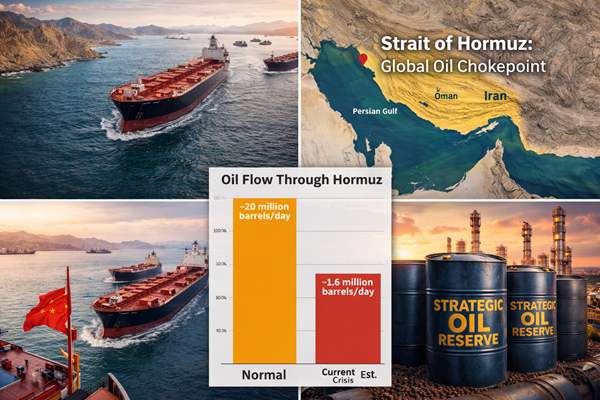
In normal market conditions, the Strait of Hormuz handles about 20 million barrels of oil per day, representing approximately 20% of global oil consumption and trade flows.
Oil Flow Through the Strait of Hormuz
| Situation | Oil Flow |
|---|---|
| Normal conditions | ~20 million barrels/day |
| Current crisis estimate | ~1.6 million barrels/day |
| Share of normal flow | ~20% of usual traffic |
The sharp drop in tanker movements reflects heightened security risks and insurance costs rather than a complete shutdown of the shipping route.
Why Oil Is Still Moving
Despite the conflict, several factors explain why oil shipments have not stopped entirely.
1. Iranian Exports Continue
Iran continues exporting oil, primarily to Asian buyers, particularly China. Tankers carrying Iranian crude are still transiting the region, often through complex shipping arrangements.
2. “Shadow Fleet” Operations
Many shipments are conducted using so-called shadow fleets – tankers operating with altered ownership structures, disabled transponders, or indirect routing to avoid sanctions or detection.
3. Selective Shipping Activity
Some vessels are waiting outside the strait or using convoy-style routing while geopolitical tensions remain high.
Alternative Export Routes Reduce Risk of Total Supply Loss
Even if shipping through the Strait of Hormus becomes more difficult, several producers have limited alternatives that reduce the risk of a complete supply collapse.
Key Alternative Export Routes
| Country | Alternative Route |
|---|---|
| Saudi Arabia | East-West pipeline to the Red Sea |
| UAE | Abu Dhabi pipeline to Fujairah (outside Hormus) |
| Iraq | Northern pipeline through Turkey (limited capacity) |
| Iran | Jask terminal on the Gulf of Oman |
These routes cannot fully replace the strait’s capacity but can help keep a portion of exports flowing.
Economic Impact Depends on Duration
Energy economist David Fyfe of Argus Media emphasizes that the economic consequences depend largely on how long disruptions persist.
Possible Economic Scenarios
| Duration of Disruption | Likely Impact |
|---|---|
| 1 month | Temporary price spike, manageable economic impact |
| 3 months | Rising inflation, delayed interest rate cuts |
| 6 months | Severe price shock, risk of global recession |
A prolonged disruption could push global GDP growth below 2%, a level economists often interpret as a near-stall in global economic activity.
China and the United States: Different Exposure Levels
The crisis affects major economies differently.
China
- large strategic energy reserves
- strong dependence on global trade and shipping
- vulnerability to rising freight costs.
United States
- major domestic oil and gas production
- lower direct exposure to imported energy shocks
- inflation risks more linked to tariffs and domestic factors.
Europe Faces Renewed Energy Pressure
For Europe, the risk lies primarily in energy prices. European industry is still recovering from the energy shock triggered by the Ukraine war.
Higher oil prices could eventually feed into:
- natural gas prices
- electricity costs
- industrial competitiveness.
Energy-intensive sectors such as chemicals, steel, and manufacturing remain particularly sensitive to such shocks.
Why a Permanent Supply Shock Is Unlikely
While the geopolitical risks are significant, analysts emphasize that a permanent collapse in oil supply is unlikely.
Several mechanisms help stabilize markets:
- strategic petroleum reserves held by major economies
- alternative pipelines and export terminals
- increased production in other regions
- price-driven demand adjustments.
Even during major geopolitical crises, global oil markets have historically adapted through rerouting trade flows and releasing emergency reserves.
Outlook
The Strait of Hormus remains one of the most important pressure points in global energy markets. While tanker traffic has fallen sharply in the current crisis, oil continues to move through the region.
For now, the key question for markets is not whether the strait closes completely, but how long disruptions last and how quickly alternative supply routes can compensate.
As long as some oil continues to flow and alternative export routes remain available, the risk of a prolonged global supply collapse remains limited — though volatility in energy markets is likely to persist.
Related posts:
 Energy Shock Threatens Europe’s Retail Sector as Oil Prices Surge After Iran War
 Trump’s Plan to Escort Tankers Through Strait of Hormuz Eases Oil Price Surge
 Iran Threatens to Target Ships in Strait of Hormuz, Escalating Global Energy Fears
 Strait of Hormuz Crisis: Oil Surges as Iran Escalation Threatens Global Energy Supply
 Iran Conflict Could Trigger Prolonged Commodity Rally — Here’s What Traders Must Know
 Strait of Hormuz Crisis Sends Oil Prices Surging 8% as Middle East Escalation Threatens Global Supply
 U.S. Deregulates, EU Tightens Standards – Is Global Agriculture Heading for a Trade Shock?
 Lower Indian Output Sends Sugar Market Into Tight Supply Mode: ISMA Steps Trigger Export Caution