
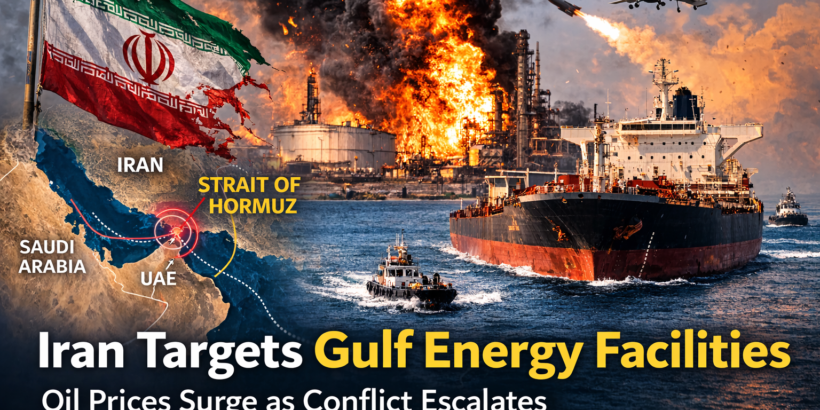


Iran Targets Gulf Energy Infrastructure as Conflict Escalates and Oil Prices Rise
CMB News | Energy & Geopolitics | March 2026
The war involving Iran is increasingly spilling over into the energy infrastructure of the Persian Gulf, raising the economic costs of the conflict and intensifying pressure on global oil markets. Iranian forces have expanded their attacks on energy facilities and commercial shipping in the region, a strategy analysts say is designed to increase the financial and logistical costs of continuing the war.
As tensions escalate, crude oil prices recently climbed to their highest level since the summer of 2022, driven largely by disruptions to shipping through the Strait of Hormuz, one of the world’s most critical energy transport routes.
Energy Facilities Become Strategic Targets
According to regional authorities, Iranian strikes have increasingly targeted energy-related infrastructure across the Gulf.
In Bahrain, fuel storage facilities near the international airport in the capital Manama were reportedly struck. Authorities urged residents in nearby districts to remain indoors and keep windows closed as a precaution.
It remains unclear whether the affected installations were aviation fuel depots for the airport or separate fuel storage facilities.
Attacks on energy infrastructure are widely viewed as part of Iran’s effort to raise the economic stakes for countries supporting military operations against it.
Tankers Under Fire in the Persian Gulf
Commercial shipping has also been affected.
Two oil tankers were attacked in Iraqi territorial waters in the Persian Gulf, according to Iraqi authorities. The incident resulted in at least one fatality.
Rescue operations recovered 38 crew members, while Iraqi port authorities temporarily suspended operations at nearby oil terminals following the attack.
Shipping in the wider region—including the Persian Gulf, the Strait of Hormuz, and the Gulf of Oman—has been repeatedly targeted since the conflict began.
Cargo Ships Hit Near Hormuz
A Thai-flagged cargo vessel was struck by Iranian missiles near the Strait of Hormus.
The ship, Mayuree Naree, was reportedly traveling from the United Arab Emirates to India when two projectiles hit above the waterline, causing fires in the engine room and stern of the vessel.
Of the 23 Thai crew members on board, 20 were rescued by the Omani navy, while three sailors were initially believed to be trapped in the engine room.
In a separate incident, the UK Maritime Trade Operations (UKMTO) authority reported that a container ship off the coast of the United Arab Emirates was struck by an unidentified projectile, causing a small onboard fire.
Rising Threat Across the Gulf
Regional air defenses have also been activated in several Gulf states.
The United Arab Emirates reported intercepting missile threats overnight, while a drone crash in Dubai caused a small fire in a residential building.
Saudi Arabia stated that its air defense systems intercepted 18 drones over the eastern part of the kingdom. Kuwait also reported intercepting several hostile drones that entered its northern airspace.
These incidents highlight the widening geographic scope of the conflict across the Gulf region.
Diplomatic Fallout
As the security situation deteriorates, Switzerland announced the temporary closure of its embassy in Tehran due to rising security risks.
The Swiss embassy plays a unique diplomatic role, acting as the protecting power for the United States in Iran since diplomatic relations between the two countries were severed decades ago.
Through this role, Switzerland facilitates communication between Washington and Tehran and assists U.S. citizens in Iran.
Israel Expands Strikes Against Hezbollah
At the same time, Israeli forces intensified military operations in Lebanon.
According to the Israeli military, a wave of airstrikes targeted multiple Hezbollah positions in the Dahieh district near Beirut, including command centers and missile launch sites.
The strikes reportedly destroyed several operational facilities belonging to the pro-Iranian group, including the headquarters of Hezbollah’s intelligence branch and elite Radwan unit.
Earlier, Hezbollah had launched rockets toward northern Israel, further escalating regional tensions.
Outlook
While U.S. President Donald Trump recently suggested the war could end soon, military officials on the ground indicate that the conflict may continue for some time.
Israel has stated that it still maintains a large list of military targets within Iran.
As long as the conflict continues to affect shipping lanes, energy infrastructure, and regional security, global oil markets are likely to remain highly volatile.
For the global economy, the key risk remains whether disruptions to oil transport through the Strait of Hormuz persist long enough to trigger a broader energy supply shock.
Source: NTV
Related posts:
 Oman Evacuates Major Oil Export Port as Tanker Attacks Deepen Middle East Energy Crisis
 Energy Shock Threatens Europe’s Retail Sector as Oil Prices Surge After Iran War
 Oil Markets Caught Between War Premium and Political Pressure: Brent, WTI and Gasoil React Nervously to Iran Conflict
 US–Iran War: Oil, Dollar, Gold and Rupee Face Volatile Outlook as Conflict Unsettles Markets
 China Orders Immediate Halt to Diesel and Gasoline Exports Amid Gulf Supply Fears
 Iran Threatens to Target Ships in Strait of Hormuz, Escalating Global Energy Fears
 Strait of Hormuz Crisis: Oil Surges as Iran Escalation Threatens Global Energy Supply
 Iran Conflict Could Trigger Prolonged Commodity Rally — Here’s What Traders Must Know