
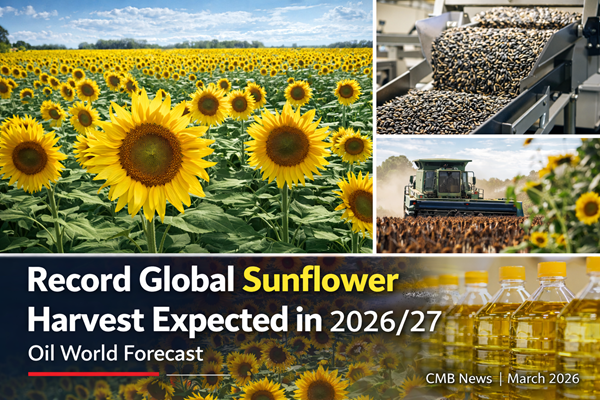


Record Global Sunflower Harvest Expected in 2026/27 – Oil World Forecast
CMB News | Oilseeds & Vegetable Oils | March 2026
Global sunflower production could reach a new record in the 2026/27 marketing season, according to analysts from the German agricultural market research firm Oil World.
The forecast suggests that worldwide sunflowerseed production may rise sharply thanks to improved yields and expanding planted areas across key producing regions.
If favorable weather conditions persist, global output could reach 62.3 million tonnes, significantly above the estimated 56.56 million tonnes expected for the current 2025/26 season.
Global Sunflower Production Outlook
The expected growth reflects a recovery from drought-related yield losses in previous seasons and a noticeable expansion of sunflower acreage in major producing countries.
Global Sunflower Production
| Season | Production |
|---|---|
| 2025/26 | 56.56 million tonnes |
| 2026/27 (forecast) | 62.3 million tonnes |
If realized, the new harvest would represent the largest sunflower crop ever recorded globally.
Russia and Ukraine Drive Production Growth
The largest increase in production is expected in the Black Sea region, which dominates global sunflower supply.
Sunflower Production by Major Producers
| Country/Region | 2025/26 | 2026/27 Forecast |
|---|---|---|
| Russia | 17.8 MMT | 21.0 MMT |
| Ukraine | 11.1 MMT | 12.6 MMT |
| European Union | 8.64 MMT | 9.53 MMT |
| Argentina | 6.1 MMT | 5.9 MMT |
| Kazakhstan | 2.07 MMT | 2.07 MMT |
Russia is expected to record the strongest production growth, potentially increasing its harvest by more than 3 million tonnes.
Ukraine’s production is also forecast to recover after previous seasonal losses.
EU Output Also Expected to Increase
The European Union is projected to increase sunflower production to approximately 9.53 million tonnes, up from 8.64 million tonnes in the current season.
The expansion reflects improved weather conditions and relatively strong planting incentives compared with competing oilseed crops.
Argentina Sees Slight Decline
In contrast, Argentina’s sunflower production could decline slightly in the coming season.
Oil World estimates the harvest may fall from 6.1 million tonnes to 5.9 million tonnes, mainly due to shifting planting decisions and competition from other crops.
Weather Remains the Key Risk
Despite the optimistic outlook, analysts emphasize that weather conditions will remain the decisive factor in determining final production volumes.
In the coming weeks, market participants will closely monitor:
- weather patterns across the Northern Hemisphere
- planting progress in major producing regions
- soil moisture conditions.
These factors will determine whether the projected record harvest can actually be achieved.
Impact on Vegetable Oil Markets
A record sunflower crop could have significant implications for global vegetable oil markets.
Higher sunflowerseed supplies may lead to:
- increased sunflower oil production
- downward pressure on raw material prices
- stronger competition with soybean and rapeseed oils.
For consumers and food processors, the outlook could translate into lower sunflower oil prices in the coming months.
Oilseed Market Dynamics
Earlier analyses by OleoScope indicated that production of soybeans, flax, and rapeseed may also reach record levels, partly offsetting previous declines in sunflower output.
Together, these trends suggest that the global oilseed complex may enter a period of relatively abundant supply.
Outlook
If weather conditions remain favorable, the 2026/27 season could mark a turning point for the global sunflower market.
Record production in the Black Sea region and rising output in the European Union could significantly expand global sunflower oil availability.
However, analysts caution that vegetable oil markets remain highly sensitive to weather risks, geopolitical developments, and fluctuations in energy and fertilizer costs — factors that could still influence final harvest outcomes and price trends in the months ahead.
Related posts:
 Palm Oil Futures Surge: Detailed Market Trends & Forward Guidance (Mar 2026+)
 Global Oilseeds Production Forecast to Reach 695.8 Million MT in 2025/26
 Sunflower Market Slumps: SAFEX Prices Slide Amid Oil & Edible Oil Volatility
 Soybeans Surge: Global Supply Jitters & Oil Price Rally Drive 2026 Highs
 Palm Oil Soars: MDEX Futures Rally with Bullish Sentiment for 2026/2027
 Global Peanuts Market: Oil Demand, Tight Crops, and Cautious Buyers Shape 2026 Outlook
 Sunflower Market: Volatility, Price Highs & Geopolitical Risks Shape 2026 Outlook
 Argentina Maintains 48 MMT Soybean Forecast as Rains Stabilize Crop; Sunflower Hits 5.8 MMT Record