
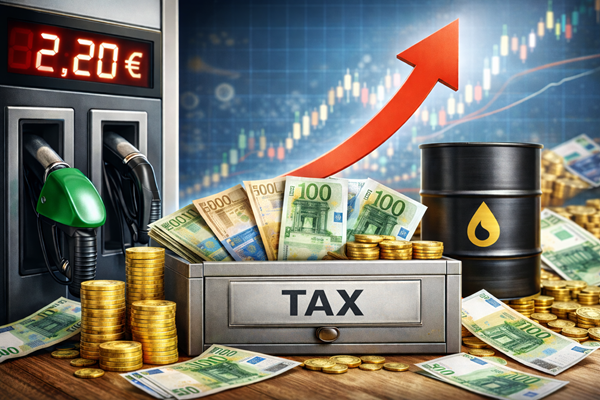


Strategic Oil Reserves Released – Why Prices Still Don’t Fall
An Emergency Tool – Not a Price Control Mechanism
Strategic oil reserves were originally created to protect countries from physical supply disruptions. After the oil crises of the 1970s, members of the International Energy Agency agreed to maintain emergency stocks that could be released if global supply chains were disrupted.
One of the best-known reserves is the U.S. Strategic Petroleum Reserve, managed by the U.S. Department of Energy. Similar reserves exist in Europe, China, Japan and South Korea.
The core purpose is simple:
- compensate sudden supply shortages
- keep refineries operating during disruptions
- buy time until markets stabilize
However, in recent years reserves have increasingly been released not because oil is physically unavailable, but because prices rise due to geopolitical tensions. This is where the structural problem begins.
Why Releasing Reserves Often Fails to Lower Prices
1. The volumes are small relative to the global market
Global oil demand is roughly 100 million barrels per day.
If governments release 60 million barrels, that equals:
- less than one day of global consumption
In such a massive market, the impact on price formation is inherently limited.
2. The oil is sold at the market price
Strategic reserves are usually released through auctions.
Refineries and major trading companies bid for the oil.
This means:
- governments sell oil at the current market price
- buyers have no incentive to lower prices
- traders can store or resell the oil later
As a result, the mechanism does not function as a price-control tool.
Instead, it operates entirely within the same market dynamics.
3. Oil prices are driven more by expectations than physical supply
Global oil prices are largely determined in futures markets such as the Intercontinental Exchange and the Chicago Mercantile Exchange.
If traders expect:
- geopolitical escalation
- disruptions to major shipping routes
- production cuts
prices may rise regardless of short-term supply increases.
Markets react strongly to expectations, sometimes more than to actual physical flows.
4. The bottleneck is often refining capacity
In many crises the real constraint is not crude oil itself but:
- refining capacity
- diesel and heating oil production
If refineries are already operating at full capacity, additional crude oil does little to increase fuel supply. Product prices remain high.
The Economic Paradox: Governments Also Profit
This leads to a paradoxical situation.
When governments release oil from strategic reserves, they sell it at the elevated market price.
That means they generate:
- direct revenue from the sale of crude oil
- additional tax income from higher energy prices
A simple example calculation
Assume a government releases 50 million barrels.
If the market price is 100 USD per barrel, the auction generates:
Revenue from the sale
50 million barrels × 100 USD
= 5 billion USD
In addition, higher energy prices generate extra tax revenues throughout the supply chain.
A modest tax component of 20 USD per barrel would produce:
50 million barrels × 20 USD
= 1 billion USD in tax income
➡️ In this simplified scenario, the government could generate around 6 billion USD in total revenue.
A Systemic Contradiction
Critics argue that this mechanism creates a structural contradiction.
Strategic reserves are meant to stabilize markets and protect consumers, yet the release process follows the same market pricing logic that drives prices upward.
As a result:
- governments publicly criticize high energy prices
- but they simultaneously benefit from them through sales and tax revenues
Conclusion
Strategic oil reserves remain a critical tool for safeguarding energy security during genuine supply disruptions.
However, when they are deployed primarily to address price spikes rather than physical shortages, their effectiveness becomes limited.
As long as reserve oil is sold through market auctions at prevailing prices, the mechanism is unlikely to significantly reduce oil prices.
Instead of acting as a brake on the market, the release simply injects additional barrels into the existing pricing system.
For consumers, this creates a difficult reality:
while governments promise to ease the burden of high energy costs, the structure of the system means that the state may actually benefit financially from the same price increases it seeks to control.
Related posts:
 Iran Says It Will Not Close Strait of Hormuz but Reserves Right to Protect Security
 Iran Targets Gulf Energy Infrastructure as Conflict Escalates and Oil Prices Rise
 Oman Evacuates Major Oil Export Port as Tanker Attacks Deepen Middle East Energy Crisis
 IEA Announces Record Strategic Oil Release to Stabilize Markets
 Sugar Beet Market Faces Steady Correction: EU Prices Ease on Oil Reserve Release
 Energy Shock Threatens Europe’s Retail Sector as Oil Prices Surge After Iran War
 Rapeseed Market Rallies: Energy, Geopolitics, and Trade Tensions Shake Fundamentals
 Strait of Hormuz Crisis: Oil Surges as Iran Escalation Threatens Global Energy Supply