



Oil Prices Hold Above $100 Despite Temporary US Waiver for Russian Crude
Global oil markets remained firmly above the $100 per barrel threshold on Thursday, showing little reaction to a temporary decision by the United States to allow the delivery of Russian crude that had been stranded at sea due to sanctions.
The waiver, issued by the US Treasury, allows shipments of Russian crude oil and petroleum products loaded onto vessels before March 12 to be delivered and sold until April 11. The move is intended to prevent an even sharper spike in global oil prices following escalating tensions in the Middle East and attacks linked to Iran.
Despite the additional supply potentially entering the market, traders remained focused on far larger disruptions affecting global energy flows.
Brent Above $100 as Hormuz Crisis Dominates Markets
Brent crude, the global oil benchmark, rose slightly by 0.2% to nearly $101 per barrel, marking its highest level since 2022 if the price holds through the session.
Meanwhile, WTI crude, the US benchmark, slipped marginally by 0.3% to around $95 per barrel.
The limited market reaction highlights the scale of the geopolitical risks currently affecting oil supply.
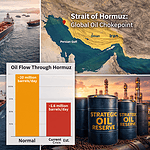
A key driver behind the price surge has been the effective disruption of shipping through the Strait of Hormuz, one of the world’s most critical energy corridors. The strait normally handles around 20% of global oil supply, making it one of the most strategically important maritime chokepoints.
Hormuz Disruption Overshadows Russian Supply
Economists note that the impact of the Hormuz crisis far outweighs the additional supply potentially released by the US waiver.
According to Mohit Kumar, economist at Jefferies, Russia produces roughly 10 million barrels of oil per day, while the disruption around the Strait of Hormuz has reduced oil flows by an estimated 13–14 million barrels per day.
Even that estimate may underestimate the scale of the disruption, as several oil and gas facilities in the region have also faced operational challenges.
“Russia was already exporting significant volumes to Asian markets,” Kumar noted, adding that it remains unclear how much the temporary easing of sanctions will actually increase global oil supply.
Shipping Attacks and Mine Threats Escalate Risks
The security situation in the region continues to deteriorate.
According to the UK Maritime Trade Operations (UKMTO) monitoring service, at least 16 vessels including oil tankers and cargo ships have been attacked in the past two weeks across the Strait of Hormuz, the Arabian Gulf and the Gulf of Oman.
Reports suggest that Iran has been laying naval mines in the area, while the US military claims to have destroyed several mine-laying vessels earlier this week.
Iran has also warned that it could set Middle Eastern oil and gas infrastructure “on fire” if its own energy facilities are targeted.
These threats have significantly increased fears of a prolonged disruption to global energy supply.
Washington Attempts to Stabilize Markets
US officials appear to be scrambling to contain the economic fallout from the crisis.
The temporary sanctions waiver for Russian oil is part of a broader attempt to keep crude supplies flowing into the global market.
US Treasury Secretary Scott Bessent described the measure as a narrowly tailored step designed to increase the reach of existing supply without significantly boosting Russian government revenues.
“This authorization applies only to oil already in transit and will not provide significant financial benefit to the Russian government,” Bessent said.
The Russian government collects most of its energy revenue through taxes assessed at the point of extraction rather than from shipping or trading.
Political Criticism in Washington
The move has already drawn criticism from US lawmakers.
Senator Jeanne Shaheen, a senior member of the Senate Foreign Relations Committee, warned that the policy risks providing financial benefits to Moscow.
She argued that allowing Russian oil shipments could effectively increase revenues for the Kremlin while US consumers face rising fuel prices.
Energy Markets Brace for Prolonged Disruption
Despite the waiver, analysts warn that the global oil market remains highly vulnerable.
Even if hostilities in the region ease, reopening the Strait of Hormuz could take considerable time due to the security and logistical challenges involved.
Investment bank Goldman Sachs recently revised its oil price outlook upward, forecasting Brent prices around $100 per barrel in March and $85 per barrel in April, assuming a three-week disruption.
However, if the closure of the Strait of Hormuz extends to two months, the bank estimates Brent prices could climb to $93 per barrel by the end of the year, significantly higher than previous projections.
Source: CNN
Related posts:
 Iran Says It Will Not Close Strait of Hormuz but Reserves Right to Protect Security
 Strait of Hormuz Blockade Could Trigger Global Economic Shock, Argus Economist Warns
 Mojtaba Khamenei Named Iran’s New Supreme Leader as Oil Prices Surge Above $100
 USA Allow Temporary Indian Purchases of Russian Oil Amid Middle East Crisis
 Trump’s Plan to Escort Tankers Through Strait of Hormuz Eases Oil Price Surge
 Iran Threatens to Target Ships in Strait of Hormuz, Escalating Global Energy Fears
 Strait of Hormuz Crisis: Oil Surges as Iran Escalation Threatens Global Energy Supply
 Strait of Hormuz Crisis Sends Oil Prices Surging 8% as Middle East Escalation Threatens Global Supply