
Energy Shock Threatens Europe’s Retail Sector as Oil Prices Surge After Iran War
CMB News | Retail & Energy | March 10, 2026
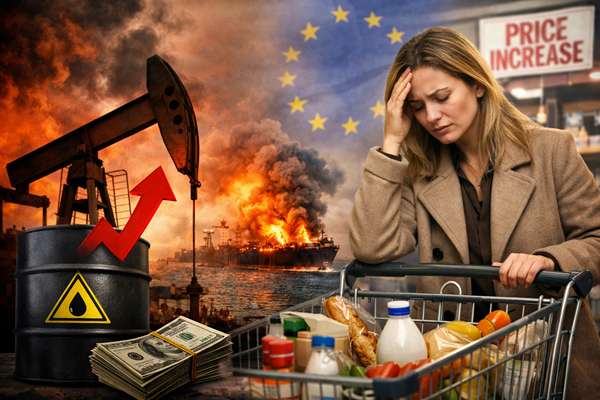
Europe’s retail sector may be poorly prepared for another energy price shock as oil and gas prices rise following the outbreak of the U.S.-Israeli war with Iran. The surge in energy costs adds new pressure to an industry that is already struggling with weak consumer demand and reduced spending power across Europe.
Retail stocks came under pressure on Monday. Shares in major companies such as Inditex, the owner of Zara, and British retailer Marks & Spencer declined as investors anticipated the knock-on effects of higher fuel and energy costs on the sector.
The industry has barely recovered from the inflation cycle triggered by soaring gas prices following Russia’s invasion of Ukraine in 2022. At that time, food producers, supermarkets, and clothing retailers significantly raised prices to offset rising energy and logistics costs.
Today, however, the economic environment is even more fragile. Growth in both the eurozone and the United Kingdom remains weak, while households have already endured several years of high inflation.
Consumers Are More Sensitive to Price Increases
According to Christian Eufinger, a finance professor at IESE Business School in Barcelona, consumers may now react much more strongly to price increases than during the last energy crisis.
When the Ukraine conflict erupted in early 2022, demand was still relatively strong as economies were recovering from the pandemic. Today, however, many households have significantly less disposable income after years of inflation.
“If prices rise again now, consumers could react much more strongly because demand is already fragile,” Eufinger said.
The retail sector is also facing additional pressure from global trade tensions. A global trade conflict initiated by U.S. President Donald Trump last year has increased supply chain costs and created further uncertainty for businesses.
Retail Sector Already Under Financial Stress
Even before the latest surge in oil prices, the European retail and consumer goods sector was considered one of the most financially stressed industries.
An index published in January by restructuring law firm Weil identified the sector as the most distressed in Europe, based on indicators such as declining profitability and rising insolvency risks.
Higher energy prices are expected to worsen these conditions further.
Transport Costs Hit Retailers First
The most immediate impact of rising oil prices is on logistics. According to consultancy Simon-Kucher, road transport typically accounts for 5–10 percent of a retailer’s operating expenses.
In addition, retailers face rising energy costs within their stores, including:
-
refrigeration for food products
-
air conditioning in stores
-
heating and lighting of large retail spaces
Supermarkets and shopping centres are particularly exposed because of their high energy consumption.
At the same time, rising oil prices are pushing fertiliser costs higher, which directly affects agricultural producers and eventually feeds through to food prices.
Massimiliano Giansanti, president of the Italian farmers’ association Confagricoltura, warned that this could trigger a broader cost chain reaction across the entire food supply system.
“A cost-driven inflationary spiral appears almost inevitable, starting with rising transport costs that affect the entire supply chain, from farm to table,” Giansanti said.
Fashion Retailers Most Vulnerable
Clothing retailers are considered especially vulnerable to rising inflation. Fashion purchases are typically among the first expenses consumers cut when essential costs such as food, transport, and energy increase.
Analysts at RBC have already lowered their profit forecasts for Marks & Spencer, warning that higher oil and gas prices could significantly increase household spending on energy, transport, and food later this year.
Retailers Call for Government Support
As costs continue to rise, retail organisations are urging governments to limit additional inflationary pressures on households.
“It is more important than ever that government keeps other inflationary pressures within its control to a minimum in order to protect households,” said Andrew Opie, director of food and sustainability at the British Retail Consortium.
Outlook
Europe’s retail sector may therefore face another challenging year. If the conflict in the Middle East persists and energy prices continue to rise, a new inflationary wave could emerge, increasing costs throughout supply chains and further weakening consumer spending.
Industries with thin margins and high price sensitivity are likely to be the most vulnerable, while rising food and energy costs once again threaten to become the dominant economic challenge for European consumers.
Source: Reuters