
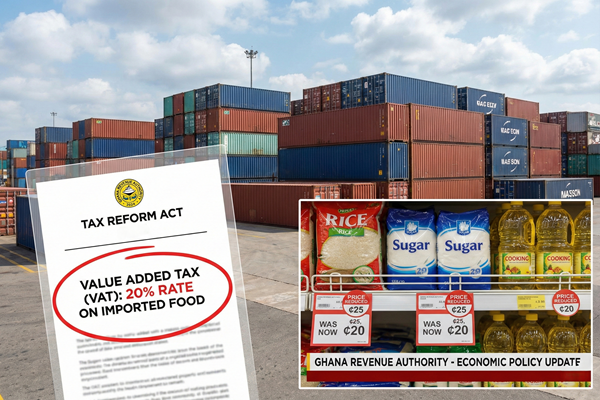
Ghana Resets VAT System to Reduce Food Costs and Improve Trade Transparency
Ghana has implemented major tax reforms effective January 1, 2026, restructuring its Value Added Tax (VAT) system to lower the effective tax burden on goods — including imported food and agricultural products.
The reform reduces the effective VAT rate from 21.9 percent to 20 percent, eliminates cascading tax calculations, and abolishes the COVID-19 Health Recovery Levy
For food importers and retailers — including those handling U.S.-origin products — the changes are expected to improve price transparency and reduce landed costs.
What Changed Under the New VAT Framework
1️⃣ COVID-19 Levy Eliminated
The 1 percent COVID-19 Health Recovery Levy has been abolished.
Under the previous system, this levy was layered into the tax base before VAT was applied, creating a compounding “tax-on-tax” effect.
Its removal directly lowers the total indirect tax burden.
2️⃣ Cascading Taxes Scrapped
Under the old system:
-
NHIL (2.5%)
-
GETFund (2.5%)
-
COVID-19 Levy (1%)
were added to the transaction value before applying the 15% VAT rate.
This created a cascading structure that pushed the effective tax rate to 21.9 percent.
Under the new system:
-
VAT (15%)
-
NHIL (2.5%)
-
GETFund (2.5%)
are all applied on the same base value, eliminating tax compounding.
The new effective total tax rate is 20 percent
Ghana Tax Reforms of 2026 – Imp…
Example: Old vs New System
Using a USD 1,000 transaction example (as shown in Table 2 of the report):
Old System (Pre-2026)
-
Levies applied first → transaction rises to USD 1,060
-
VAT applied on USD 1,060
-
Final total cost: USD 1,219
New System (Post-Jan 1, 2026)
-
VAT calculated only on original USD 1,000
-
Levies applied on same base
-
Final total cost: USD 1,200
Result: USD 19 savings per USD 1,000 transaction
Ghana Tax Reforms of 2026 – Imp…
This simplified structure lowers operating costs for importers and distributors.
VAT Registration Threshold Increased
The VAT registration threshold for goods businesses has increased from:
-
GHS 200,000 (~USD 18,433)
to -
GHS 750,000 (~USD 69,124)
Ghana Tax Reforms of 2026 – Imp…
This exempts many micro and small enterprises from VAT compliance, reducing administrative burdens and allowing the tax authority to focus on larger operators.
Retail Price Reductions Already Visible
Major shopping malls and food retail outlets have reportedly reduced prices by approximately 1.9 percent following implementation.
Ghana Revenue Authority officials have conducted inspections and test purchases to verify compliance.
Authorities estimate the reform could return approximately GHS 6.5 billion (~USD 600 million) to consumers through lower tax burdens
Ghana Tax Reforms of 2026 – Imp…
Implications for U.S.-Origin Food and Agricultural Imports
The reforms benefit importers in several ways:
-
Lower upfront tax assessments at ports
-
Improved cash flow
-
Reduced compounding of indirect taxes
-
Greater pricing predictability
-
Better pass-through of savings to retail shelves
For U.S. exporters, lower indirect tax distortion improves competitiveness in Ghana’s price-sensitive consumer market.
Products likely to benefit include:
-
Consumer-oriented packaged foods
-
Intermediate agricultural inputs
-
Processed food ingredients
-
Specialty retail food items
The stabilization of the Ghanaian cedi also contributes to improved pricing conditions.
Digital VAT Administration Improvements
The Ghana Revenue Authority is deploying new digital monitoring systems to:
-
Improve VAT compliance
-
Monitor cross-border digital transactions
-
Enhance transparency for non-resident suppliers
These measures aim to modernize tax administration while improving enforcement consistency.
🔎 CMB Outlook
Ghana’s 2026 VAT reform represents a structural shift toward greater transparency and reduced tax compounding.
By lowering the effective tax rate from 21.9 percent to 20 percent and eliminating cascading levies, the reform reduces distortions across import and distribution chains.
For food importers — including those sourcing from the United States — the changes improve cost predictability and strengthen price pass-through to consumers.
If currency stability continues and enforcement remains consistent, the reform could support stronger demand for imported consumer food products in 2026 and beyond.