
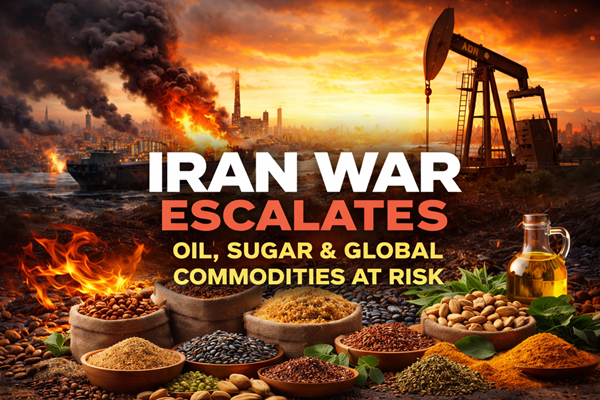
Iran Conflict Could Trigger Prolonged Commodity Rally — Here’s What Traders Must Know
CMB News | Market Analysis | March 2026
The military escalation involving the United States, Israel and Iran marks a structural turning point for global commodity markets. While political messaging suggests a limited engagement, our editorial assessment assumes a broader regional expansion and a significantly longer duration than publicly projected.
For commodity trade, this changes the equation.
This is not a short-term shock.
It is the beginning of a geopolitical risk premium cycle.
Oil: The Multiplier Across All Commodity Classes
The Strait of Hormuz remains one of the most critical chokepoints in global trade, handling roughly 20% of internationally traded crude oil.
If tensions escalate or shipping risks increase, the likely consequences are:
-
Structurally higher oil prices
-
War-risk insurance premiums on tankers
-
Rising container freight rates
-
Stronger US dollar
-
Increased volatility in futures markets
Energy is not just another commodity.
It is a cost multiplier embedded in agriculture, transport, fertilizer production and processing.
Sugar: The Ethanol Transmission Mechanism
Sugar markets are directly linked to energy.
If crude oil remains elevated:
-
Ethanol production in Brazil becomes more attractive
-
More sugarcane is diverted into biofuel
-
Global export sugar supply tightens
-
ICE raw sugar futures receive structural support
For European importers, this means:
-
Higher FOB values
-
More expensive freight
-
Currency pressure from a stronger USD
Under a prolonged conflict scenario, sugar is likely to remain structurally firm.
Oilseeds & Seeds: Indirect but Powerful Transmission
Core traded products such as:
-
Flaxseed
-
Sunflower seeds
-
Sesame
-
Mustard seed
-
Poppy seed
are affected through three primary channels:
1️⃣ Fertilizer Costs
Natural gas is the key input for ammonia production. Sustained energy inflation raises input costs for farmers.
2️⃣ Logistics
Black Sea and global container flows become more expensive and risk-sensitive.
3️⃣ Risk Behavior
In times of geopolitical uncertainty:
-
Producers hesitate to pre-sell
-
Traders increase risk margins
-
Spot markets tighten
Volatility increases even without physical shortage.
Spices & Direct Iran Exposure
Certain markets carry more direct exposure:
-
Cumin
-
Anise
-
Pistachios
-
Raisins
Iran is a significant origin in several of these segments.
Potential escalation risks include:
-
Sanctions tightening
-
Payment restrictions
-
Port disruptions
-
Container shortages
Historically, specialty markets react sharply to political supply disruptions, often posting double-digit spot price increases in short timeframes.
Nuts & Dried Fruits: Market Share Rotation
If Iranian volumes are constrained:
-
Turkey may gain export share
-
Alternative origins price at a premium
-
Quality differentiation becomes more pronounced
This does not necessarily create shortage — but it shifts pricing power.
Scenario Outlook: 6–12 Month Escalation
If the conflict persists:
| Variable | Likely Market Impact |
|---|---|
| Oil > $90 | Structural cost inflation |
| Container rates +20–40% | Margin compression |
| USD strength | Higher import prices |
| Insurance premiums | FOB risk adjustments |
| Speculative positioning | Increased volatility |
The key takeaway:
This would represent a structural shift, not a temporary spike.
Strategic Implications for Commodity Traders
A prolonged regional conflict would:
-
Accelerate price cycles
-
Increase hedging activity
-
Widen spreads between origins
-
Reward data-driven market participants
Periods of uncertainty historically increase demand for reliable market intelligence.
In that sense, geopolitical risk does not freeze markets.
It intensifies them.
Conclusion
If the conflict expands regionally and lasts longer than initially expected, global commodity markets are entering a phase of sustained geopolitical risk premium.
Energy becomes the transmission mechanism.
Logistics becomes the bottleneck.
Volatility becomes the norm.
For physical traders, the question is no longer whether prices will react — but how long the risk premium will remain embedded in the system.