
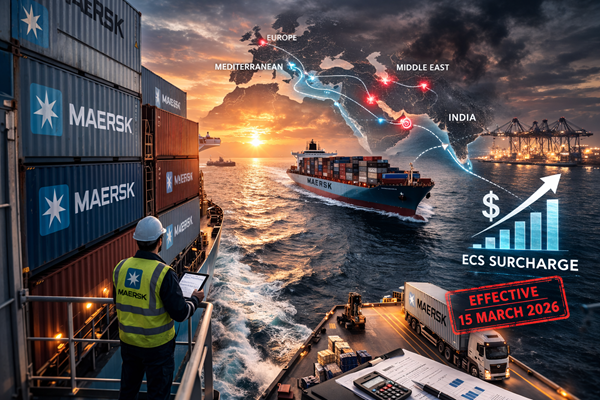
Maersk Raises Emergency Contingency Surcharge on Middle East–Europe Trades from Mid-March
CMB News | Freight & Logistics | 27 February 2026
Global shipping major Maersk has announced significant adjustments to its Emergency Contingency Surcharge (ECS) on trade lanes connecting the Middle East Gulf and Indian Subcontinent with North Europe and the Mediterranean (E3W & E4W).
The revised surcharge structure will take effect from the Price Calculation Date (PCD) 15 March 2026, reflecting rising geopolitical risk and operational uncertainty across key maritime corridors.
Affected Trade Routes
The surcharge adjustments apply to the following corridors:
-
Indian Subcontinent → North Europe
-
Middle East Red Sea → North Europe
-
Indian Subcontinent → Mediterranean
-
Middle East Red Sea → Mediterranean
All rates are quoted in USD per container and apply to dry, reefer, OOG, SOC and NOR containers.
Key ECS Increases (Effective 15 March 2026)
North West India & Pakistan → North Europe (E3W)
-
20’ Dry: $200 → $500
-
40’ Dry: $0 → $500
-
40’ High Cube / NOR: $0 → $500
Middle East Red Sea → North Europe (E3W)
-
All container types: $300 → $600
North West India & Pakistan → Mediterranean (E4W)
-
40’ Dry: $300 → $800
-
40’ High Cube / NOR: $300 → $800
-
20’ Dry unchanged at $600
Middle East Red Sea → Mediterranean (E4W)
-
All container types: $300 → $600
Reefer surcharges remain elevated at $1,500–$1,800 depending on trade lane.
Strategic Context: Freight Markets React to Rising Regional Risk
The surcharge adjustments come amid heightened geopolitical tensions in the Middle East and growing uncertainty around maritime security in the broader Gulf region.
Even without formal closure of major sea routes, insurers have increased war-risk premiums and carriers are factoring elevated operational costs into pricing structures.
The introduction and expansion of Emergency Contingency Surcharges indicate that carriers are pricing:
-
Security risk
-
Insurance volatility
-
Potential rerouting costs
-
Slower transit times
For European importers of agricultural commodities, sugar, oilseeds and spices from India and the Gulf region, the surcharge increase translates into immediate landed-cost pressure.
Implications for Commodity Trade
Higher freight costs from:
-
Mundra, JNPT, Pipavav (India)
-
Jeddah, King Abdullah, Jordan (Red Sea)
-
Dammam, UAE, Oman, Qatar, Kuwait, Iraq, Bahrain
will directly affect CIF pricing into North Europe and Mediterranean destinations.
In combination with elevated oil prices and geopolitical uncertainty, freight is once again becoming a decisive cost driver in physical commodity flows.
What Comes Next?
All surcharge changes remain subject to regulatory approval and required notice periods.
Market participants should expect:
-
Continued volatility in Middle East–Europe freight rates
-
Potential further ECS adjustments if tensions escalate
-
Increased hedging activity in physical trade
The reintroduction of meaningful contingency pricing underscores that logistics risk has returned as a structural factor in global supply chains.