
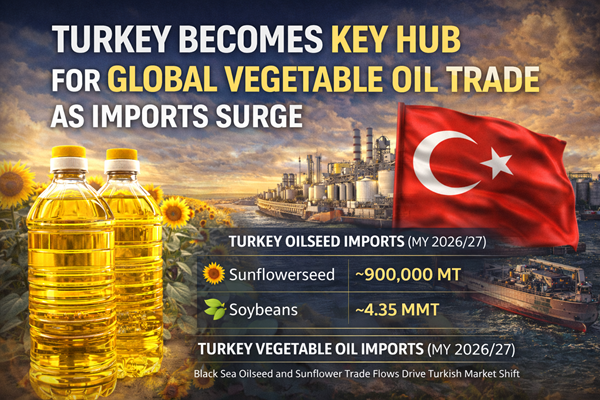
Turkey’s Oilseed Market Expands but Import Dependence Remains Structural
CMB News | Oilseeds & Vegetable Oils | March 2026
Turkey’s oilseed and vegetable oil sector is entering a new growth phase, driven by expanding demand from the livestock, poultry and food industries. However, despite rising domestic production, the country will continue to rely heavily on imported oilseeds and vegetable oils to meet both domestic consumption and export demand.
According to the latest USDA Foreign Agricultural Service report from Ankara, Turkey’s oilseed production is forecast to increase modestly in the 2026/27 marketing year, but the structural gap between domestic supply and demand remains significant.
This structural imbalance ensures that Turkey will remain one of the most important import markets for sunflower seeds, soybean products and vegetable oils in the wider Black Sea and Mediterranean regions.
Oilseed Production Expected to Reach 2.6 MMT
Total oilseed production in Turkey – including sunflowerseed, cottonseed and soybeans – is projected to rise slightly to approximately 2.6 million metric tons (MMT) in MY 2026/27.
The increase is largely attributed to improved weather conditions and an expansion in sunflower acreage after two drought-affected seasons.
Turkey Oilseed Production Outlook (MY 2026/27)
| Crop | Production |
|---|---|
| Sunflowerseed | ~1.55 MMT |
| Cottonseed | ~0.90 MMT |
| Soybeans | ~0.16 MMT |
| Total | ~2.6 MMT |
Despite this improvement, domestic production remains insufficient to satisfy the country’s rapidly expanding crushing and feed sectors.
Sunflowerseed Remains the Core of Turkey’s Oilseed Sector
Sunflowerseed continues to dominate Turkey’s oilseed production and vegetable oil consumption.
The harvested area for sunflowerseed is forecast to expand to approximately 760,000 hectares in MY 2026/27, particularly in regions facing irrigation constraints where drought-resistant crops are preferred.
Turkey Sunflowerseed Market (MY 2026/27)
| Indicator | Volume |
|---|---|
| Production | 1.55 MMT |
| Imports | 0.90 MMT |
| Crush | 2.15 MMT |
| Domestic consumption | 2.35 MMT |
Even with higher production, Turkey still needs substantial imports to supply its crushing industry.
Much of these imports originate from the Black Sea region, particularly Romania, Moldova, Bulgaria, Russia and Ukraine.
Soybean Imports Continue to Rise
Soybeans play a crucial role in Turkey’s animal feed sector. However, domestic soybean production remains extremely limited compared with demand.
Turkey Soybean Market (MY 2026/27)
| Indicator | Volume |
|---|---|
| Production | 160,000 MT |
| Imports | 4.35 MMT |
| Crush | 3.10 MMT |
| Domestic consumption | 4.35 MMT |
Imports are expected to reach record levels, driven primarily by the rapid expansion of the poultry and aquaculture industries.
The leading soybean suppliers include:
- United States
- Ukraine
- Brazil
According to the report, imports briefly slowed in late 2025 due to disruptions in Ukrainian shipments but are expected to accelerate again.
Feed Sector Drives Oilseed Demand
Turkey’s feed industry remains the primary driver of oilseed imports and crushing demand.
Compound feed production has grown steadily in recent years as the livestock and poultry sectors expand.
Compound Feed Production in Turkey
| Year | Production |
|---|---|
| 2023 | 27.9 MMT |
| 2024 | 29.3 MMT |
| 2025 | 30.7 MMT |
The expansion is particularly visible in poultry feed, reflecting strong growth in chicken meat production, which reached 2.8 MMT in 2025, an increase of about 11% year-on-year.
Vegetable Oil Production to Reach 2 MMT
Turkey’s total vegetable oil production is forecast to increase by around 6% to roughly 2.0 MMT in MY 2026/27.
The increase will be mainly driven by higher soybean oil and olive oil output.
Turkey Vegetable Oil Production (MY 2026/27)
| Oil Type | Production |
|---|---|
| Sunflower oil | 936,000 MT |
| Soybean oil | 570,000 MT |
| Olive oil | 400,000 MT |
| Cottonseed oil | 126,000 MT |
| Total | ~2.0 MMT |
Sunflower oil remains the dominant edible oil in Turkey.
Sunflower Oil Consumption Remains High
Sunflower oil continues to dominate household consumption in Turkey due to its affordability and availability.
Vegetable Oil Consumption (Human Use)
| Oil | Consumption |
|---|---|
| Sunflower oil | 1.12 MMT |
| Olive oil | 320,000 MT |
| Cottonseed oil | 117,000 MT |
| Soybean oil | ~2,000 MT |
| Total | 1.56 MMT |
Soybean oil consumption remains minimal because Turkish biosafety regulations restrict the use of oil derived from genetically modified soybeans in food products.
Turkey Imports Large Volumes of Sunflower Oil
Turkey remains one of the world’s largest importers of sunflower oil and seeds.
Turkey Sunflower Oil Market (MY 2026/27)
| Indicator | Volume |
|---|---|
| Production | 936,000 MT |
| Imports | 1.29 MMT |
| Exports | 1.07 MMT |
| Domestic consumption | 1.16 MMT |
A significant portion of imported sunflower oil is refined in Turkey and then re-exported to neighboring markets in the Middle East and Africa.
Major export destinations include:
- Iraq
- Djibouti
- Syria
Russia remains the dominant supplier, accounting for the majority of crude sunflower oil imports.
Olive Oil Production to Rebound in 2026/27
Olive oil production is expected to rebound sharply due to the natural cyclical pattern of olive harvests.
Turkey Olive Oil Market
| Indicator | MY 2025/26 | MY 2026/27 |
|---|---|---|
| Production | 210,000 MT | 400,000 MT |
| Consumption | 220,000 MT | 320,000 MT |
| Exports | 50,000 MT | 90,000 MT |
The increase reflects improved rainfall conditions and ongoing investments in olive groves and irrigation systems.
Strategic Role in the Black Sea Vegetable Oil Trade
Turkey plays a unique role in global vegetable oil markets. The country acts both as a major import hub and as a regional refining and re-export center.
Turkey’s oilseed crushing capacity currently stands at approximately 9 MMT, while refining capacity is around 4.5 MMT.
New crushing facilities scheduled to come online in the coming years are expected to further strengthen the country’s position in the regional oilseed processing industry.
Outlook
Turkey’s oilseed sector is likely to remain structurally dependent on imports despite moderate growth in domestic production.
Rising feed demand, expanding livestock production and strong vegetable oil consumption ensure that Turkey will remain a critical market for global exporters of:
- sunflower seeds
- soybean products
- vegetable oils.
At the same time, Turkey’s growing refining and crushing capacity positions the country as a key processing hub connecting Black Sea suppliers with markets across the Middle East, North Africa and beyond.
Source: USDA