
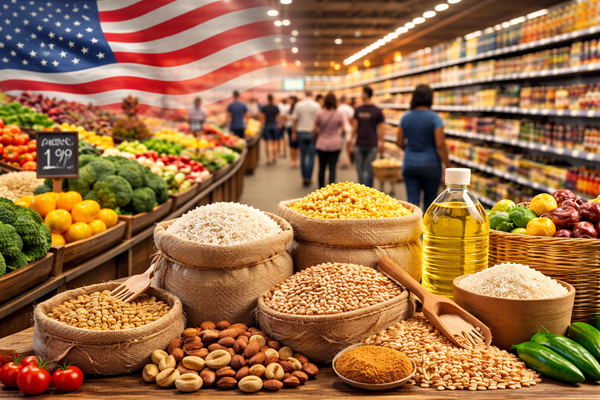
U.S. Retailers Struggle With Shifting Tariffs – Food Commodity Markets Also Affected
CMB News | Trade & Food Commodity Markets | March 2026
U.S. retailers are cautiously reassessing their strategies as the country’s tariff environment shifts again, creating renewed uncertainty for consumer spending and global supply chains.
Recent earnings updates from major retailers including Best Buy, Target and Abercrombie & Fitch show that companies are still adjusting to changing trade policies after U.S. President Donald Trump raised temporary import tariffs to 15% from 10%, the maximum allowed rate, following a Supreme Court ruling that struck down earlier emergency duties.
Policy Volatility Creates Planning Challenges
Analysts say the primary concern for retailers is not necessarily the tariff level itself but the unpredictability of policy.
“The core issue isn’t the elevated tariff rates — it’s the policy whiplash,” said eMarketer analyst Zak Stambor.
“Retailers can plan for a difficult environment, but they cannot plan around rules that change day by day or week by week.”
Abercrombie Adjusts Forecast
Abercrombie & Fitch is currently the only major retailer that has explicitly incorporated the new 15% tariff rate into its annual outlook.
The company estimates:
- a 70-basis-point tariff impact
- roughly $40 million in additional costs, based on 2025 sales of $5.27 billion
Earlier this year the company had projected about $90 million in tariff costs for 2025.
Meanwhile Best Buy, which imports a significant share of its products from China, stated that the Supreme Court decision may open the door to lower temporary tariffs, though it has not yet adjusted its official forecasts.
Impact Extends to Global Food Commodity Markets
Beyond consumer goods, the evolving tariff environment is increasingly relevant for global food commodity markets, as many agricultural products are traded internationally and directly influence retail food prices.
Key commodities potentially affected include:
Grains and Feed Commodities
- Wheat
- Corn
- Rice
- Barley
These commodities form the basis of many staple food products and animal feed, meaning changes in trade flows can indirectly affect meat, dairy and bakery prices.
Oilseeds and Vegetable Oils
- Soybeans
- Soybean oil
- Rapeseed
- Sunflower oil
Vegetable oils are essential inputs for processed food production, making them highly sensitive to global trade policy shifts.
Sugar Markets
- Raw sugar
- Refined sugar
Tariff changes, freight costs and energy prices can quickly feed through to beverages, confectionery and processed foods.
Nuts and Specialty Commodities
- Almonds
- Cashews
- Peanuts
- Raisins
These internationally traded products are particularly sensitive to logistics costs, tariffs and currency movements.
Retailers Try to Avoid Price Increases
Executives across the retail sector say that raising consumer prices remains a last resort.
Instead, companies are focusing on:
- negotiating with suppliers
- diversifying sourcing regions
- optimizing supply chains
Target CFO Michael Fiddelke emphasized the importance of protecting consumer purchasing power.
“Price is the very last lever we want to pull because price matters to consumers on a budget.”
Global Companies Also Feeling Pressure
The uncertainty surrounding U.S. trade policy is affecting global companies as well.
German sportswear giant Adidas recently warned that U.S. tariffs on imports from countries such as Vietnam, combined with a weaker U.S. dollar, could reduce 2026 earnings by approximately €400 million ($465 million).
Similar risks are emerging across the global food industry, where complex supply chains connect producers, traders and retailers.
Middle East Conflict Adds New Risk
Additional uncertainty comes from the escalating conflict in the Middle East, which could disrupt shipping routes and increase transportation costs.
Higher energy prices may also increase costs across the entire food supply chain, from agriculture to processing and distribution.
Morningstar analyst David Swartz noted:
“Higher gasoline prices increase costs and could depress consumer spending.”
Trade Policy Costs Remain Significant
According to a Reuters analysis of corporate filings and earnings calls, tariff-related costs remain substantial.
Companies previously projected a combined financial impact of:
- $21–22.9 billion for 2025
- nearly $15 billion for 2026
While tariff levels may now be somewhat lower than during the peak of trade tensions in 2025, policy uncertainty, geopolitical risks and energy costs continue to shape the outlook for global retail and food commodity markets.