
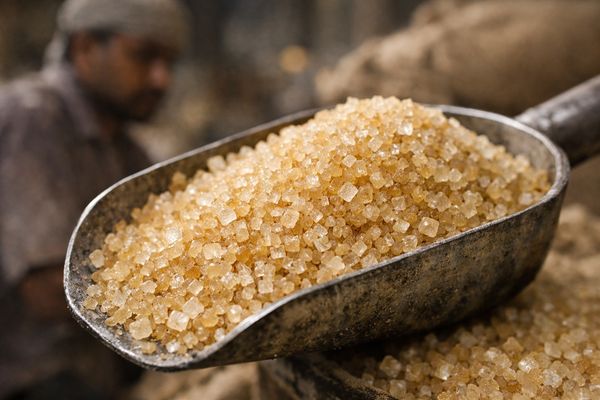
India’s domestic sugar market is holding a narrow, cautious range, with weak offtake offsetting tight arrivals and higher costs from the Iran–Israel conflict. A modest seasonal demand lift from the upcoming marriage season could nudge prices higher, but a sustained rally looks unlikely without stronger industrial buying or reduced reseller supply.
Spot and mill-gate prices in western Uttar Pradesh are broadly steady, supported by weak arrivals yet capped by hesitant buyers and active resellers offering at elevated levels. Traditional grades such as khandsari, shakkar and jaggery are firm but face resistance at current prices, particularly at the consumer end. Globally, sugar has bounced from recent lows on energy-driven ethanol demand and logistical disruptions through the Strait of Hormuz, while European FCA offers are stable around EUR 0.42–0.54/kg. Near term, India’s domestic market looks set to trade sideways with a slight upward bias into late April.
Exclusive Offers on CMBroker

Sugar granulated
ICUMSA 45, 0,2 - 1,2 mm
FCA 0.44 €/kg
(from LT)

Sugar granulated
ICUMSA 45, 0,2-1,2 mm
FCA 0.43 €/kg
(from LT)
📈 Prices & Spreads
India’s mill-delivered white sugar in western Uttar Pradesh is trading in a range of roughly ₹4,040–₹4,180 per quintal, while spot market values are quoted at ₹4,350–₹4,500 per quintal. Converting at an indicative rate of ₹90 per EUR and 100 kg per quintal, this implies an approximate ex-mill range of EUR 0.45–0.49/kg and spot levels around EUR 0.54–0.56/kg.
Khandsari remains the strongest segment, at ₹5,250–₹5,300 per quintal (about EUR 0.58–0.59/kg), supported by niche rural and small-processor demand. Shakkar is quoted at ₹4,800–₹4,900 per quintal (about EUR 0.53–0.54/kg), with steady but modest offtake. Jaggery prices are stable on scattered buying, but elevated absolute levels are clearly rationing consumer demand rather than stimulating new buying.
| Segment / Region | Price (local) | Approx. price (EUR/kg) | Trend (last week) |
|---|---|---|---|
| India, mill delivery (UP) | ₹4,040–4,180/quintal | ≈ EUR 0.45–0.49 | Stable |
| India, spot markets (UP) | ₹4,350–4,500/quintal | ≈ EUR 0.54–0.56 | Stable |
| Khandsari (India) | ₹5,250–5,300/quintal | ≈ EUR 0.58–0.59 | Firm |
| Shakkar (India) | ₹4,800–4,900/quintal | ≈ EUR 0.53–0.54 | Firm |
| EU FCA bulk, LT (ICUMSA 45) | — | EUR 0.43–0.44 | Flat vs. mid-March |
| EU FCA bulk, DE (ICUMSA 45) | — | EUR 0.54 | Flat |
🌍 Supply & Demand Balance
Domestic supply arrivals from western Uttar Pradesh wholesale markets are described as weak, creating an underlying floor beneath prices. However, overall offtake remains thin: resellers are actively pushing volume into the market at relatively high offers, while both retail and industrial buyers resist paying up, resulting in a standoff that keeps prices rangebound.
Industrial consumption is particularly soft. Dal processing mills, an important secondary consumer of industrial sugar grades, have curtailed purchases this week, reducing incremental demand that might otherwise tighten the balance. At the same time, niche and traditional segments (khandsari, shakkar, jaggery) are holding firm mainly thanks to loyal, steady demand rather than any genuine expansion of usage.
On the global side, recent data point to a record Indian crop alongside a broader surplus outlook, but freight and policy frictions are slowing the translation of that surplus into aggressive export flows. Internationally traded sugar has rebounded from recent multi-year lows, supported by higher energy prices and supply disruptions, yet remains below recent peaks, limiting spillover bullishness into India’s inland markets.
📊 Fundamentals & External Drivers
The Iran–Israel conflict and the associated Strait of Hormuz disruptions are pushing up fuel and freight costs, feeding into India’s wider food processing cost base and complicating logistics for sugar and related products. While the direct impact on physical sugar availability in India is muted so far, the cost push is eroding margins for refiners, traders and food manufacturers, making them more cautious in their forward buying and pricing strategies.
Globally, rising crude oil prices are improving the relative economics of ethanol production from sugarcane in Brazil, encouraging millers there to allocate more cane to fuel rather than crystallised sugar. This, combined with a partial halt of seaborne sugar trade through key chokepoints, has recently lifted world sugar benchmarks and reversed part of the earlier surplus-driven slide. Nevertheless, with record output from India and expectations of only a modest global production decline ahead, the overarching fundamental picture remains one of adequate supply rather than shortage.
📆 Short-Term Outlook (2–3 Weeks)
In northern India, the marriage season beginning around 15 April should deliver a measurable, if moderate, uptick in demand for sugar, confectionery and sweet-based foodservice, lending some support to wholesale prices. However, given today’s subdued industrial offtake and active reseller participation at elevated levels, any price rise is likely to be gradual rather than abrupt.
Absent a notable supply-side disruption – for example, sharper-than-expected cutbacks in arrivals from western Uttar Pradesh or logistical blockages inside India – the existing price corridor of roughly ₹4,040–₹4,500 per quintal (about EUR 0.45–0.56/kg) appears likely to persist over the next two to three weeks. The bias is slightly upward into late April as seasonal consumption improves, but a decisive breakout will probably require either stronger demand from food processing units or a meaningful reduction in reseller inventories.
🧭 Trading & Procurement Recommendations
- Industrial buyers (food processing, dal mills): Use current rangebound conditions to secure near-term coverage ahead of the mid-April marriage season, but avoid overbuying given the lack of a clear bullish catalyst beyond seasonal demand.
- Resellers and traders: Consider gradual liquidation of high-priced inventories into any seasonal strength; the combination of global surplus signals and still-fragile local demand argues against holding large long positions.
- Importers/European buyers: With FCA European offers stable around EUR 0.42–0.54/kg and global benchmarks supported but not overheated, maintain rolling coverage, watching energy markets and Brazil’s ethanol allocation decisions for signs of tighter availability later in the year.
📍 3-Day Directional Price Indication
- India – Western Uttar Pradesh (mill delivery): Sideways to slightly firmer; range expected near ₹4,050–₹4,200 per quintal (≈ EUR 0.45–0.49/kg) as weak arrivals offset muted demand.
- India – Spot wholesale (UP): Stable with mild upside; prices likely to hold in the ₹4,350–₹4,500 band (≈ EUR 0.54–0.56/kg) ahead of seasonal demand.
- EU FCA bulk (LT/DE/CZ): Mostly flat in the EUR 0.42–0.54/kg range; short-term moves driven more by global futures and freight than by regional fundamentals.
Related posts:
 Sugar Market Edges Higher as Indian Demand Firms and Global Supply Risks Linger
 Sugar Beet Market: White Sugar Futures Ease, EU Cash Prices Stabilise
 Stable Sugar Beet Prices in PL/CZ Amid Softening Global Sugar Market
 EU Sugar Beet Market: White Sugar Futures Flat, Beet Margins Under Mild Pressure
 Dominican sugar recovery reshapes raw sugar trade flows
 Sugar Beet Market: White Sugar Futures Ease, EU Spot Prices Mixed
 Sugar Beet Market: Strong White Sugar Rally, Mixed EU Beet Signals
 EU Sugar Beet Market: White Sugar Futures Ease, Beet Economics Stay Firm