
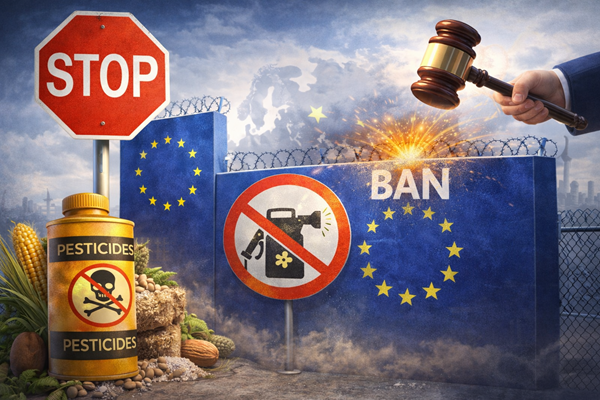
EU Proposes Zero-Tolerance Pesticide Rule on Imports – Major Impact on Soybeans, Corn and Tree Nut Trade
CMB News | EU Trade & Commodities | February 2026
The European Union is preparing a major shift in its pesticide residue policy that could significantly tighten import conditions for agricultural raw materials.
Under the proposed Food & Feed Omnibus package, the European Commission intends to lower Maximum Residue Levels (MRLs) for certain non-EU-approved pesticides to the limit of quantification (0.01 mg/kg) — effectively a zero-tolerance standard .
If adopted in its current form, the proposal could materially complicate the import of key agricultural commodities into the EU.
A Structural Risk for Import-Dependent Markets
The scale of the issue is substantial.
The EU is heavily dependent on imports for several core agricultural commodities, including:
- Soybeans
- Soybean meal
- Corn
- Tree nuts (almonds, pistachios, walnuts)
Soybeans are particularly critical.
The EU produces only a small fraction of its total soybean demand and relies extensively on imports from:
- Brazil
- The United States
- Argentina
If pesticide residues from substances not approved in the EU are no longer tolerated — even at minimal levels — large portions of global production could effectively become non-compliant for the EU market.
What Would Change?
Until now, imports have generally been allowed if:
- International standards (Codex MRLs) were respected
- Scientific risk assessments confirmed safety
Under the proposed framework, the logic would shift toward:
Not approved in the EU = virtually no detectable residues allowed.
This marks a move away from a strictly science-based risk approach toward a more regulatory alignment model tied to EU domestic approvals.
Trade Consequences
The EU is already one of the most demanding import markets globally:
- Strict MRL requirements
- Complex documentation procedures
- Frequent border inspections
- Politically sensitive pesticide regulation
Exporters already face rising compliance costs and shipment risks.
A formalized zero-tolerance mechanism could:
- Reduce the pool of eligible global suppliers
- Increase sourcing costs
- Redirect trade flows
- Add volatility premiums to EU-bound cargo
For processors in feed, oilseeds, and nut sectors, supply chain adjustments could become necessary.
The Core Question: Supply Security
The political objective behind the proposal is clear — establishing reciprocity between EU production standards and imports.
However, the economic reality is equally clear:
The EU is not self-sufficient in several strategic raw materials.
In the case of soybeans — a cornerstone of European livestock production — stricter residue enforcement could result in:
- Narrower supply windows
- Higher import prices
- Increased procurement risk
The broader dimension may not yet be fully appreciated by many market participants.
Where Things Stand
The proposal has been notified to the WTO and is currently under review by the European Parliament and the Council .
An impact assessment is underway, with further legislative debate expected in 2026.
Bottom Line
If implemented as proposed, this would not be a minor regulatory adjustment — it would represent a structural shift in EU import policy.
For commodity traders, crushers, feed manufacturers, and nut importers, the implications could be significant.
The key question now is whether policymakers will balance regulatory alignment with the realities of Europe’s raw material dependency.