
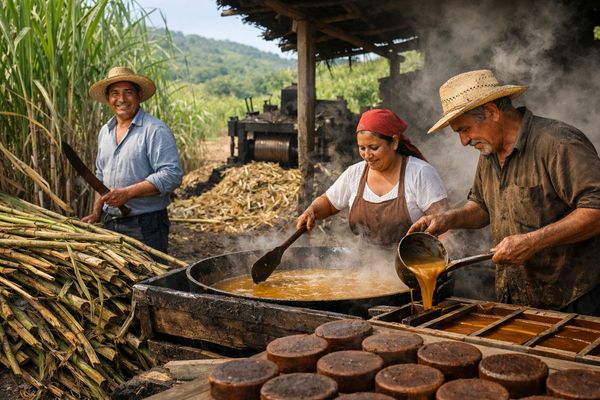
Honduras enters marketing year 2026/27 with rising sugar output, stable stocks and slightly higher exports, positioning the country as a competitive niche supplier despite a recent pullback in global futures. Elevated input costs and a weaker local currency keep domestic prices above world levels, but diversified export destinations and potential ethanol demand underpin a broadly constructive medium-term outlook.
Supported by a 2% rise in cane output and continued yield gains from irrigation and improved varieties, Honduran sugar production is set to reach 570,000 metric tons in 2026/27. Exports are forecast to grow just over 3%, with the United States, China, Haiti and an expanding group of European buyers anchoring demand. At the same time, global ICE sugar benchmarks have eased to a one‑month low on improving supply expectations, while spot prices for refined sugar in Europe remain broadly steady in the EUR 0.42–0.55/kg range, leaving export margins still attractive for efficient producers.
Exclusive Offers on CMBroker

Sugar granulated
ICUMSA 45, 0,2 - 1,2 mm
FCA 0.46 €/kg
(from LT)

Sugar granulated
ICUMSA 45, 0,2-1,2 mm
FCA 0.45 €/kg
(from LT)

Sugar granulated
ICUMSA 32, 0,300 - 0,600 mm
FCA 0.47 €/kg
(from GB)
📈 Prices & Global Market Context
International raw sugar prices on ICE have come under pressure in mid‑April, with No.11 futures sliding roughly 7% week‑on‑week and testing one‑month lows as traders focus on ample global supply and strong output in key origins.
Exclusive Offers on CMBroker
Sugar granulated
ICUMSA 45, 0,2 - 1,2 mm
FCA 0.46 €/kg
(from LT)
Sugar granulated
ICUMSA 45, 0,2-1,2 mm
FCA 0.45 €/kg
(from LT)
Sugar granulated
ICUMSA 32, 0,300 - 0,600 mm
FCA 0.47 €/kg
(from GB)
In Europe, physical spot indications for refined and standard granulated sugar are holding broadly steady despite softer futures. Recent offers for FCA delivery in Lithuania, Great Britain, Ukraine, the Czech Republic and Germany cluster around EUR 0.42–0.55/kg, with German product at the upper end and Ukrainian volumes at the lower end. This stability suggests that local supply–demand and logistics are cushioning the impact of the global futures sell‑off.
| Region / Origin | Product | Indicative price (EUR/kg) | Terms |
|---|---|---|---|
| Lithuania | Sugar granulated ICUMSA 45 | 0.43–0.44 | FCA Mirijampole |
| United Kingdom | Sugar granulated ICUMSA 32–45 | 0.46 | FCA Norfolk |
| Ukraine/Czech Republic | Sugar granulated ICUMSA 45 | 0.42–0.43 | FCA Vyškov / Vinnytsia |
| Germany | Sugar granulated ICUMSA 45 | 0.55 | FCA Berlin |
In Honduras, wholesale prices for plantation white and refined sugar are reported at about USD 0.45/lb, with retail levels near USD 0.53/lb in 2025/26. Converted at current exchange rates, these correspond broadly to EUR 0.90–1.05/kg, leaving domestic values around 8% above international benchmarks. Currency depreciation and high transport and fertiliser costs are the main drivers of this premium.
🌍 Supply & Demand Dynamics in Honduras
Honduras remains a structurally self‑sufficient sugar producer and a consistent net exporter. Seven mills under the national association control 70% of cane area, with the remaining 30% farmed by independent growers under supply contracts. The sector generates an estimated USD 410 million per year in economic activity and supports up to 350,000 jobs during harvest, underscoring its macroeconomic importance.
For marketing year 2026/27, sugarcane production is forecast at 5.712 million metric tons, up about 2% from 5.6 million metric tons in 2025/26. Planted area is set to rise modestly from 57,000 to 58,000 hectares, as producers recover from recent El Niño/La Niña impacts and respond to better international prices around 18 US cents per pound. Productivity growth, not expansive land use, remains the key engine of supply.
Domestic demand is well covered. Stocks are projected to remain stable at about 198,000 metric tons by the end of 2025/26, stored mainly in mill‑owned facilities. Imports are negligible at roughly 160 metric tons, almost entirely from the United States, confirming the country’s self‑sufficiency. Regulatory control over wholesale prices and the requirement to fortify all sugar for human consumption with vitamin A provide an additional layer of stability for domestic buyers.
📊 Fundamentals, Trade Flows & Policy Drivers
Centrifugal sugar output is expected to reach 570,000 metric tons in 2026/27, an increase from a revised 560,000 metric tons in 2025/26. Yield gains of roughly 28% since 1980/81 have been driven by drip irrigation, improved seed varieties and increasing use of precision agriculture. A land‑ownership cap introduced under agrarian reform has steered investment into productivity improvement rather than large‑scale area expansion.
Exports are projected at 212,460 metric tons in 2026/27, up 3.14% year‑on‑year. The United States remains the largest single market, taking around 28% of shipments, while China and Haiti each account for about 16%. South Korea, the United Kingdom and a growing roster of European buyers, including Spain, Italy, Greece, France, the Netherlands and Germany, complement this increasingly diversified portfolio.
Tariff‑rate quotas under WTO, CAFTA‑DR and bilateral EU and UK agreements provide a stable base of premium outlets. For 2026, Honduras holds a 11,200‑ton CAFTA‑DR allocation, 22,864 tons to the EU and 7,863 tons to the UK. These quotas are typically fully utilised, with remaining volume sold into open markets. Despite an 18% decline in total export volume in 2024/25, new demand from Asian and European buyers has partially offset reductions in traditional destinations such as the US, Haiti, South Korea, the UK, the Dominican Republic and Puerto Rico.
On the cost side, higher global energy prices have lifted fertiliser and transport costs across the Honduran sugar value chain. This, combined with lempira depreciation, has tightened producer margins even as world prices have improved. Internationally, Brazil’s ongoing decision matrix between sugar and ethanol remains a critical external driver of global sugar availability and price levels, indirectly shaping Honduran export returns.
⚡ Energy, Diversification & Weather Considerations
Honduras’s sugar industry benefits from a significant energy co‑generation component. Mills generate around 130 megawatt‑hours of electricity during the harvest by burning bagasse, with technical potential of up to 344 megawatt‑hours. Excess power is sold into the grid at roughly USD 0.09/kWh, well below prevailing tariffs of about USD 0.25/kWh from other sources, providing both a cost advantage and a meaningful revenue stream.
A draft regulation to enforce a 10% ethanol blend in transport fuel, based on the 2007 biofuels law, remains pending in Congress. If approved, it would open a substantial new domestic outlet for sugarcane‑based ethanol, likely reallocating a portion of cane away from crystal sugar production. Over time this could tighten Honduran export availability and lend structural support to domestic and regional prices.
From a weather perspective, the current 2025/26 harvest in Honduras is reported about 85% complete as of March 2026, with all seven mills fully operational and recovering from earlier El Niño/La Niña effects. In Brazil and other key exporters, recent analyses point to generally adequate rainfall and expectations of strong crush in the new 2026/27 season, one factor behind the current softening in ICE futures. Continued monitoring of Brazil’s cane yields and ethanol policy signals will be essential for anticipating global supply swings over the next 6–12 months.
📆 Market Outlook & Trading View
In the next 30–90 days, Honduras approaches the new marketing year with firm production fundamentals, stable stocks and a harvest that is largely complete. The combination of softer but still historically supportive global prices, high local costs and a weak currency suggests limited downside for domestic price levels, even if international benchmarks remain under pressure. Exporters, however, may see narrower but still positive margins, especially on quota‑based and premium EU/UK sales.
Over a 6–12 month horizon, the key medium‑term variables are the fate of the ethanol blend mandate and Brazil’s sugar‑ethanol allocation. Congressional approval of the 10% blending rule would likely shift part of Honduras’s cane into domestic fuel use, tightening export supply and underpinning prices. At the same time, ongoing investment in irrigation and agronomic technology should sustain roughly 2% annual output growth, anchoring Honduras as a reliable origin for diversified buyers in Asia and Europe.
🎯 Trading Recommendations (Indicative)
- Industrial buyers in Europe: Use the current softness in ICE futures and stable EU spot prices (around EUR 0.42–0.55/kg) to secure forward coverage on Honduran and regional sugar for late‑2026 delivery, especially under EU and UK quotas.
- Honduran exporters: Prioritise quota and premium‑market sales while keeping some volume flexible for opportunistic tenders if global prices rebound from current one‑month lows.
- Financial participants: Given high open interest and recent downside momentum, consider that further short‑term weakness is possible, but medium‑term risks are skewed to the upside if weather in Brazil disappoints or Honduran ethanol legislation tightens export supply.
📍 3‑Day Price Indication & Directional Outlook (EUR)
- ICE No.11 raw sugar (nearby, EUR equivalent): Slightly bearish to sideways over the next three sessions, with trading likely near recent lows as the market digests ample supply signals.
- EU physical refined sugar (FCA core hubs): Largely stable around EUR 0.42–0.55/kg, with only minor downside expected given steady regional demand and cost support.
- Honduran wholesale/retail (EUR/kg, implied): Stable to mildly firm, remaining at a premium to world levels due to currency and cost pressures even as global benchmarks ease.