
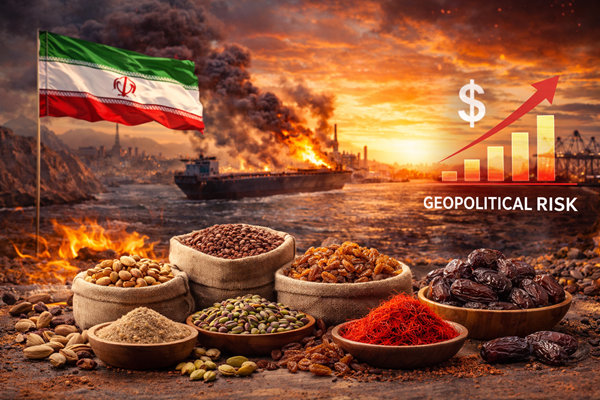
Iran Exports Under Pressure: Which Products Matter Most for Global Commodity Trade
CMB News | Market Analysis | March 2026
The recent escalation in the Middle East has not only unsettled energy markets. A number of key agricultural and specialty exports from Iran are now facing heightened logistical, financial and compliance risks.
For European importers and physical traders, the critical question is clear:
Which Iranian export products are commercially relevant — and where could supply, pricing or freight disruptions emerge?
1️⃣ Pistachios: High-Value Market, Fast Price Reaction
Iran remains one of the world’s leading producers and exporters of pistachios. In several destination markets, Iranian origin holds strong quality positioning and brand recognition.
Risk factors in an escalation scenario:
-
Payment settlement complications
-
Rising war-risk insurance premiums
-
Extended transit times
-
Increased scrutiny in banking channels
Should container flows from Iranian ports face disruption or sanctions tighten, buyers are likely to shift toward U.S. or Turkish origin. However, such substitution typically results in immediate price premiums in CIF markets.
2️⃣ Raisins: Substitutable, But Not Without Cost
Iran is a major global supplier of raisins, particularly in certain quality segments.
If tensions escalate further, traders may encounter:
-
Shipping delays
-
Higher freight surcharges
-
Compliance-related payment constraints
Turkey and the United States could absorb part of the demand, but origin rotation generally leads to upward price adjustments, especially in short-term contracts.
3️⃣ Dates: Seasonal and Logistics-Sensitive
Iranian dates hold a significant position in international trade, particularly in premium and processing segments.
This market is especially sensitive to:
-
Container availability
-
Re-export routes via third countries
-
Port operations in the Gulf region
Given the seasonal nature of shipments, even moderate delays can disrupt supply timing and contract performance.
4️⃣ Saffron: High Value, High Settlement Sensitivity
Iran dominates the global saffron market. Although shipment volumes are relatively small, the value per kilogram is substantial.
Here, the primary risks lie less in physical transport and more in:
-
Financial settlement channels
-
Sanctions compliance
-
Re-export via intermediary hubs
Even limited trade restrictions can lead to significant price volatility in specialty markets such as saffron.
Petrochemicals and Industrial Exports: Indirect Market Effects
Beyond agricultural commodities, Iran exports substantial volumes of petrochemical products and chemical intermediates.
If port infrastructure or maritime security conditions deteriorate, impacts may include:
-
Reduced container capacity
-
Rerouting of feeder services
-
Increased insurance and freight premiums
Importantly, these effects could spill over into non-Iran origin cargo moving through the Gulf region, indirectly affecting shipments from India and the broader Middle East.
What This Means for European Commodity Traders
For CMB readers active in:
-
Nuts and dried fruits
-
Spices
-
Seeds
-
Specialty agricultural products
the immediate concern is not necessarily physical supply loss — but rather:
-
Higher financing costs
-
Elevated freight surcharges
-
Longer transit times
-
Increased risk premiums
Markets are currently pricing uncertainty rather than confirmed shortages.
Conclusion
Iran remains a relevant export origin for several high-value agricultural commodities. A prolonged regional escalation would not automatically trigger supply collapse — but it would likely sustain higher logistics costs, compliance complexity and price volatility in sensitive segments.
For physical traders, the decisive factor is not only military developments, but the stability of logistics, insurance and payment channels.
As long as that stability remains uncertain, a geopolitical risk premium is likely to stay embedded in affected commodity markets.