
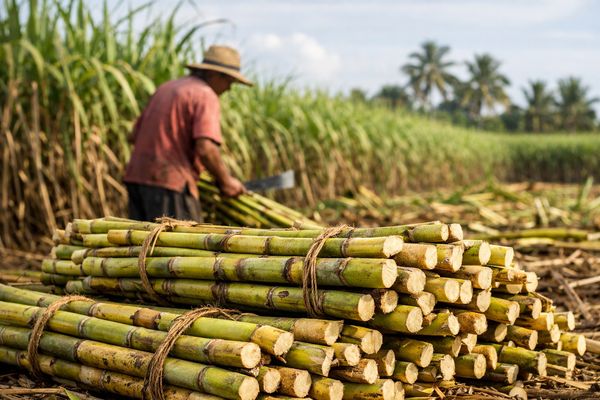
Sugar futures are ticking moderately higher along the curve, but overall levels remain well below last year’s peaks, pointing to a more balanced global sugar cane market with only modest nearby tightness.
The current market picture is one of cautious firmness rather than outright bullishness. ICE Sugar No.11 contracts from July 2026 to March 2029 gained around 0.4–0.6% on 5 May 2026, with the front month July 2026 settling near 15.4 USc/lb and deferred contracts gradually rising towards 17.4 USc/lb for March 2029. This upward-sloping forward curve signals expectations of slightly tighter fundamentals over the medium term, but not an acute supply squeeze. In the physical market, Brazilian refined sugar export prices out of São Paulo remain stable to slightly firmer, supporting cane crush economics but not yet triggering strong demand rationing.
Exclusive Offers on CMBroker

Sugar refined
ICUMSA 45
FOB 0.53 €/kg
(from BR)
📈 Prices & Curve Structure
ICE Sugar No.11 futures closed higher across the board on 5 May 2026. The key front month July 2026 settled at 15.37 USc/lb, up 0.08 USc or 0.52% on the day, on solid volume above 100,000 lots. The October 2026 contract followed at 15.83 USc/lb (+0.44%), while March 2027 closed at 16.63 USc/lb (+0.42%), confirming a gently rising forward structure.
Further out, May and July 2027 traded around 16.40 and 16.37 USc/lb respectively, with late-2028 to early-2029 contracts clustered near 16.8–17.4 USc/lb. This moderate contango suggests that the market is comfortably supplied in the short term, but anticipates firmer balance sheets and potentially higher production costs or weather risks later in the decade rather than immediate scarcity.
🌍 Physical Market & Refinery Margins
In the refined market, Brazilian ICUMSA 45 FOB São Paulo is currently indicated around EUR 0.49–0.50/kg (converted from recent USD prices), slightly above mid-October levels. Offers have edged up from roughly EUR 0.47/kg in early October 2024, pointing to a modest, steady firming in export values rather than a sharp spike. This trend is consistent with the mild gains seen in the futures curve.
For Brazilian mills, the combination of slightly higher refined premiums and a still-manageable No.11 benchmark supports crush margins and encourages continued strong cane throughput. At the same time, end-users are not yet facing price levels high enough to force aggressive demand destruction, suggesting that consumption in key import regions can remain resilient if macro conditions do not deteriorate sharply.
📊 Fundamentals & Demand Signals
The gently rising futures curve indicates expectations of a gradually tightening global sugar balance, likely driven by stable to slightly rising demand and only moderate supply growth. Nearby contracts in the mid‑15 USc/lb range imply that exportable surpluses from major producers such as Brazil should be sufficient for the 2026/27 season, while deferred prices around 17 USc/lb suggest weather, policy, or cost risks further out.
Refined price firmness from Brazil, without disorderly spikes, is compatible with a scenario of balanced but not oversupplied physical stocks. Buyers appear willing to accept small price increases to secure forward coverage, particularly in traditional deficit regions, but there is no sign of panic buying. Overall, the market structure points to a transition from the extreme tightness of previous high-price years to a more normalized, though still risk-sensitive, trading environment.
🌦️ Weather & Crop Outlook
Weather in key cane regions such as Brazil’s Center-South, India, and Thailand will remain a central risk factor over the coming months. With current futures levels only moderately elevated, any material disruption to the 2026/27 cane harvests—through excessive rainfall, drought pockets, or temperature anomalies—could prompt a faster move higher along the curve. Conversely, a season of broadly favourable conditions would likely cap rallies and keep the curve in moderate contango.
For now, the pricing pattern suggests that the market is assigning some probability to weather-related downside risks in production, but not enough to justify strong backwardation. Traders will closely watch early season crush data from Brazil and monsoon developments in South and Southeast Asia for confirmation of either a tightening or a more comfortable global balance sheet.
📆 Trading Outlook & Risk Management
- Producers (especially in Brazil and other low-cost origins): Consider layering in forward hedges in the 2027–2028 contracts where prices are above the front months, locking in attractive margins while maintaining some upside via options in case of adverse weather or policy shocks.
- Industrial users and importers: Use current mid‑15 USc/lb front-month levels to secure partial coverage for the next 6–12 months, while preserving flexibility for longer tenors given the already higher deferred prices and uncertainty around macro demand.
- Traders and speculators: The mild contango and moderate daily gains favour a cautiously constructive bias, with strategies focused on buying dips rather than chasing short-term rallies, especially ahead of key weather and crop updates.
📉 Short-Term Price Direction (3-Day View)
Given the recent 0.4–0.6% upward move across ICE Sugar No.11 contracts, the short-term technical tone is mildly positive. Over the next three sessions, prices on the key ICE contracts are likely to remain in a slightly firmer to sideways range, with July 2026 expected to consolidate around the mid‑15 USc/lb area and deferred contracts holding their modest premium unless new weather or macro shocks emerge.
Related posts:
 Off-season squeeze lifts Indian sugar while global prices edge higher
 Central European Sugar Beet Prices Hold Firm as Futures Stay Supportive
 Indian Sugar Firming Tightens Global Balance as EU Prices Edge Higher
 Sugar Beet Market Firms as White Sugar Futures Push Higher
 Lithuanian Sugar Prices Firm as Global Futures Edge Higher
 EU Sugar Beet Under Pressure While White Sugar Futures Edge Higher
 Sugar Futures Edge Higher as Market Eyes Tighter Balance in 2026–27