
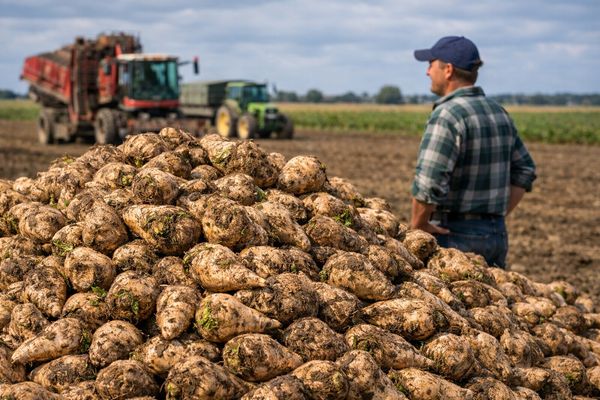
ICE white sugar futures have firmed along the forward curve, while EU wholesale sugar prices in Central Europe remain stable to slightly higher. This underpins relatively attractive beet economics for 2026/27 but comes against shrinking beet area in key EU producers, pointing to a balanced-to-tight medium‑term outlook.
Global sugar prices have stabilized after recent weakness, with London white sugar futures moving higher again on 14 April. In parallel, spot granular sugar offers in Poland, Czechia and Lithuania show a steady upward bias since late March, signalling that processors can defend current price levels. At the same time, fresh data from France confirm another contraction in sugar beet area, and Ukraine is also set to reduce beet plantings, both of which may tighten regional supply if weather normalizes. Overall, the beet market is moving into the new season with firm price support but rising acreage and policy risks.
Exclusive Offers on CMBroker

Sugar granulated
KAT EU 2 Czech
FCA 0.45 €/kg
(from PL)

Sugar granulated
white-crystal, Icumsa-45
FCA 0.48 €/kg
(from PL)

Sugar granulated
Kat EU2
FCA 0.46 €/kg
(from PL)
📈 Prices & Futures Structure
ICE White Sugar No.5 futures closed sharply higher across nearby contracts on 14 April 2026. The May 2026 contract settled at about 424 USD/t, up 3.1% day‑on‑day, with August 2026 at roughly 420 USD/t and October 2026 at around 421 USD/t. Further out, prices rise gradually to about 453 USD/t by December 2028, pointing to a moderately upward‑sloping forward curve and signaling that the market continues to price structural tightness rather than surplus.
Converted at an indicative 1.08 USD/EUR, this implies a May 2026 white sugar value near 393 EUR/t and late‑2028 levels around 420 EUR/t. These benchmarks align well with recent industry reports that processors are testing 2026/27 beet‑based sugar contract equivalents above 430–440 EUR/t, indicating that European beet processors anticipate maintaining relatively firm returns despite some recent easing in world prices.
📊 Regional Wholesale Sugar Prices (EUR)
Wholesale offers for refined sugar in Central and Eastern Europe have been broadly stable to slightly firmer since late March, confirming that downstream markets are absorbing current price levels.
| Product | Origin / Location | Latest price (EUR/kg) |
Prev. price (EUR/kg) |
Last update |
|---|---|---|---|---|
| Sugar granulated, KAT EU 2 | CZ → PL (Kalisz) | 0.45 | 0.42 | 13 Apr 2026 |
| Sugar granulated, white‑crystal ICUMSA‑45 | PL, Warsaw | 0.47 | 0.47 | 13 Apr 2026 |
| Sugar granulated, Kat EU2 | PL, Kalisz | 0.43 | 0.43 | 13 Apr 2026 |
| Icing sugar | CZ, Vyškov | 0.60 | 0.58 | 09 Apr 2026 |
Compared with late March, core granulated categories in Kalisz have gained about 0.01–0.02 EUR/kg, while Czech and Lithuanian quotes remain firm around 0.44–0.45 EUR/kg. This modest firming, despite softer global futures earlier in April, suggests continued tightness in regional beet‑based sugar supply chains and supports solid beet price negotiations for the coming campaign.
🌍 Supply, Acreage & Demand
In France, the largest EU beet producer, the farm ministry now projects 2026 sugar beet area at roughly 379,000 ha, down 4.6% from 2025 and nearly 5% below the five‑year average. This confirms a structural drift away from beet toward crops such as rapeseed and cereals, driven by relative profitability, agronomic rotation needs and environmental constraints.
Beyond France, EU outlook work suggests total beet area in the Union is edging lower, while yields are expected to improve only gradually over the coming decade. Recent analysis for Ukraine, a growing regional exporter, points to a projected 26% drop in sugar output in 2025/26 due to lower beet area and tighter EU import conditions, reinforcing the picture of tighter regional supply growth. On the demand side, EU food and beverage consumption of sugar remains relatively inelastic, keeping baseline demand steady even in the face of high retail prices.
🌦️ Weather & Crop Conditions
European sugar beet is currently being sown or has just been sown in most key regions, with Germany and neighboring countries typically planting from March through April. Recent reports highlight mixed but not extreme weather conditions across Western and Central Europe, with some excess moisture in parts of France and drier pockets further east, but no widespread stress severe enough yet to alter the yield outlook in a meaningful way.
For the coming 7–10 days, forecasters indicate a pattern of alternating cool and mild periods with scattered rainfall across much of the EU beet belt. This should support emergence where soils are not waterlogged, though localized delays in late planting and early fieldwork remain possible. At this early stage, weather is a watchpoint rather than a fully‑formed bullish catalyst; markets will become more sensitive to any prolonged heat or drought signals from late May onward.
🧮 Fundamentals & Market Balance
The current configuration of ICE No.5 futures—with nearby contracts around 420–430 USD/t and a gentle carry into 2027–28—suggests that the global refined sugar market is not in acute shortage but remains far from surplus. The combination of shrinking EU and Ukrainian beet area, modest yield gains, and stable demand indicates that the regional balance is likely to stay tight through 2026/27, even if India maintains relatively high cane sugar output and exports.
For beet growers and processors, this means margins are increasingly driven by cost inflation (energy, labor, environmental compliance) and by relative pricing versus alternative crops rather than by headline price spikes alone. Nonetheless, present wholesale and futures levels remain historically attractive for beet in many parts of Europe, and multi‑year contracting at current levels can lock in positive returns if agronomic risks are well managed.
📆 Trading & Procurement Outlook
- Growers: Use current firmer beet price indications linked to No.5 levels around 390–420 EUR/t equivalent to secure contracts for 2026/27, but retain some volume for potential upside if acreage cuts tighten the balance further.
- Processors: Maintain disciplined beet pricing but consider offering limited multi‑year contracts indexed to ICE No.5 to secure raw material against competing crops; hedge white sugar exposure on the forward curve where prices exceed 430 EUR/t.
- Industrial buyers: For food and beverage users, cover a substantial share of Q4‑2026 to Q2‑2027 needs at current FCA levels around 0.43–0.47 EUR/kg, while keeping some flexibility for opportunistic spot purchases if global sugar softens later in 2026.
📍 3‑Day Directional Price Indication (EUR)
Assuming stable FX and no major weather or policy shock, the following directional tendencies are expected for the next three trading days:
| Market | Current level (approx. in EUR) |
3‑day bias | Comment |
|---|---|---|---|
| ICE White Sugar No.5 May 2026 | ≈393 EUR/t | Sideways to slightly firm | Supported by tight EU beet outlook and steady demand. |
| FCA PL Kalisz granulated sugar | 0.43–0.44 EUR/kg | Stable | Local supply balanced; moves likely within ±0.01 EUR/kg. |
| FCA PL Warsaw ICUMSA‑45 | 0.47 EUR/kg | Stable | Premium segment holding firm versus mass‑market grades. |
Overall, the sugar beet market is entering the 2026 growing season with firm price support, modest but persistent acreage pressure in Europe, and weather as the key variable for price direction into the summer.