
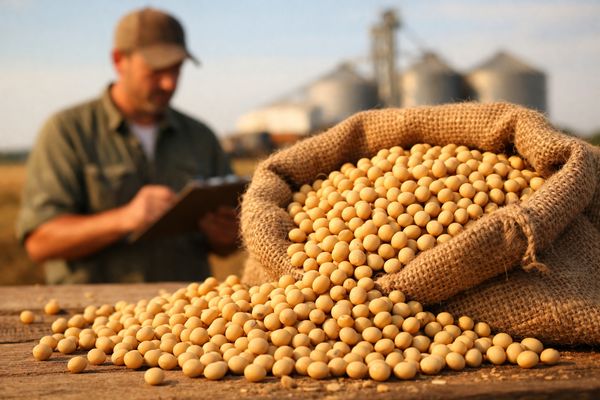
Soybean futures and physical premiums are trading slightly firmer today, but the overall soybean complex remains under structural pressure from a record South American crop, heavy soy oil stocks and weak competing vegetable oils.
After early-week losses on lower crude oil and softer palm oil, CBOT soybeans, soymeal and soyoil are staging only modest intraday rebounds. A strong start to U.S. planting, record-high Brazilian production and expectations of a new peak in U.S. crush and soy oil inventories are limiting any sustained upside. EU imports are lagging last season, while FOB offers from the U.S., India, Ukraine and China show only marginal week‑on‑week changes, confirming a broadly stable but bearish‑tilted price environment.
Exclusive Offers on CMBroker

Soybeans
No. 2
FOB 0.59 €/kg
(from US)

Soybeans
sortex clean
FOB 0.97 €/kg
(from IN)

Soybeans
FOB 0.33 €/kg
(from UA)
📈 Prices & Curve Structure
Across the CBOT soybean complex, today’s board shows a slightly firmer tone but keeps the medium‑term downtrend intact:
- CBOT Soybeans (old crop): May 2026 trades around 1,163.5 USc/bu, up about 0.5% on the day, with July 2026 near 1,178.0 USc/bu. The curve from May 2026 to November 2027 remains in mild contango, signaling comfortable forward availability.
- CBOT Soyoil: May 2026 last around 66.6 USc/lb, up 0.2%, but the strip from 2026 into late 2028 trends lower toward 55–56 USc/lb, reflecting expectations of ample oil supply and weak biodiesel support.
- CBOT Soymeal: May 2026 is near 331 USD/short ton, marginally higher on the day. Forward contracts out to 2027 are clustered in the low‑to‑mid 300s, consistent with comfortable meal supply.
Physical FOB offers confirm this soft tone. Using an indicative 1 EUR = 1.10 USD, current offers translate roughly as:
| Origin | Type | FOB Price (EUR/kg) | Trend vs. prev. quote |
|---|---|---|---|
| US, No. 2 | Standard | ≈ 0.55 | Flat w/w |
| India | Sortex clean | ≈ 0.91 | Flat w/w |
| Ukraine | Conventional | ≈ 0.31 | Slightly softer |
| China | Yellow | ≈ 0.64–0.72 | Mostly unchanged |
The combination of a gently upward‑sloping futures curve and mostly steady FOB indications points to a market that is well supplied but not under acute short‑term stress.
🌍 Supply & Demand Drivers
South America remains the key bearish anchor. Brazil’s crop agency CONAB has revised its 2025/26 soybean crop estimate up to about 179.15 million tons, from 177.85 million tons previously, reinforcing expectations of a record harvest and strong export potential. Independent and trade forecasts are aligned around similar volumes, with Brazil’s harvest reported near 85–90% complete and export programs robust through Q2 2026.
U.S. supply prospects are also improving. The latest Crop Progress data show U.S. soybean planting at 6% complete, well ahead of both last year and the five‑year average, with only Iowa lagging the normal pace. Early, smooth planting typically raises the probability of a large U.S. crop, especially if spring weather remains cooperative.
Demand signals are mixed. On the positive side, the National Oilseed Processors Association (NOPA) is expected to report a record March crush near 230 million bushels, which would imply very strong domestic soybean use for meal and oil. At the same time, surveys suggest U.S. soyoil stocks may climb to their highest level in almost 13 years, underlining that oil demand is not keeping pace with the surge in crush. On the import side, EU soybean arrivals since the start of the 2025/26 marketing year (July 2025) are reported at about 9.98 million tons, down from 11.06 million tons a year earlier, confirming softer European pull.
Competing oils weigh on the complex. Malaysian palm oil futures have fallen to a five‑week low, pressured by lower crude oil prices and weakness in other vegetable oils. The latest Malaysian biodiesel mandate increase disappointed traders, moving only from 12% to 15% instead of the 20%+ blend many had hoped for. This caps discretionary demand for palm and, by extension, for soyoil as a competing feedstock.
📊 Fundamentals & Weather
Crush and oil balance: Expectations for a record March U.S. crush underline robust meal demand, but the concurrent build‑up in soyoil inventories to multi‑year highs is clearly bearish for the oil leg. This is consistent with the downward‑sloping soyoil forward curve on CBOT and the recent weakness in palm oil futures.
Brazilian export momentum: Trade groups anticipate Brazilian soybean exports in early 2026 to stay above last year’s levels following a record March shipment volume, with cumulative exports for January–April projected up around 7% year‑on‑year. This flow competes directly with U.S. origin, depressing U.S. export sales and encouraging a shift of U.S. beans into domestic crush.
EU and non‑GM segment: In Europe, non‑GM soybean prices have shown some resilience, reaching roughly 440 EUR/t in mid‑March, the highest in the past 12 months, driven by niche demand and tighter regional supply. However, this premium market is relatively small and does not offset the broader global oversupply in conventional beans and oil.
Weather outlook (key regions): Recent assessments from Brazilian and U.S. agencies indicate that Brazil’s harvest weather is mostly benign, allowing rapid completion of fieldwork. In the United States, early spring conditions in southern states have permitted accelerated sowing, with no major widespread planting delays reported so far. Any later‑season weather scare (drought or excessive rains in the Midwest) could still introduce risk premia, but for now fundamentals are dominated by surplus rather than weather threats.
📉 External Markets & Macro Influences
Energy and biofuels: The recent pullback in global crude oil prices has reduced support for vegetable oil demand via the biodiesel channel. Alongside the weaker‑than‑expected biodiesel blending increase in Malaysia, this has been a key driver of the recent sell‑off in palm oil and a drag on soyoil valuations.
FX and competitiveness: A firmer euro against the U.S. dollar has weighed on euro‑denominated soybean and meal quotes at Euronext, making imports slightly cheaper in EUR terms but simultaneously reducing export competitiveness for EU crushers. For U.S. exporters, the combination of a strong dollar and aggressive Brazilian FOB offers continues to erode price competitiveness, particularly into Asia and the Middle East.
📆 Outlook & Trading Considerations
- Flat to slightly lower bias for CBOT soybeans: With Brazil harvesting a record crop and U.S. planting off to a very strong start, rallies toward the upper end of the recent CBOT trading range (around 11.70–12.00 USD/bu for nearby contracts) appear vulnerable to producer selling and increased hedging.
- Soyoil under structural pressure: Record or near‑record U.S. crush and rising oil stocks, combined with weak palm oil and limited biodiesel policy support, argue for a continued soft bias in soyoil spreads and a preference for meal over oil in crush‑spread strategies.
- Physical buyers: Feed manufacturers and crushers with uncovered needs for Q2–Q3 2026 may consider scaling in coverage on price dips, especially where local basis remains historically weak. However, heavy South American supplies and improving Northern Hemisphere prospects reduce the urgency to chase short‑term rallies.
- Producers and originators: Farmers in the Americas should use strength in nearby and new‑crop contracts to layer in sales, focusing on maintaining margin discipline rather than targeting absolute price highs in an oversupplied environment.
📍 3‑Day Directional View (EUR Perspective)
- CBOT soybeans (front month, EUR/t equivalent): Expected to trade sideways to slightly lower, with rallies capped by aggressive South American selling and strong U.S. planting progress.
- CBOT soymeal (front month, EUR/t equivalent): Mildly firmer relative to beans and oil, supported by steady feed demand, but overall rangebound within a comfortable supply backdrop.
- CBOT soyoil (front month, EUR/t equivalent): Bias remains lower, tracking weakness in palm oil and crude, with any short‑covering bounce likely to be sold into unless energy markets reverse.