
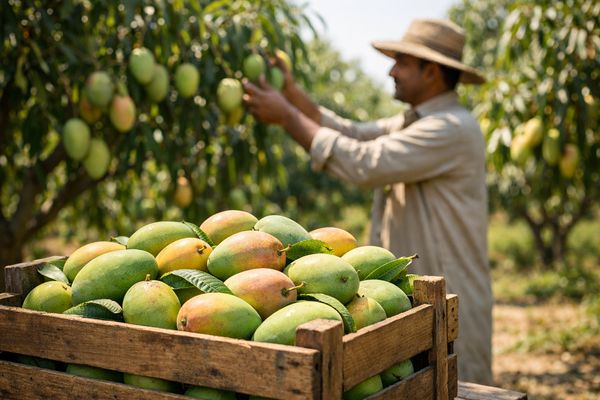
Pakistan’s decision to push the start of the 2026 mango export season to 1 June sharply narrows the commercial window for early varieties and risks direct losses for growers, while offering competing origins a tactical opening in key markets.
Pakistan’s mango sector, with 1.6–2.0 million tonnes of annual output and only around 5% exported, is facing a policy-driven squeeze at the front of the season. The export ban, now extended to 30 May with shipments allowed from 1 June, directly hits early maturing varieties like Dussehri and Sonaro that are normally ready in May. At the same time, Pakistan’s potato sector is absorbing heavy losses, eroding farm liquidity just as growers need capital for the next production cycle. Together, these pressures raise questions about export competitiveness and food security in the coming seasons.
Exclusive Offers on CMBroker

Mango dried
chunks: : 2 – 3 cm. Thickness: 2 mm. – 15 mm MOISTURE 13 – 19 %
FOB 5.60 €/kg
(from VN)

Mango dried
slices: 5 – 9 cm. Chunks: : 2 – 3 cm. Thickness: 2 mm. – 15 mm
FOB 5.80 €/kg
(from VN)

Mango dried
normal sugar, 8-10 mm
FCA 4.55 €/kg
(from NL)
📈 Prices & Immediate Market Signals
Official fresh mango export prices by variety are not yet available, but the timing of Pakistan’s export window is itself an important price signal. The delay to 1 June compresses the high-value early-season slot in Gulf and European markets, where Pakistan normally benefits from arriving ahead of, or alongside, limited volumes from competitors. This year, that advantage is curtailed, and importers may lean more heavily on India, Egypt and some African origins during May.
In processed mango products, recent dried mango quotations in Europe and Asia remain relatively stable in EUR terms. Vietnamese dried mango (FOB Hanoi) is currently indicated around EUR 5.6–5.8/kg for conventional slices and chunks, while Thai-origin dried mango delivered FCA Netherlands trades close to EUR 4.55/kg. These levels show only marginal movement over the past three weeks, suggesting that the policy shock in Pakistan has not yet translated into visible price dislocation in the dried segment.
| Product | Origin | Location / Terms | Current Price (EUR/kg) | 1–3 Week Change |
|---|---|---|---|---|
| Dried mango chunks (2–3 cm) | Vietnam | Hanoi, FOB | 5.60 | ≈ flat to -0.03 |
| Dried mango slices/chunks | Vietnam | Hanoi, FOB | 5.80 | ≈ flat to -0.03 |
| Dried mango, normal sugar | Thailand | NL, FCA | 4.55 | ≈ +0.05 |
🌍 Supply, Demand & Policy Shock
Pakistan’s mango production base is substantial, with 1.6–2.0 million tonnes produced annually and roughly 80,000–100,000 tonnes entering export channels under normal conditions. The vast majority—about 95%—is consumed domestically, cushioning global markets from abrupt supply shocks but amplifying local price and income effects when policy disrupts trade. Early-season varieties such as Dussehri and Sonaro, which reach maturity in May, capture export premiums thanks to their timing and eating quality.
The Ministry of Commerce has now extended the export ban to 30 May 2026, effectively delaying the official export start to 1 June. Authorities justify the step as necessary to prevent the shipment of immature fruit and to protect Pakistan’s reputation in quality-sensitive destinations. However, the National Assembly Standing Committee on National Food Security and Research has publicly challenged this blanket approach, arguing that it fails to differentiate between truly immature fruit and varieties that legitimately reach commercial maturity earlier in the season. This gap between quality-control intent and varietal reality is at the core of current industry frustration.
On the demand side, the May–July window is strategically important, especially into the Gulf and Europe. By ceding much of May, Pakistan effectively opens a door for India, Egypt and selected African exporters to deepen relationships with key buyers. Once programmes are locked in for the season, regaining shelf space can be difficult, even if Pakistan later offers competitive pricing. For Pakistani exporters whose model depends on early-season airfreight and premium pricing, the shortened window translates directly into lost revenue potential and pressure to discount later in the season.
📊 Fundamentals & Cross-Commodity Stress
The export delay occurs against a backdrop of stress in Pakistan’s potato sector. The same parliamentary committee has flagged that potato growers have been selling below production cost, and that previously ordered support measures and market-development steps were not implemented. Prolonged margin compression is already eroding farmers’ working capital, limiting their capacity to invest in inputs for upcoming seasons. For mixed mango–potato producers, this dual shock tightens liquidity just as orchard management and harvest expenses come due.
Structurally, the episode exposes weaknesses in agricultural governance and inter-ministerial coordination. Despite earlier directions to expand trade routes, ease visas for exporters and improve logistics for horticultural exports, there has been little visible follow-through. Frequent leadership changes at the food security ministry have disrupted continuity, and the current dispute over mango export timing underlines how policy decisions can be made without fully integrating varietal agronomy, commercial realities and diplomatic market-building efforts.
Globally, Pakistan’s share in mango exports is modest but not negligible. Its competitive edge lies in varietal diversity and in its traditional early-season arrival in some markets. When that edge is compromised, buyers may re-optimise supply portfolios in ways that are not easily reversed. This risk is particularly acute where Pakistan competes head-to-head with India and Egypt, both of which have been actively investing in phytosanitary compliance and logistics for fruit exports.
🌦️ Weather & Crop Timing Outlook
The immediate issue for Pakistan’s mango crop is less about absolute yield loss and more about timing relative to market access. Climatic variability has been cited by officials as a reason for delaying exports, suggesting that in some regions, fruit maturity has lagged historical norms. The concern is that exporting visually full-sized but physiologically immature mangoes could lead to quality complaints, particularly from European and high-end Middle Eastern buyers. In that sense, weather-induced maturity shifts have interacted with rigid policy dates to create the current bottleneck.
For early varieties like Dussehri and Sonaro, now entering or imminently reaching harvest readiness in May, the risk is that the optimal harvest and marketing window will not align with the export opening. If domestic wholesale markets are unable to absorb this concentrated volume at remunerative prices, growers could be forced into distress sales or face post-harvest losses. The coming three to four weeks are therefore critical: any administrative flexibility—such as targeted exemptions for certified mature lots—could materially change on-farm outcomes, even if total national production remains close to average.
📆 Market & Policy Outlook
Over the next 30–90 days, the key event to watch is the emergency cross-ministerial meeting convened at the Foreign Office, bringing together the Ministries of Commerce and Foreign Affairs, the Federal Board of Revenue and Customs. If this forum produces concrete, actionable exemptions or an adjusted protocol for early-maturing orchards, some of the damage for the 2026 season could still be contained. However, the parliamentary committee’s intervention and tight seasonal calendar mean that any further delay in decision-making will quickly translate into non-recoverable missed shipments.
In the 6–12 month horizon, Pakistan’s broader horticultural export competitiveness will hinge on whether this episode catalyses structural reform or remains an isolated dispute. Without improvements in policy coordination, logistics, and consistent leadership at the food security ministry, the risk of recurring crises in both mango and potato chains remains high. For international buyers, repeated disruptions can reduce Pakistan’s reliability score, encouraging a gradual shift of long-term programmes to other suppliers, even if Pakistani product remains price-competitive in nominal terms.
🧭 Trading Outlook & Strategy Pointers
- Fresh importers (EU & Gulf): Anticipate tighter availability of Pakistani early-season mangoes through May and consider balancing programmes with Indian, Egyptian or African fruit. Keep optionality for June in case Pakistan relaxes rules or volumes surge once the ban lifts.
- Pakistani exporters: Prioritise dialogue with authorities on varietal exemptions and clear maturity protocols. Prepare contingency plans for redirecting part of early May volumes to domestic or regional markets, potentially with promotional pricing to limit waste.
- Dried mango buyers in Europe: With Vietnamese FOB offers around EUR 5.6–5.8/kg and Thai FCA Netherlands near EUR 4.55/kg and broadly stable, use current price stability to secure medium-term contracts, but monitor any shift if fresh export disruptions later encourage additional fruit to move into processing.
- Producers with exposure to both mango and potato: Manage cash flow conservatively and reassess planting intentions for the next potato season, given sustained below-cost sales and ongoing policy uncertainty.
📍 3-Day Directional Outlook (EUR-Based)
- Fresh Pakistani mango export offers (CFR Gulf/EU): Limited spot activity before 1 June; not enough volume for clear EUR benchmarks, but upside risk for early-June prices if buyers compete for compressed supplies.
- Dried mango Vietnam, FOB Hanoi: Short-term prices expected to remain broadly stable around EUR 5.6–5.8/kg as current offers show minimal week-on-week movement.
- Dried mango Thailand, FCA Netherlands: Mildly firm tone near EUR 4.55/kg over the next three days, with no immediate catalyst for sharp moves but some upward bias if freight or demand tightens.
Related posts:
 Italy’s Mango Boom: Record Imports, Strong Demand and Stable Prices
 Dried Mango Prices Steady as Vietnam FOB Holds, Thailand Faces Heat and Storms
 Costa Rican Pineapple Oversupply Looms as Costs and Currency Squeeze Margins
 Premium Indian Mango Varieties Target Niche High-Value Buyers
 Hail Damage in Malatya Puts a Weather Risk Premium Under Apricots
 Bangladesh Mango Boom Meets a Freight-Cost Wall
 Dried Mango Prices Edge Sideways as Thai & Vietnamese Supply Stays Ample