
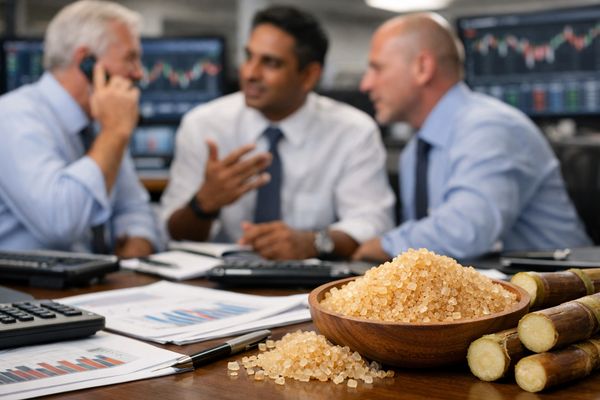
India’s sugar and jaggery markets are edging higher on reduced western Uttar Pradesh arrivals and firmer mill prices, creating a modest but durable upward bias into the pre-monsoon period. European refined sugar offers are also ticking up in EUR terms, underscoring a gradually tightening global balance rather than a sharp rally.
India’s quiet but clear firming is driven by mill price hikes and seasonally weaker cane flows, with spot sugar and jaggery both moving higher in Delhi. At the same time, FCA prices for refined sugar in key EU origins have risen slightly over recent weeks, suggesting that confectionery and beverage buyers face incrementally higher replacement costs but no acute shortage. With export parity from India still unattractive and domestic mills exercising pricing discipline, the global trade sees more of a floor under prices than a new spike.
Exclusive Offers on CMBroker

Sugar granulated
ICUMSA 32, 0,300 - 0,600 mm
FCA 0.47 €/kg
(from GB)

Sugar granulated
ICUMSA 32, 0,450 - 0,600 mm
FCA 0.47 €/kg
(from GB)

Sugar granulated
ICUMSA 45, 0,212 - 0,425 mm
FCA 0.47 €/kg
(from GB)
📈 Prices & Spreads
Sugar at Indian mills has firmed by about $0.30–0.35 per quintal, lifting mill-delivery values to roughly $48.32–$49.86 per quintal. This translates to approximately EUR 0.48–0.50 per kg, while spot wholesale sugar in Delhi is now around EUR 0.52–0.53 per kg after the latest increases. The pass-through from mills to wholesale has been swift given the thin spot availability.
Khandsari sugar remains notably higher priced, at roughly EUR 0.64–0.65 per kg, but flat on the day as buyers resist further increases and sellers refuse to discount. Jaggery has gained about $1.18 per quintal, now around EUR 0.60–0.61 per kg, reflecting tighter supply and competing demand from distilleries for molasses-grade material.
| Product / Region | Market level | Price (approx. EUR/kg) | Recent direction |
|---|---|---|---|
| India – refined sugar | Mill delivery | 0.48 – 0.50 | Firming |
| India – refined sugar | Delhi wholesale | 0.52 – 0.53 | Firming |
| India – jaggery | Delhi wholesale | 0.60 – 0.61 | Firming |
| India – khandsari | Delhi wholesale | 0.64 – 0.65 | Stable, high |
| EU refined sugar ICUMSA 32–45 | FCA GB / CZ / LT | 0.45 – 0.47 | Slightly higher vs. mid-April |
🌍 Supply & Demand Drivers
Reduced arrivals from western Uttar Pradesh, India’s most productive cane belt, are the key immediate driver of firmness. Hot summer conditions are curbing cane cutting and market activity in rural mandis, limiting fresh flows to mills and wholesale centers. Mills have responded with price increases of $0.30–0.35 per quintal, which wholesale markets have absorbed given limited competing spot supply.
On the jaggery side, high prices for molasses-grade material used in distilleries are pulling some cane away from jaggery production. This diversion, on top of weaker arrivals, is tightening jaggery availability and supporting the recent EUR 0.60+/kg wholesale levels. Khandsari’s stable but elevated prices, combined with buyer resistance, signal that the current sugar rally is still in an early, selective phase rather than a broad-based surge across all segments.
📊 Fundamentals & Global Context
India remains the world’s largest sugar producer and can be a significant exporter in surplus years, but current domestic prices near EUR 0.48–0.50 per kg at mill gate are still below most international parity scenarios. That keeps export flows muted and focuses mills on domestic marketing, reinforcing the local upward bias as pre-monsoon cane supplies tighten. Effective supply discipline and pricing power at the mill level are central to the current firmness.
In Europe, FCA offers for refined sugar in Germany, the UK, the Czech Republic, Lithuania and Ukraine are mostly in the EUR 0.44–0.58 per kg range, with several locations showing modest increases of around EUR 0.01–0.02 per kg over the second half of April. This points to slightly rising replacement costs but not to a tightness comparable to India’s western UP belt. For European buyers using Indian raw or jaggery, the combination of firm Indian domestic values and higher molasses returns suggests limited scope for aggressive price discounts in coming weeks.
📆 Short-Term Outlook (2–4 Weeks)
Over the next two to four weeks, Indian sugar prices are likely to stay firm or grind modestly higher. The main supports are continued reduced arrivals from western Uttar Pradesh, strong mill pricing discipline, steady consumer demand, and ongoing competition for cane from distilleries via high molasses-grade prices. The pre-monsoon period typically does not bring a major influx of fresh cane, reinforcing this pattern.
A meaningful downside correction would probably require either a sharp rise in crushing activity—unlikely without a change in field conditions—or a government-driven stock release program. At present, neither appears imminent. For global users, this translates into a slightly tighter floor under raw and refined sugar values, particularly for origins linked to India, while EU refined markets continue to trade in a moderate, gently upward band in EUR terms.
📌 Trading Outlook & Recommendations
- Industrial buyers in Europe: Consider accelerating near-term sugar procurement at current EUR 0.45–0.47/kg FCA levels, as the combination of firm Indian fundamentals and gradual EU price gains argues for limited downside in the short run.
- Importers of Indian raw sugar and jaggery: Plan for continued firmness through at least June; negotiate volumes early and avoid over-reliance on last-minute spot coverage from western UP-linked supply chains.
- Producers and traders in India: Maintain disciplined sales strategies; with export parity still weak, prioritizing domestic channels and cautious release schedules should help preserve the current upward bias.
📉 3-Day Directional Price Indication (EUR)
- India – Delhi wholesale sugar: Stable to slightly firmer (around EUR 0.52–0.54/kg) as reduced arrivals persist and mills defend recent increases.
- EU refined sugar (GB, CZ, LT FCA): Largely steady in a EUR 0.45–0.47/kg band; mild upward risk from replacement costs but no strong short-term catalyst.
- India – jaggery & khandsari: Jaggery biased higher within EUR 0.60–0.62/kg; khandsari stable but firm near EUR 0.64–0.65/kg amid buyer resistance at elevated levels.
Related posts:
 Indian Sugar Tightens at Home While Exports Stall on Weak Global Prices
 Indian Sugar & Jaggery Rally Tightens Global Offers as EU Prices Edge Up
 Sugar Beet Market Firms as White Sugar Futures Push Higher
 Lithuanian Sugar Prices Firm as Global Futures Edge Higher
 Indian Sugar Shortfall Tightens Global Balance as EU Prices Edge Up
 EU Sugar Beet Under Pressure While White Sugar Futures Edge Higher
 Sugar Futures Edge Higher as Market Eyes Tighter Balance in 2026–27