
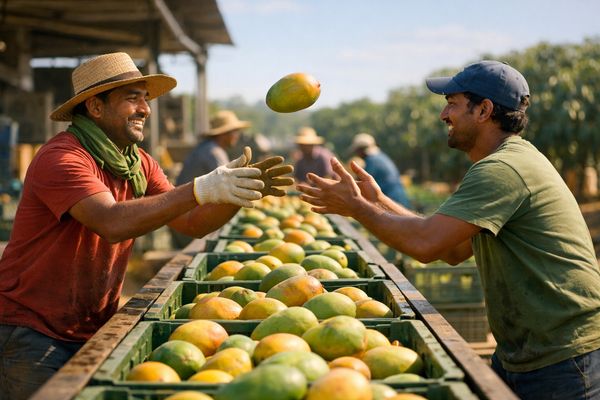
Indian mango prices are starting the 2026 season at elevated levels, driven by tight premium supply from western India and structurally improving market access for eastern producers like Odisha. Early farmgate prices around EUR 0.57/kg for high‑quality fruit are roughly 80% above last year and are expected to stay firm through most of May as export and domestic demand remain robust.
India’s new mango marketing season has opened on a notably strong footing, led by Odisha’s Dhenkanal district, where farmers are receiving nearly double last year’s early‑season prices. The first organized shipment of around three tonnes into the eastern domestic market has tested both quality and logistics positively, reinforcing buyer confidence just ahead of the main production flush. At the same time, weather‑related quality issues in key western states are tightening the availability of premium export‑grade fruit, helping to keep prices supported even as volumes build.
Exclusive Offers on CMBroker

Mango dried
chunks: : 2 – 3 cm. Thickness: 2 mm. – 15 mm MOISTURE 13 – 19 %
FOB 5.60 €/kg
(from VN)

Mango dried
slices: 5 – 9 cm. Chunks: : 2 – 3 cm. Thickness: 2 mm. – 15 mm
FOB 5.80 €/kg
(from VN)

Mango dried
normal sugar, 8-10 mm
FCA 4.55 €/kg
(from NL)
📈 Prices & Market Tone
Early‑season premium mangoes in India are trading around USD 0.53/kg at the farm gate, equivalent to roughly EUR 0.57/kg, nearly 80% above last year’s comparable level near EUR 0.31/kg. This is more than a short‑term spike: it reflects a combination of constrained top‑grade supply from Maharashtra and Gujarat and improved market linkages for emerging regions like Odisha.
In processed product, dried mango offers in early May remain relatively stable: Vietnamese FOB Hanoi material is indicated around EUR 5.60–5.80/kg, while Thai origin ex‑Netherlands is quoted near EUR 4.55/kg FCA. These prices have moved only marginally in recent weeks, suggesting that the sharp firming in fresh Indian farmgate values has not yet fully filtered through to the global dried segment.
🌍 Supply & Demand Dynamics
The season’s first significant domestic consignment from Odisha — about three tonnes shipped to Siliguri in West Bengal — was executed under a coordinated programme involving national and state‑level agencies, technical partners, and local farmer organisations. Beyond the modest physical volume, the key signal is that quality and logistics performance met buyer expectations, encouraging repeat orders as the season advances.
Odisha exported over 120 tonnes of mangoes to more than 11 countries last year and is targeting more than 500 tonnes this season across domestic and export channels. This four‑fold ambition underscores a structural shift: the state is moving from subsistence‑oriented selling to disciplined, export‑ready production, adding diversity and depth to a global trade traditionally dominated by Maharashtra and Uttar Pradesh.
On the demand side, premium Indian mangoes — especially Alphonso and Kesar — continue to enjoy strong pull in the UK, EU, and Gulf markets, driven by both diaspora and mainstream consumers willing to pay a seasonal premium. With western India facing weather‑related quality constraints, the incremental supply from organised growers in Odisha is well‑positioned to capture part of this demand, though total premium‑grade availability is likely to remain tighter than usual.
📊 Fundamentals & Structural Shifts
The current price strength is rooted in several fundamentals. First, adverse weather during the flowering period in Maharashtra and Gujarat has trimmed the share of export‑grade fruit, tightening premium supply even as overall crop volumes build. Second, domestic consumption of mangoes remains resilient, supporting firm pricing in the higher‑quality tiers.
Third, the formalisation of farmer‑to‑market supply chains — via farmer producer organisations, government‑backed programmes, and professional implementation partners — is reducing intermediary losses and improving price realisation for growers. In Odisha, coordinated quality control and adherence to buyer specifications are already translating into higher farmgate prices and stronger buyer confidence, a pattern increasingly visible across India’s better‑organised horticulture value chains.
Related premium fruit segments, such as pomegranate arils from Himachal Pradesh and other hill regions, are also firming on supply disruptions. This cross‑segment strength in high‑value horticulture reinforces the broader narrative of tightness in premium fresh fruit markets, particularly for export‑oriented categories.
🌦️ Short-Term Outlook & Weather Context
Over the next two to four weeks, mango prices in India are likely to remain firm or ease only marginally as the seasonal flush accelerates across producing states. The key swing factor is quality rather than quantity: persistent weather‑related constraints in Maharashtra and Gujarat should keep premium‑grade supply relatively tight, which in turn supports elevated price levels versus last year.
For European buyers now receiving the first shipments of the 2026 Indian season, farmgate prices are expected to stay noticeably higher than in recent years. Any additional weather stress or logistics bottlenecks in western India would likely translate quickly into firmer CIF offers, while the scaling‑up of organised supply from states like Odisha will be watched closely as a potential stabilising factor.
🧭 Trading Outlook & Recommendations
- Fresh importers (EU/UK/Gulf): Plan for sustained higher Indian mango prices through May and early June; secure volumes early with quality‑focused suppliers, including emerging origins like Odisha, to mitigate western India quality risks.
- Retailers and foodservice: Consider targeted premium positioning and shorter, more agile promotions rather than broad discounting, reflecting structurally higher farmgate costs and limited top‑grade supply.
- Processed and dried buyers: With dried mango offers still relatively stable in the EUR 4.5–5.8/kg range, evaluate forward coverage before fresh‑fruit tightness starts to feed more visibly into dried raw material costs.
- Producers and FPOs: Maintain strict quality control and traceability; in the current environment, consistent export‑grade quality can command a significant and sustainable premium over bulk domestic grades.
📆 3‑Day Indicative Outlook (Direction Only)
| Market | Product | Price Level* | 3‑Day Trend |
|---|---|---|---|
| India (farmgate, premium) | Fresh mango | ≈ EUR 0.57/kg | Stable to slightly softer as volumes build |
| EU (NL, FCA) | Dried mango, TH origin | ≈ EUR 4.55/kg | Stable |
| Vietnam (FOB Hanoi) | Dried mango, VN origin | ≈ EUR 5.60–5.80/kg | Stable |
*Indicative price levels converted to EUR; actual transactional values depend on specification, contract size, and logistics.
Related posts:
 Tainan’s Champagne Mango Push Targets Japan’s Premium Fruit Buyers
 Italy’s Mango Boom: Record Imports, Strong Demand and Stable Prices
 Dried Mango Prices Steady as Vietnam FOB Holds, Thailand Faces Heat and Storms
 Premium Indian Mango Varieties Target Niche High-Value Buyers
 Bangladesh Mango Boom Meets a Freight-Cost Wall
 Dried Mango Prices Edge Sideways as Thai & Vietnamese Supply Stays Ample