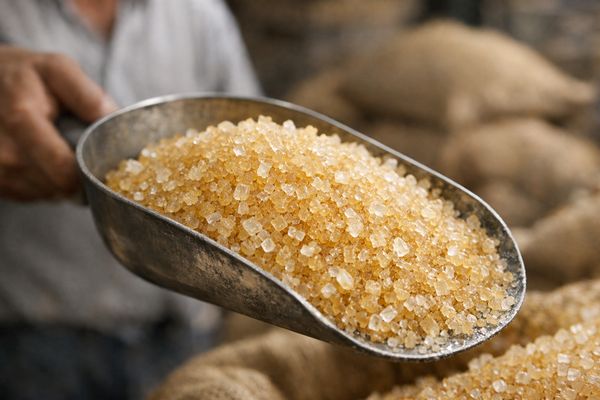
Indian sugar and jaggery prices have turned firmly higher as reduced arrivals from Uttar Pradesh collide with strengthening seasonal demand, establishing a short‑term price floor and mildly tightening export offers.
India’s sugar complex has shifted from subdued trade to a clear, demand‑supported uptrend. Reduced jaggery inflows from key Uttar Pradesh mandis and more aggressive mill bidding in Delhi at the close on 29 April are lifting prices across jaggery, crystal sugar, shakkar and khandsari. At the same time, world futures have rebounded from recent softness, and EU cash prices remain broadly firm in euro terms, embedding higher floor costs for refiners and food manufacturers. For European buyers, Indian price firmness, freight cost pressure and a weaker rupee imply continued competitiveness, but little room for deep discounts in the near term.
Exclusive Offers on CMBroker

Sugar granulated
ICUMSA 45, 0,2 - 1,2 mm
FCA 0.46 €/kg
(from LT)

Sugar granulated
ICUMSA 45, 0,2-1,2 mm
FCA 0.45 €/kg
(from LT)

Sugar granulated
ICUMSA 32, 0,300 - 0,600 mm
FCA 0.47 €/kg
(from GB)
📈 Prices & Market Tone
In Delhi on 29 April, jaggery advanced by about USD 0.53 per quintal to trade around USD 49.55–50.58 per quintal, while sugar at mill delivery gained roughly USD 0.26 to USD 42.71–44.48 per quintal. Spot sugar firmed further, to approximately USD 46.07–47.72 per quintal, indicating stronger end‑user pull and tighter immediate availability. Coarser shakkar and semi‑refined khandsari held in a higher band near USD 52.70–58.04 per quintal as sellers withheld low‑priced offers, reinforcing a newly established floor across the complex.
Converted into euro terms, these Delhi spot values broadly align with a global raw sugar reference near 260–280 EUR/t equivalent on ICE No.11, where front‑month futures recently bounced around 2% day‑on‑day and remain mildly bullish. In Europe, recent physical offers for refined beet and cane sugar cluster around 0.44–0.57 EUR/kg FCA in Central and Eastern EU, with Lithuanian ICUMSA 45 granulated sugar lifting from roughly 0.44 to 0.45–0.46 EUR/kg between 20 and 24 April, signalling a modest firming trend in regional cash prices. Meanwhile, German refined sugar in Berlin holds near 0.57 EUR/kg, consistent with a structurally higher price tier.
| Region / Product | Latest Level (EUR) | Trend vs. Mid‑April |
|---|---|---|
| India – Delhi spot sugar (qtl, approx.) | ≈ 42–43 EUR/qtl | Firming, +0.5–1% in late April |
| EU – Granulated sugar LT ICUMSA 45 (kg) | 0.45–0.46 EUR/kg | Up ~0.02 EUR/kg |
| EU – Granulated sugar DE ICUMSA 45 (kg) | 0.57 EUR/kg | Stable at high level |
| World – ICE No.11 nearby (t, equiv.) | ≈ 275–290 EUR/t | Rebounding, +~2% d/d |
🌍 Supply, Demand & Logistics
The immediate driver of India’s rally is a supply squeeze from Uttar Pradesh, where weaker jaggery arrivals into key mandis have intersected with the onset of the domestic wedding season. Mills that had previously resisted higher prices turned active buyers in the afternoon session on 29 April, lifting mill‑gate bids and confirming buyers’ willingness to chase volume. This behaviour strongly suggests that a cyclical low has been set and that nearby downside is limited so long as arrivals remain constrained.
On the demand side, bulk offtake from caterers and food processors for weddings running through May and June is adding consistent pull for both refined sugar and jaggery. Indian retail and mandi price data corroborate a firm bias, with all‑India sugar prices on 29 April reported around INR 44.1/kg ex‑mandi, modestly above early‑month levels. At the macro level, Indian sugar production as of 30 April has reached about 27.5 million tonnes, roughly 7% above the same point last year, but Uttar Pradesh’s output is slightly lower year‑on‑year, tightening local availability despite comfortable national balances.
Internationally, the ongoing Israel–Iran–US conflict is keeping shipping and insurance costs for sugar trade elevated, especially along Middle East and Red Sea routes. Higher freight, together with the weaker Indian rupee, is making imported sugar into India relatively expensive while keeping Indian export offers attractive in foreign‑currency terms. Global trade flows also reflect a firmer tone: raw sugar on ICE recently hit a two‑week high as selling from Brazil eased and higher fuel prices encouraged mills there to divert more cane towards ethanol, trimming export availability.
📊 Fundamentals & Weather
Fundamentally, India is entering the late phase of its 2025/26 crushing season with comfortable overall stocks but localized tightness in key northern consuming areas. Even as total output has risen, the small year‑on‑year dip in Uttar Pradesh production is amplifying the impact of reduced jaggery arrivals, particularly into Delhi and surrounding markets. Mills’ willingness to pay up in the evening session indicates that pipeline inventories at buyers and traders are not overly heavy and that restocking is underway rather than being postponed.
Globally, futures curve behaviour supports the domestic bullish tilt: the ICE No.11 curve has steepened modestly, with nearby contracts outperforming deferred months on rising demand expectations and cautious concern around medium‑term supply. Chinese sugar futures, by contrast, have traded broadly flat in recent sessions, suggesting that importers there currently see no immediate need to chase the market higher and that global demand growth remains orderly rather than explosive. In Europe, official data on ACP raw and white sugar import prices for early 2026 show average white sugar import values near 550–560 EUR/t, well above pre‑2025 norms, validating the idea that current EU cash prices around 0.45–0.57 EUR/kg retain a strong structural floor.
Weather is not an acute driver in the very short term, but market attention is turning to monsoon prospects for India and conditions in Brazil. While no major new weather shock has been reported in the last few days, the premium embedded in white sugar futures reflects latent concern about any disruption to 2026/27 cane output. For now, the key short‑term fundamental remains the interplay of Indian domestic logistics, jaggery arrivals, and seasonal demand rather than field‑level production risks.
📆 Short-Term Outlook
Over the next 2–3 weeks, Indian sugar and jaggery prices are likely to remain firm to slightly higher. The combination of wedding‑season demand, constrained jaggery arrivals from Uttar Pradesh, and disciplined mill selling points toward a possible move of Delhi spot sugar toward roughly USD 48–50 per quintal (around 44–46 EUR/qtl) if buyers continue to accept higher evening bids. Sellers appear reluctant to offer aggressively at lower levels, effectively underpinning the market.
For the global complex, the recent bounce in ICE No.11 and persistently elevated EU cash prices suggest that the downside for refined values in euro terms is limited in the very near term. Any further escalation in Middle East geopolitical tensions or renewed freight bottlenecks could translate quickly into higher CIF prices for European buyers. Conversely, a sudden easing of freight rates or a stronger euro could cap euro‑denominated import costs even if dollar‑based futures remain firm.
💡 Trading & Procurement Strategy
- European industrial buyers: Consider covering a portion of Q2–Q3 refined sugar needs at current FCA levels around 0.45–0.57 EUR/kg, given firm Indian domestic prices, elevated freight, and a mildly bullish global futures curve. Leave some volume open for potential dips linked to currency or macro‑driven corrections.
- Importers sourcing from India: Expect Indian export offers to stay competitive in euro terms thanks to the weak rupee, but do not anticipate steep discounts while domestic prices are firm and logistics remain costly. Building a modest buffer stock ahead of any further freight disruption may be prudent.
- Indian mills and traders: The recent firming and mills’ own higher bids suggest the current price cycle floor is in place. Opportunistic forward sales into export channels can lock in attractive margins, but retaining some unpriced volume offers optionality if wedding‑season demand and global futures extend the rally.
📍 3‑Day Directional View (EUR)
- India – Delhi spot sugar: Bias: firm to slightly higher; wedding demand and tight jaggery arrivals support a gradual drift toward the upper end of the indicated 44–46 EUR/qtl range.
- EU Central/Eastern FCA refined sugar: Bias: broadly stable to mildly firmer around 0.45–0.47 EUR/kg as global futures stay supported and input costs for refiners remain elevated.
- EU premium markets (e.g., Germany): Bias: stable at high levels near 0.57 EUR/kg; little sign of immediate relief given tight import parity and steady regional demand.