
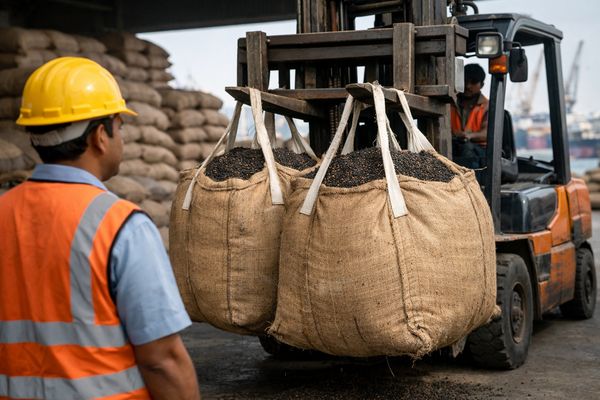
Black pepper prices in India are holding a firm floor and remain biased to the upside as farmers restrict selling and a sizeable production shortfall collides with elevated global prices. With import parity still well above domestic levels and arrivals shrinking at key mandis, a further leg higher toward the next resistance band looks increasingly likely in the coming weeks.
India’s pepper market is trading in a classic tight-supply, firm-demand configuration. At Kochi, Delhi and secondary centres in Andhra Pradesh and Telangana, farmers are deliberately throttling arrivals after a 25–30% production drop, forcing buyers to bid up limited volumes. At the same time, high landed costs for imports from Sri Lanka and other origins prevent any meaningful downside from global competition. For European and other international buyers, this combination points to continued price strength and only shallow, short-lived corrections.
Exclusive Offers on CMBroker

Pepper powder
black
FOB 8.70 €/kg
(from IN)

Pepper
white whole
FOB 7.00 €/kg
(from IN)

Pepper
green dehydrated
FOB 8.50 €/kg
(from LK)
📈 Prices & Market Structure
At Kochi, India’s main pepper hub, black pepper prices have firmed by about USD 0.21–0.32 per kg over the past two weeks, with the latest range at roughly USD 7.64–7.74 per kg on 29 April. Delhi wholesale levels for Merkara and ASTA 12.5 grades are even higher, around USD 8.07–8.18 and USD 8.60–8.71 per kg respectively, after a fresh USD 0.11 per kg uptick in the most recent session. Despite sluggish wholesale buying, this resilience underlines a market supported primarily by constrained supply rather than aggressive demand.
Converted to EUR using a working rate of 1 USD ≈ 0.93 EUR, Kochi black pepper is effectively trading near EUR 7.10–7.20 per kg, with Delhi’s premium grades extending well above that. Parallel indications from current FOB offers show Indian organic black whole pepper around EUR 8.00 per kg and organic pepper powder near EUR 8.70 per kg in New Delhi, with white whole at about EUR 7.00 per kg. Vietnamese black pepper offers for standard FAQ and clean grades range approximately EUR 5.70–6.45 per kg FOB Hanoi, confirming India’s position at the higher end of the global price spectrum.
🌍 Supply & Demand Balance
Production in India this season is estimated to be 25–30% below normal across the main pepper belts, led by Kerala. Crucially, the new Kerala crop, which began arriving in January, has never reached typical arrival levels at any major market, indicating a structural deficit rather than a temporary, seasonal dip. This shortfall is being compounded by farmer behaviour: growers are withholding stocks in anticipation of higher prices, further reducing near-term liquidity at wholesale markets.
Arrivals at Kochi, previously as high as 150,000 bags of about 75 kg each, have now shrunk to roughly 70,000 bags per day. Warangal in Telangana has seen a similar pattern, with peak arrivals around 40,000 bags now down to 25,000–30,000 bags. While secondary red chilli markets such as Guntur are experiencing weakness and quality issues, pepper itself is holding its premium, and traders remain committed to long positions. Domestic demand from spice processors and food manufacturers is steady, with no evidence yet of significant demand destruction at current price levels.
📊 Fundamentals & Trade Flows
A key pillar of the current price floor is the import cost barrier. Landing pepper from Colombo, Sri Lanka into India would currently cost at least about USD 8.43 per kg (≈ EUR 7.84 per kg) on a CIF basis, clearly above prevailing domestic wholesale prices. This effectively locks out economically viable imports and prevents global supply from capping Indian prices. The rupee’s recent ~1% appreciation versus the dollar, to around 93 per USD, has marginally improved import economics on paper but has not closed the gap enough to change the picture.
Globally, benchmarks reported by the International Pepper Community show Indonesian black pepper near USD 6,998 per tonne, Brazilian at USD 6,100 per tonne and Malaysian at USD 9,300 per tonne, underscoring a broadly elevated international market. India’s export data confirm this strength: in the first ten months of FY 2025–26, pepper exports reached USD 103.74 million from 16,178 tonnes, compared with USD 89.38 million from 17,262 tonnes a year earlier. Volume is down about 6%, but revenue is up 16%, evidencing higher unit values. Exporters have shifted away from declining-quality red chilli flows in Guntur and remain engaged in pepper, viewing the sustained arrival deficit as fundamental support.
⛅ Weather & Regional Outlook
The current season’s 25–30% production loss across India’s main pepper regions reflects earlier adverse conditions in key estates rather than a single recent weather shock. With the main crop already harvested and in the market pipeline, short-term weather over the next few weeks will have limited impact on immediate supply, although pre-monsoon showers and upcoming monsoon onset will be closely watched for implications on the next crop’s vegetative development. Any confirmation of further stress in South Indian pepper belts would reinforce the structural tightness already evident in arrivals.
📆 Price Outlook (2–4 Weeks)
Market participants widely see black pepper prices as well supported for the coming two to four weeks, with risk skewed decidedly to the upside. Traders warn that if arrivals at Kochi, Warangal and other centres do not recover meaningfully, a further rally of around USD 0.53–0.63 per kg from current levels is plausible. From today’s Kochi range, that implies a move toward roughly USD 8.43–9.01 per kg, equivalent to about EUR 7.84–8.38 per kg using the same working FX rate.
Given that import parity remains above domestic prices and global benchmarks are generally elevated, there is limited room for a deep correction unless there is an unexpected surge in farmer selling or a sharp softening in international markets. Instead, the dominant scenario is for a grinding, supply-led rally punctuated by brief pauses as end-users opportunistically cover nearby requirements. European spice importers and food manufacturers who delayed procurement face the risk that waiting further will only cement higher replacement costs.
📌 Trading & Procurement Recommendations
- Importers / Food Manufacturers (EU & MENA): Use any short-lived dips to layer in coverage for Q2–Q3, targeting incremental purchases as prices approach but remain below the USD 8.43–9.01 (≈ EUR 7.84–8.38) per kg band at Kochi.
- Indian Traders & Stockists: Maintain core long positions while monitoring arrivals closely; consider partial profit-taking on sharp intraday spikes but avoid heavy short exposure while import parity remains clearly underwater.
- Industrial Buyers in India: Advance-book a portion of raw material needs rather than relying solely on spot, as continued farmer holding and weak imports make sudden tightness and price spikes likely.
- Growers: With a structural deficit and strong export values, gradual, staged selling into strength may optimise realisations while managing price and storage risk.
📍 3-Day Directional Outlook (EUR Basis)
| Market / Contract | Indicative Level (EUR/kg) | 3-Day Bias |
|---|---|---|
| Kochi physical black pepper | ≈ 7.10–7.20 | Mildly bullish; supported by tight arrivals |
| Delhi high-grade (ASTA 12.5) | Above 7.50 | Firm to higher; quality demand steady |
| FOB India black whole (New Delhi) | ≈ 8.00 | Stable to slightly higher, export interest active |
| FOB Vietnam black FAQ / clean | ≈ 5.70–6.45 | Firm; tracking global strength |
Over the very near term, prices are expected to trade sideways to higher within a supported band, with dips remaining shallow due to constrained farmer selling and uncompetitive import parity.
Related posts:
 Nigella squeeze: Indian supply shock keeps kalonji prices elevated
 Ginger Market Holds Firm as Nigeria Supply Shock Tightens Global Balance
 Indian Pepper Prices Ease Slightly As Global Supply Recovers
 Indian Pepper in a Standoff: Tight Farm Supply Meets Blocked Export Demand
 Black Pepper Rally Accelerates as Indian Supply Tightens
 Indian Black Pepper Rallies as Supply Tightens and Stockists Chase Scarcity
 Pepper Market Snapshot IN–LK–VN: FOB Prices Hold Firm Amid Tight Supply