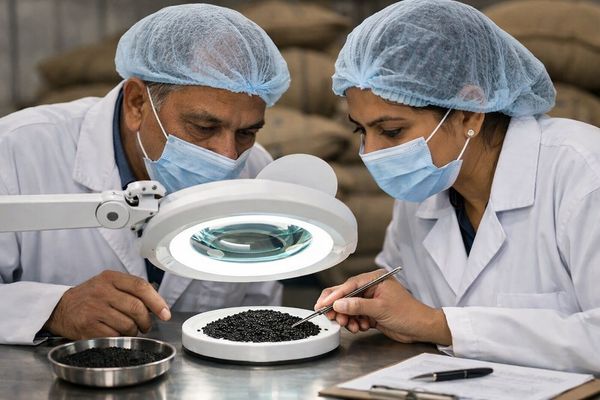
Indian nigella (kalonji) is in a classic supply squeeze, with sharply lower output in key producing states and thin old-crop stocks driving prices to elevated levels and supporting a firmly bullish near-term outlook.
India’s nigella market has emerged as one of the most dynamic segments in the spice complex in recent days. A sharp rally of about $15.97 per quintal has pushed wholesale prices to roughly $212.97–218.29 per quintal, as traders digest the scale of production losses in Rajasthan, Gujarat and Madhya Pradesh. With old-crop stocks at mandis reported as very low and fresh arrivals disappointing, buyers face limited sourcing options just as demand from domestic processors and bakers remains steady. Export interest is expected to follow once prices stabilise, potentially tightening the market further.
Exclusive Offers on CMBroker

Nigella seeds
Machine Clean
99.80%
FOB 2.02 €/kg
(from IN)

Nigella seeds
Kalonji Sortex
99%
FOB 1.95 €/kg
(from IN)

Nigella seeds
Sortex
99.5%
FOB 2.20 €/kg
(from EG)
📈 Prices & spreads
Wholesale prices in India surged last week, reflecting the sudden reassessment of supply after confirmation of a severe production shortfall across the main producing belt. The recent jump to around $213–218 per quintal underscores how quickly nigella prices adjust in the absence of significant state-backed buffer mechanisms.
Export-oriented offers from India currently sit around EUR 1.95–2.02/kg FOB New Delhi for conventional qualities, with FCA levels in a similar range depending on specification. Egyptian origin remains slightly higher, around EUR 2.20/kg FOB for 99.5% Sortex quality, maintaining a modest premium over Indian material.
| Origin / Type | Delivery term | Latest price (EUR/kg) | 1 week ago (EUR/kg) |
|---|---|---|---|
| IN – Nigella, Machine Clean 99.8% | FOB New Delhi | 2.02 | 2.06 |
| IN – Nigella, Kalonji Sortex 99% | FOB New Delhi | 1.95 | 1.98 |
| EG – Nigella, Sortex 99.5% | FOB Kairo | 2.20 | 2.20 |
🌍 Supply & demand balance
The key driver behind the price surge is a pronounced production decline in Rajasthan, Gujarat and Madhya Pradesh, which together account for the majority of India’s nigella output. Reports from the trade indicate that both harvested volumes and market arrivals are significantly below last season, with little carry-over stock available to cushion the shortfall.
On the demand side, offtake from domestic food processors, pickle manufacturers and bakery channels has stayed broadly stable, providing a firm consumption floor. Nigella’s growing use in European artisan bakery and health-food segments, driven by interest in its thymoquinone content, adds a medium-term demand tailwind. While export enquiries have not been the main engine of the latest rally, they are expected to increase once prices consolidate, given India’s central role as the primary origin for European and Middle Eastern buyers.
📊 Market structure & fundamentals
Unlike major cereals or pulses, nigella does not benefit from strong government price support or large public stocks. This structural feature means that production shocks transmit rapidly into spot prices, amplifying volatility and making procurement timing more critical for downstream users.
Traders who built positions ahead of the rally are reportedly holding back sales to benefit from the tight market, further constraining spot liquidity. With both old-crop and fresh-crop availability limited, nearby physical supply remains tight and there is no clear short-term catalyst for a meaningful price correction.
📆 Short-term outlook & risks
Market sentiment is firmly bullish for the next three to four weeks. Given reduced production, thin carryover and steady demand, prices are expected to remain elevated and may firm further if export demand accelerates from current levels.
The main risk factor for the medium term is the upcoming sowing cycle. Any disruption from weather or a delayed planting response—whether due to input availability, rainfall patterns or farmer decisions—could prolong tight supply conditions well into the second half of the year. Conversely, an aggressive acreage response to today’s high prices could eventually cap the rally, but this lies beyond the immediate horizon.
📌 Trading and procurement recommendations
- European and Middle Eastern buyers: Review coverage for bakery, condiment and nutraceutical uses promptly; consider forward buying a portion of Q2–Q3 needs while liquidity is available.
- Indian processors: Manage raw material exposure carefully; stagger purchases but avoid running lean inventories given the lack of a visible bearish catalyst in the near term.
- Traders: Existing long positions remain supported by fundamentals; be alert to any sudden uptick in export bookings or sowing news as potential inflection points.
🔭 3-day regional price indication (directional)
- India FOB New Delhi (conventional nigella): EUR 1.95–2.05/kg – bias: sideways to slightly firmer on tight spot supply.
- Egypt FOB Kairo (Sortex 99.5%): around EUR 2.20/kg – bias: stable, tracking Indian benchmarks but cushioned by existing offer levels.
- European landed prices: elevated versus earlier in the season, with a firm to slightly firmer tone as buyers reassess coverage.