
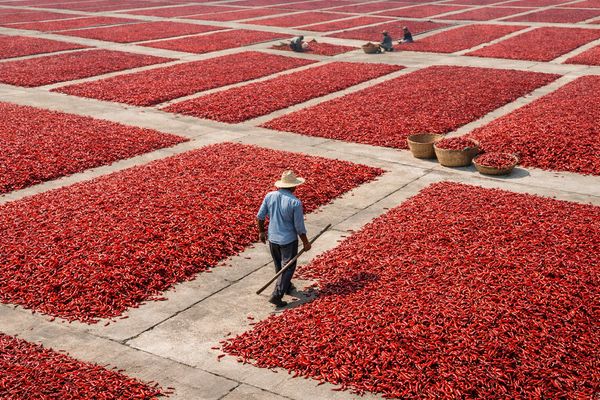
India’s red chilli market is trading in a structurally tight environment after a sharp production drop, with farmholders and stockists showing little selling pressure. Prices at key hubs such as Guntur and Jaipur remain firm, and forward expectations for premium grades point to further increases if export demand stays strong.
India’s 2025/26 red chilli season is defined by weather‑driven crop losses, lower arrivals and steady export interest from Asia, creating a classic supply‑side bull market. Domestic consumption from weddings and summer demand is reinforcing the tightness just two months into the new crop. In this context, buyers face limited downside in the near term, while producers and holders of quality stocks retain clear pricing power.
Exclusive Offers on CMBroker

Chilli dried whole
bird eye, grade a
FOB 4.65 €/kg
(from IN)

Chilli dried
powder, grade a
FOB 4.40 €/kg
(from IN)

Chilli dried
flakes, grade a
FOB 4.35 €/kg
(from IN)
📈 Prices & Market Levels
National red chilli production is estimated around 2.1 million tonnes, down roughly 28–30% from about 3.0 million tonnes last season, fundamentally tightening the balance. At the Guntur wholesale market, Teja Dandidaar (premium stemmed export grade) is reported around ₹230–₹265/kg, equivalent to roughly EUR 2.29–2.64/kg, while Full Cut grade is trading mostly at ₹260–₹265/kg (about EUR 2.58–2.64/kg), with best lots touching ₹295/kg (about EUR 2.99/kg). Across the previous fortnight, prices for all quality grades have reportedly firmed by roughly ₹28–₹30/kg, underlining the strength of the rally.
In Jaipur’s wholesale spice market, red chilli is quoted in a wide band of ₹14,000–₹25,000 per quintal (100 kg), or approximately EUR 1.30–2.32/kg, reflecting varied quality and origin. Despite a modest day‑to‑day softening of about ₹500/quintal in Jaipur, the broader price trend in production centres remains upward. FOB indications for Indian dried chilli products in early April also align with the firm domestic tone, with organic bird’s eye whole at about EUR 4.63/kg and premium organic powder and flakes around EUR 4.38/kg and EUR 4.33/kg respectively, while conventional stemless and with‑stem whole are offered near EUR 2.13–2.14/kg.
| Market / Product | Specification | Price (EUR/kg) | Comment |
|---|---|---|---|
| Guntur (domestic) | Teja Dandidaar, premium stemmed | 2.29–2.64 | Strong export interest, arrivals below normal |
| Guntur (domestic) | Full Cut, bulk grade | 2.58–2.64 (top up to ~2.99) | Best lots commanding clear premium |
| Jaipur (domestic) | Mixed grades | 1.30–2.32 | Day’s easing, but structurally firm vs previous season |
| FOB India | Dried chilli powder, organic, grade A | 4.38 | Reflects strong value‑added demand |
| FOB India | Dried chilli flakes, organic, grade A | 4.33 | Stable week‑on‑week |
| FOB India | Dried whole bird’s eye, organic, grade A | 4.63 | Premium niche segment |
| FOB India | Dried whole, stemless, conventional | 2.13 | Bulk export benchmark |
🌍 Supply, Demand & Trade Flows
The current season’s supply shock is rooted in severe weather disruptions. Unseasonal and excessive rainfall from August onwards in Andhra Pradesh, Telangana, Madhya Pradesh and West Bengal damaged the crop at seedling and planting stages. Of roughly 0.9 million hectares sown, an estimated 0.75 million hectares suffered significant damage or outright loss, leading to a pronounced yield decline – up to 40% per hectare in some pockets.
Arrivals at Guntur, India’s main chilli hub, underline the tightness: peak‑season inflows that would typically average around 200,000 bags per day have dropped to about 100,000 bags, less than half normal levels. Only about two months have passed since new crop started arriving, so farmers are still holding stocks, and there is little incentive to accelerate selling when prices are rising. Domestic demand remains seasonally solid, augmented by wedding‑related consumption and summer usage, which limits any near‑term relief on the demand side.
On the external front, export demand from Sri Lanka, Thailand, China, Indonesia, Malaysia and Vietnam continues to lend strong support. Although geopolitical tensions involving Iran, Israel and the United States have disrupted some sea routes and temporarily delayed execution of a portion of concluded deals, the past 12–13 days have seen a resumption of flows into Southeast Asia. This combination of tight origin supplies and resilient regional demand is keeping Guntur‑line export interest firm despite logistical headwinds.
📊 Fundamentals & Market Sentiment
Market sentiment in the chilli complex is decisively bullish. Farmers experiencing substantial yield hits are reluctant to release remaining stock at prevailing prices, effectively back‑stopping the market and contributing to a strong floor. Processors and stockists also see very limited pressure from production centres, reinforcing a perception that the supply gap will not close quickly.
Forward views among traders for Full Cut grade remain skewed to the upside. From the current level of around EUR 2.58/kg equivalent, expectations point to a move toward roughly EUR 2.99/kg over the next two months. Later in the season, values could approach around EUR 3.49/kg if export demand persists and no major secondary‑state bumper arrivals materialise. The main downside risk cited is a sudden surge in supplies from West Bengal or other secondary producing states, but current field intelligence suggests their output is also well below normal, keeping this a low‑probability scenario in the near term.
FOB offers for processed organic chilli products (powder and flakes) in Andhra Pradesh have edged only marginally lower by about EUR 0.02/kg between early and mid‑April, indicating that exporters are more inclined to fine‑tune grades and contract terms than to concede major price reductions. This pattern underscores how structural tightness in raw material availability is being transmitted along the value chain into global markets.
🌦️ Weather & Short-Term Outlook
With the main weather shock already embedded in the current harvest, near‑term price direction will be driven more by arrivals, stockholding behaviour and export execution than by fresh meteorological events. Nonetheless, any further episodes of unseasonal rain in residual late‑harvest areas of Andhra Pradesh, Telangana or Madhya Pradesh would likely exacerbate quality issues and tighten availability of premium grades, adding further support to prices.
Conversely, if weather conditions in secondary producing belts such as West Bengal remain benign and support better‑than‑expected late arrivals, the market could see some easing in the most squeezed segments. At this stage, however, the baseline remains one of structurally constrained supply, and traders are not yet pricing in a significant recovery in crop prospects.
📆 Trading Outlook & 3‑Day View
- For importers and industrial buyers: Consider advancing coverage for Q2–Q3 needs, especially for premium Guntur grades and organic powder/flakes, as further upside of EUR 0.30–0.50/kg on key grades is plausible if export demand stays firm.
- For exporters: Prioritise higher‑value grades (Teja Dandidaar, high‑colour Full Cut, organic segments) and build flexibility into shipment schedules to mitigate route disruptions in the Middle East corridor.
- For producers and stockists: With farmers showing no distress selling and supply still well below normal, a patient selling strategy in tranches appears justified, while monitoring any sudden increase in arrivals from secondary states.
Over the next three trading days, prices at Guntur are likely to remain firm to slightly higher in EUR terms, with limited downside given tight arrivals and active export enquiry. Jaipur’s more mixed quality profile may see modest day‑to‑day volatility, but the broader bias remains upward compared with last season. FOB offers for Indian dried whole, powder and flakes are expected to track this trend, holding steady to mildly firmer as long as raw material supply remains constrained.