
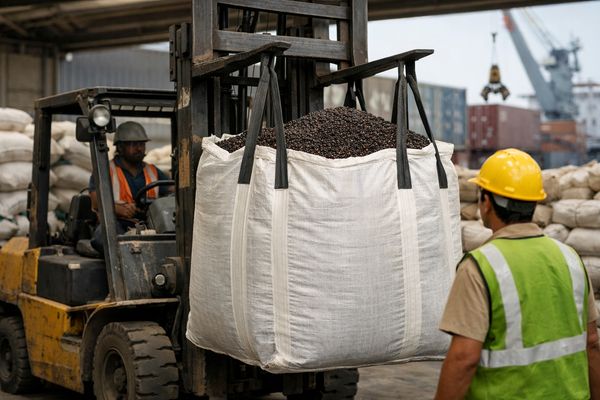
Indian pepper prices are softening mildly after recent firmness, tracking increased arrivals in India and a strong export-driven harvest in Vietnam, while overall global fundamentals remain tight. Domestic spot markets in Cochin still trade at historically elevated levels in rupee terms, but the short‑term tone has shifted from bullish to slightly bearish.
In the near term, Indian prices will be guided by the pace of arrivals in Kerala and Karnataka, export competition from Vietnam, and near‑term weather in southern India. Market participants should watch freight and insurance costs as well as currency moves, which can quickly alter export parity. Despite the current pause, structural support from firm global demand and constrained long‑term supply suggests downside in EUR terms is likely to be limited.
Exclusive Offers on CMBroker

Pepper
black 500 g/l, clean
FCA 5.45 €/kg
(from IN)

Pepper
white whole
FOB 7.00 €/kg
(from IN)

Pepper powder
black
FOB 8.70 €/kg
(from IN)
📈 Prices & Spreads
Price indications below convert recent INR levels to EUR for comparability (approx. 1 EUR = 90 INR).
| Product | Market / Term | Latest Price (EUR/kg) | 1w Change |
|---|---|---|---|
| Black pepper, garbled | India, Cochin spot | ≈ 8.01 EUR | +0.4% vs 3 days earlier |
| Black pepper, ungarbled | India, Cochin spot | ≈ 7.79 EUR | +0.4% vs 3 days earlier |
| Black pepper 500 g/l, clean | India, export parity vs VN 500 g/l | ≈ 6.00–6.20 EUR (offer-based) | Sideways to slightly softer |
| Vietnam black pepper 500–550 g/l | Export FOB | ≈ 6.10–6.20 EUR | Stable to marginally lower |
Indian domestic prices at Cochin are reported near 140,200 INR/tonne (≈ 140 INR/kg) for benchmark black pepper, implying about 1.56 EUR/kg at wholesale level, while higher‑grade garbled and packed export‑oriented lots trade substantially above this level. Recent national market data show Cochin garbled at 721 INR/kg and ungarbled at 701 INR/kg on 23 April, equivalent to roughly 8.01 and 7.79 EUR/kg respectively, with a modest uptick versus the prior session.
🌍 Supply, Demand & Trade Flows
Vietnam remains the key short‑term driver for global pepper. Q1 2026 pepper production there is estimated around 155,000 tonnes, up 5.3% year‑on‑year, with exports reaching 64,600 tonnes and turnover of 417.5 million USD. In March alone, shipments were about 29,000 tonnes, up 32.9% in value compared with March 2025, while domestic Vietnamese prices dipped in March on harvest pressure before rebounding in early April.
Early April export prices from Vietnam for black pepper 500–550 g/l are reported around 6,100–6,200 USD/ton, broadly matching current offer indications of 6,100–6,200 EUR/ton on a simple parity basis, highlighting strong competition for Indian exporters in Europe and North America. The International Pepper Community’s latest weekly report notes diverging price trends by origin but confirms that Indian rupee weakness has coincided with firmer domestic prices, while Vietnam’s larger crop is adding supply to the export market.
Global demand remains robust, particularly from the US, Germany and Thailand, which together account for over 40% of Vietnam’s pepper exports. Inventory drawdowns in major consuming markets during earlier logistics disruptions continue to underpin medium‑term demand for origin coverage, even as short‑term physical buying has turned more selective after the Q1 rally.
🌦️ Weather & Crop Conditions (India Focus)
Kerala and coastal Karnataka, India’s key pepper‑growing belts, have recently faced hot and in parts dry conditions. An agrometeorological advisory for early to mid‑April highlighted elevated temperatures and moisture stress risks for black pepper vines, particularly in Kerala, and recommended irrigation to prevent wilting. Local media and social commentary from Palakkad in central Kerala also point to very high daytime temperatures and strong diurnal swings, reinforcing concerns about heat stress ahead of the full onset of pre‑monsoon showers.
Looking ahead over the next three days (25–27 April), short‑range forecasts for Kerala and coastal Karnataka suggest isolated to scattered thundershowers, but with continued above‑normal daytime temperatures in interior pockets. While this may offer partial relief, it is unlikely to fundamentally alter the near‑term production outlook yet. For now, weather is a watch‑factor rather than an immediate bullish driver for prices, but persistent heat without adequate rainfall into May would start to tighten yield expectations for the next flush.
📊 Market Tone & Fundamentals
Recent spice‑market commentary indicates that black pepper is experiencing temporary bearish pressure from increased arrivals in India, contrasting with strong bullish trends in cardamom and several seed spices caused by supply shortages. At the same time, global pepper fundamentals remain relatively tight: Vietnam’s larger crop is still only modestly above last year, and structural constraints in other origins limit the risk of a deep, sustained price correction.
Currency is playing an important role: the recent weakening of the Indian rupee against the US dollar partly offsets lower USD‑denominated prices when converted to INR, helping domestic farm‑gate prices stay elevated. Meanwhile, freight and insurance costs on Indian trade routes remain higher than pre‑disruption norms, dampening some export competitiveness despite softer FOB indications. In this environment, buyers are cautious about chasing prices higher but are also reluctant to run down stocks excessively.
📆 3‑Day Price Outlook (Region: IN)
Baseline assumption: INR/EUR ≈ 90; short‑term moves driven more by local arrivals and Vietnam competition than by weather.
- New Delhi offers – black pepper (export‑oriented, 500–550 g/l): Mild downward bias. Expect offers to track in a range of roughly 5.8–6.1 EUR/kg over the next three days, as buyers weigh Indian quotes against stable Vietnamese FOB levels.
- Cochin spot – garbled/ungarbled: After a small uptick to ~721/701 INR/kg, prices are likely to trade sideways to slightly softer, equivalent to around 7.7–8.0 EUR/kg, as arrivals continue but no major demand shock is visible.
- Premium organic and value‑added (powders, white, green): Spreads over conventional whole black pepper should remain firm, but absolute EUR/kg levels are expected to stay broadly stable given limited trade liquidity and steady niche demand.
📌 Trading Outlook & Recommendations
- Exporters (India): Use the current soft patch to lock in forward sales selectively when EUR‑denominated bids align with a weaker rupee, especially for June–July shipments. Be prepared to compete closely with Vietnam on 500–550 g/l grades around the 6.0–6.2 EUR/kg mark.
- Importers (EU / Middle East): Consider scaling into coverage on spot and nearby positions rather than waiting for deeper corrections, as medium‑term fundamentals and weather risks in South India argue against a sharp sustained downturn.
- Domestic stockists (India): Avoid aggressive destocking at current levels; instead, rotate inventory from weaker origins/grades into high‑demand specifications, while monitoring any prolonged heat stress in Kerala and Karnataka that could tighten supply expectations later in the year.
Related posts:
 Egyptian and Indian Thyme FOB Prices Ease Slightly Amid Stable Supply
 Cumin Prices Ease Slightly but Stay Supported as Indian Supply Tightens
 Indian Black Pepper Prices Ease Slightly as Heat Builds in Southern Belts
 Indian Pepper FOB Values Ease Slightly but Uptrend Intact
 Indian Dried Ginger FOB Prices Ease Slightly Amid Firm Global Tone
 Asian Pepper Prices Ease Slightly but Market Tone Turns Firmer
 Indian Dry Ginger Prices Ease Slightly as Global Market Stays Firm
 Indian Coriander Seeds Ease Slightly But Stay Firm on Tight 2025/26 Supply