

India’s green gram (moong) and global lentil markets are trading in a broadly range‑bound pattern, with large government-held stocks in India and cautious mill buying capping any sustained price rally. Tightening arrivals in key Indian centres and upcoming seasonal demand provide support, but the balance of risks in the next few weeks remains slightly bearish to sideways for importers.
India’s wholesale green gram complex shows a mixed but overall subdued tone. Premium centres like Indore hold a modest firmer bias, while several North Indian markets ease on weak dal-processing demand. At the same time, Canadian and Chinese export offers for lentils show a mild softening versus mid‑April, reinforcing the theme of buyers purchasing hand‑to‑mouth rather than building inventory.
Exclusive Offers on CMBroker

Lentils dried
Red football
FOB 2.55 €/kg
(from CA)

Lentils dried
Laird, Green
FOB 1.72 €/kg
(from CA)

Lentils dried
Eston Green
FOB 1.62 €/kg
(from CA)
📈 Prices & Recent Moves
Across India, green gram prices are diverging by region but remain comfortably below the official support level, underlining the lack of any strong bull narrative for now. At Indore in Madhya Pradesh, bold green gram firmed to about EUR 82–83 per quintal on 29 April, while Jaipur-line chamki grade held around EUR 71 per quintal. In Delhi, Rajasthan-origin green gram traded broadly steady in a wide band near EUR 68–76 per quintal, unchanged from the previous session, signalling balanced spot demand and supply.
By contrast, markets such as Hisar (Haryana) and Hapur (Uttar Pradesh) eased by roughly EUR 1 per quintal, with prices slipping to around EUR 63–68 per quintal amid notably weak dal mill and flour mill offtake. Government procurement at the Minimum Support Price, equivalent to roughly EUR 86 per quintal, is active but limited in volume relative to total arrivals, leaving spot trade largely driven by private demand. The resulting structure is one of modest intra‑regional spreads but no strong upward trend.
In the international lentils market, recent Canadian FOB Ottawa offers (converted to EUR) indicate small week‑on‑week declines: red football lentils eased from about EUR 2.45/kg to 2.42/kg between 18 and 25 April; large green Laird from approximately EUR 1.67/kg to 1.64/kg; and Eston green from roughly EUR 1.57/kg to 1.54/kg over the same period. Chinese small green lentils ex‑Beijing have held steady around EUR 1.14–1.22/kg, highlighting generally stable export competition rather than a sharply tightening global balance.
🌍 Supply, Demand & Policy Drivers
The dominant feature in India’s green gram complex is the record government stockpile, which is exerting a clear psychological and practical cap on prices. With central reserves at their highest ever and active but relatively small procurement versus total arrivals, the market is well aware that any sharp price spikes could trigger larger state sales or reduced buying. This overhang encourages traders and dal mills to avoid aggressive forward purchases and instead adopt a conservative, requirement-based buying pattern.
On the supply side, summer green gram sowing has increased year-on-year, supported by broadly favourable weather and good plant establishment. This points to the prospect of improved arrivals in the coming months, which further reduces the urgency for mills to secure distant coverage. Demand remains steady but unspectacular: dal processors are buying strictly to cover near-term needs, and flour mill demand is absent in some centres such as Hapur, contributing to the recent minor price declines there.
Nonetheless, there are supportive elements that prevent a deeper sell‑off. In particular, tightening Rajasthan-origin arrivals are already visible in Delhi prices, and India’s festive season consumption from June onwards should provide a floor to downside in higher-quality grades. For European importers of green gram and moong dal products, this combination of strong government stocks and rising sowings, offset by modestly improving seasonal demand, translates into a market that offers reasonable value but limited immediate upside.
📊 Fundamentals & Weather Context
Fundamentally, the next 2–4 weeks look defined by ample availability and policy-induced ceilings. The government’s MSP of around EUR 86 per quintal is well above current spot levels in most markets, which in theory should encourage more procurement. In practice, however, the already high stock position means official buying only absorbs a fraction of arrivals, leaving the private segment to clear the bulk of supply. This keeps the physical balance loose and weighs on the forward curve.
Weather conditions across key Indian green gram-growing belts have been broadly favourable for the summer crop, supporting germination and early vegetative growth. Barring sudden heatwaves or unseasonal heavy rainfall, yield prospects appear stable, reinforcing expectations of improved arrivals as the season progresses. With no major weather-driven supply threat on the horizon, speculative buying interest remains muted, and mills prefer to keep pipeline inventories lean.
📆 Short-Term Outlook (2–4 Weeks)
The near-term price outlook for green gram is for range-bound, slightly soft trading. Across Indian markets, values are expected to consolidate roughly between EUR 68 and 84 per quintal depending on grade and location, with premium centres like Indore likely to hold the upper end of that band. The overarching government stock overhang will continue to dominate sentiment, capping rallies even if arrivals tighten temporarily in specific regions such as Rajasthan.
For European and other international buyers of lentils and moong dal products, current price levels represent reasonable value versus recent highs, but the probability of a sharp upward break in the next month appears low. Any modest firming linked to pre-festive restocking in India is expected to be contained, given increased summer sowings and the policy buffer. As a result, importers can afford a measured approach to coverage, avoiding panic buying yet taking advantage of dips within the established range.
📌 Trading Recommendations
- Importers (EU / MENA): Use current sideways-to-soft pricing to secure partial coverage for June–July shipments rather than chasing full‑year volumes. Focus on higher-quality Rajasthan-origin or bold grades where domestic tightness could briefly lift differentials.
- Dal mills in India: Maintain hand‑to‑mouth procurement strategies, as large government stocks and favourable crop prospects argue against a near-term bull run. Consider incremental buying on any dips towards the lower end of the expected range (around EUR 68 per quintal in weaker centres).
- Traders & Speculators: Avoid positioning for a large rally while government inventory remains heavy. Tactical short‑term trades within the established range may be viable, but risk‑reward for directional long exposure is limited over the next 2–4 weeks.
📉 3-Day Price Indication
| Market / Product | 3-Day Direction | Indicative Level (EUR) |
|---|---|---|
| Indore, bold green gram | Sideways to slightly firm | ~82–84 per quintal |
| Delhi, Rajasthan-origin green gram | Sideways | ~68–76 per quintal |
| Hisar / Hapur green gram | Slight downside bias | ~63–68 per quintal |
| FOB Ottawa red lentils | Sideways to slightly soft | ~2.40–2.45 per kg |
Related posts:
 Lentil Market Steady While Indian Black Gram Tightens Import Arbitrage
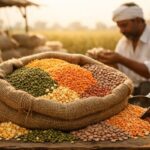 Lentils Market: Indian Moong Overhang Meets Soft but Stable Global Demand
 Lentil Market Steady as Indian Black Gram Stays Soft but Well Supplied
 Indian Chickpeas Steady as State Procurement Sets Floor, Imports Cap Upside
 Lentil Market Holds Steady as Indian Green Gram Stocks Cap Upside
 Lentil Market Steady as Indian Green Gram Signals Comfortable Pulse Supply
 Global Lentil Market Steady as Indian Green Gram Signals Structural Oversupply
 Lentil Market Steady as Indian Green Gram Oversupply Caps Upside