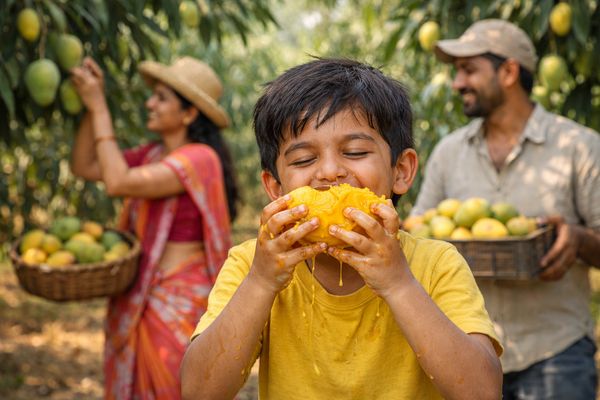
Indian mango exporters are doubling down on premium, lesser-known varieties for Europe and the Gulf just as air-freight costs spike, squeezing margins on fresh shipments. While origin prices for dried mango remain broadly stable in EUR terms, the fresh premium segment is being rationed towards channels able to pay for documented quality, provenance and traceability.
India’s mango value chain is increasingly built around flavour diversity rather than sheer volume. Specialist brands are curating multi-variety programs, aligning specific cultivars with differentiated European consumer preferences and Gulf gifting demand. At the same time, elevated air-cargo rates and domestic logistics bottlenecks are the key constraints to scaling this premium niche over the next 3–12 months.
Exclusive Offers on CMBroker

Mango dried
chunks: : 2 – 3 cm. Thickness: 2 mm. – 15 mm MOISTURE 13 – 19 %
FOB 5.60 €/kg
(from VN)

Mango dried
slices: 5 – 9 cm. Chunks: : 2 – 3 cm. Thickness: 2 mm. – 15 mm
FOB 5.80 €/kg
(from VN)

Mango dried
normal sugar, 8-10 mm
FCA 4.55 €/kg
(from NL)
📈 Prices & Market Structure
In the UAE, retail prices for premium Indian mangoes currently sit around 60–80 AED/kg, equivalent to roughly 15–20 EUR/kg depending on the exchange rate. These levels confirm that only high-income consumers and top-end retailers can absorb the full landed cost of air-freighted, quality-certified fruit. In Europe, speciality buyers in markets such as Germany are reported to accept a clear premium for documented origin and variety, though price points vary by channel rather than being commoditised.
By contrast, dried mango offers are stable, indicating no acute cost-push in the processed segment. Recent export quotations show Vietnamese FOB Hanoi prices for conventional dried slices and chunks around 5.6–5.8 EUR/kg and Thai product ex-warehouse Netherlands near 4.6–4.7 EUR/kg, broadly in line with latest offer data and evidencing flat week‑on‑week development. This stability provides buyers with a relatively low-volatility hedge against fresh-market freight shocks.
| Product | Origin / Location | Incoterm | Latest price (EUR/kg) | 1–3 week change |
|---|---|---|---|---|
| Dried mango slices/chunks | Vietnam / FOB Hanoi | FOB | 5.60–5.80 | Flat to -0.05 |
| Dried mango, normal sugar | Thailand / NL stock | FCA | 4.55 | +0.05 |
| Fresh premium Indian mango (retail) | UAE | Retail | ~15–20 | High, freight-driven |
🌍 Supply, Demand & Variety Strategy
India’s mango harvest progresses along a south–north corridor, starting in Kerala with Banganapalle and Sindhura, then moving through Uttar Pradesh with Dashahri and Langda later in the season. This geographic staggering allows exporters to curate a long calendar of distinct flavour profiles within one marketing year. Premium-focused operators are now using this corridor to assemble portfolios of 14–25 varieties, far beyond the traditional Alphonso and Kesar focus.
European demand is increasingly segmented by country. German buyers prefer larger fruits with balanced sweetness, while French customers value juiciness and soft texture over size. Exporters respond by matching cultivars such as Banganapalle, Rasalu, Langda, Chausa or Amrapali to market-specific preferences, positioning them against established competitors from Peru, Mexico and Pakistan. For many high-end European and Gulf consumers, curated variety boxes are their first exposure to lesser-known Indian cultivars, and initial feedback suggests flavour can overcome unfamiliar skin colour and shape.
📊 Logistics, Costs & Weather Risks
Air freight is the dominant cost driver for the fresh premium mango trade this season. Reported freight rates on India–Europe routes are approximately 2.5 times last year’s levels, significantly compressing exporter margins and forcing a focus on channels with the highest willingness to pay. Additional pressure stems from domestic road infrastructure: a 500 km journey can take up to 12 hours instead of six, raising the risk of temperature excursions and quality losses without full cold-chain coverage.
Leading exporters mitigate these risks through APEDA-certified packhouses, vapour-heat or hot-water treatment to meet European and Gulf phytosanitary standards, and end-to-end refrigerated transport inside India. Advanced on-pack QR‑code systems provide variety, origin, farmer name, harvest date and maximum residue level details, aligning with the growing European emphasis on traceability and food storytelling. In the short term, however, elevated air-cargo rates globally and ongoing capacity constraints in some long-haul corridors remain the key bottleneck for volume growth in premium mango exports.
Weather-wise, India faces a mixed outlook for May 2026. Meteorological guidance points to above-normal rainfall nationwide but also heightened heat-stress risks in key fruit-growing regions, with potential flower and fruit drop in sensitive crops like mango. This combination of intermittent heatwaves and heavy showers can increase quality variability, making robust packhouse selection and rapid cold-chain handling even more critical to maintain export-grade standards.
🧭 Trading & Procurement Outlook (30–90 days)
- Fresh premium segment: Expect continued tightness in high-quality air-freighted Indian mangoes into Europe and the Gulf as long as freight rates remain at current elevated levels. Volumes are likely to be rationed towards gourmet retailers, Feinkost channels and direct-to-consumer platforms willing to support price points above ~15 EUR/kg equivalent.
- Processed / dried segment: With origin prices for dried mango in Vietnam and Thailand stable and modest recent upticks already absorbed, near-term price risk looks limited. Buyers with exposure to fresh-driven supply disruptions may use dried mango contracts as a cost-stable component in mango-based ingredient portfolios.
- Variety-led opportunities: Importers able to educate retailers and consumers about varieties such as Banganapalle, Rasalu, Langda, Chausa and Amrapali can lock in differentiated shelf offerings and better margins. Multi-variety gift packs and curated tasting concepts in the Gulf and continental Europe remain a promising growth niche.
- Risk management: For fresh programs, securing air-freight capacity early and insisting on full cold-chain and traceability documentation is essential. In-season, buyers should be prepared to adjust variety mix if weather-related quality issues arise in specific regions along India’s south–north harvest corridor.
📆 Short-Term Directional View (3 days)
- Fresh premium Indian mango, Europe speciality retail: Prices in EUR are expected to remain firm to slightly higher as freight and capacity constraints persist and as more niche varieties arrive into season.
- Fresh premium Indian mango, UAE retail: High price levels around the equivalent of 15–20 EUR/kg are likely to hold, with limited downside given strong gifting demand and elevated logistics costs.
- Dried mango (Vietnam, Thailand, Europe stock): EUR-denominated offers should stay broadly stable over the next three days, with only marginal adjustments possible as freight and FX noise filters through.