
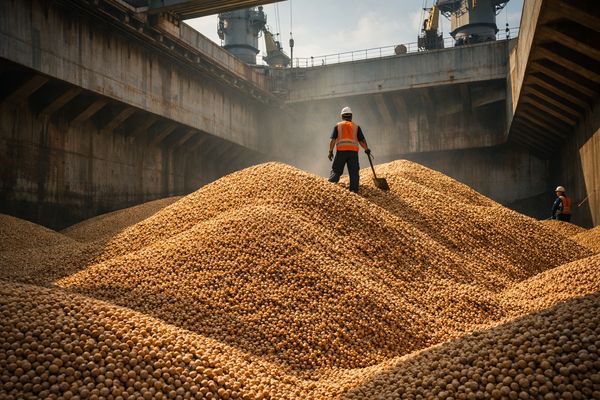
Domestic chickpea prices in India have eased slightly but are now approaching a policy-backed floor, with government procurement and shrinking yellow pea imports limiting further downside. Nearby, the market looks set to consolidate in a relatively tight range, with a modest upside bias into June as arrivals fade and processors pivot back toward chickpeas.
India’s wholesale chickpea market has softened on lighter buying from dal mills, pushing Delhi spot values modestly lower, yet selling pressure is fading as traders recognize the downside protection from active state procurement and prices already sitting below the official support level. Import flows, especially of yellow peas, are becoming less competitive, which should gradually redirect demand toward domestic chickpeas. Against this backdrop, export prices from India and Mexico are broadly steady, and near‑term weather in key Indian belts appears seasonally typical, suggesting fundamentals rather than weather shocks will dominate pricing for the coming weeks.
Exclusive Offers on CMBroker

Chickpeas dried
count 75-80, 8 mm
FOB 0.79 €/kg
(from MX)

Chickpeas dried
count 42-44, 12 mm
FOB 1.20 €/kg
(from MX)

Chickpeas dried
count 58-60, 9 mm
FOB 0.93 €/kg
(from IN)
📈 Prices & Spreads
In Delhi’s wholesale markets, Rajasthan-origin desi chickpeas slipped by about 25 rupees per quintal on Tuesday to roughly EUR 0.64–0.65 per kg, while Madhya Pradesh-origin lots traded around EUR 0.63–0.64 per kg, with Jaipur-line material at similar levels (using an approximate rate of 1 EUR = 90 INR). Domestic producing centers in Madhya Pradesh and Rajasthan remain below the Minimum Support Price (MSP) of 5,875 rupees per quintal, equivalent to about EUR 0.72 per kg, underscoring that physical spot markets are trading under the government’s price floor.
On the import side into India, Australian chickpeas for May–June container shipments are quoted around EUR 0.58–0.59 per kg CIF, with bulk vessel shipments near EUR 0.54 per kg, while Tanzania-origin containers are hovering close to EUR 0.55 per kg. Yellow peas from Canada, a key substitute, face a 30% import duty and a weaker rupee, pushing landed costs up to roughly EUR 0.52–0.53 per kg against domestic yellow pea prices of about EUR 0.50–0.51 per kg, narrowing the arbitrage.
📊 Export Offers Snapshot (Indicative)
| Origin / Type | Location / Term | Latest Price (EUR/kg) | Move vs. Prev. |
|---|---|---|---|
| India, 42–44 ct, 12 mm | New Delhi, FOB | ≈ 1.10 | Flat since 2 May |
| India, 58–60 ct, 9 mm | New Delhi, FOB | ≈ 1.03 | Flat since 2 May |
| Mexico, 42–44 ct, 12 mm | Mexico City, FOB | ≈ 1.35 | Flat since 2 May |
| Mexico, 75–80 ct, 8 mm | Mexico City, FOB | ≈ 0.89 | Flat since 2 May |
Export indications from India and Mexico in early May are broadly steady compared with late April, with only marginal adjustments across grades and sizes. This aligns with broader international chickpea pricing, which shows stable Kabuli quotes in North America and other origins at the start of May, pointing to a consolidating global market rather than a directional break.
🌍 Supply, Demand & Policy Support
Indian dal processors have temporarily scaled back aggressive buying, leading to the recent 25-rupee decline in Delhi spot prices, but this appears more a short-term adjustment than the start of a deeper sell‑off. Market participants report that selling interest at lower levels is waning, with traders increasingly wary of pushing prices too far below the MSP when state agencies are actively procuring. More than 600,000 tonnes of chickpeas have already been purchased at support levels nationwide this season, anchoring farmer returns and tightening free-market supply.
Policy signals remain clearly supportive: New Delhi has extended Maharashtra’s procurement window by 30 days to 29 May 2026 and raised the state’s procurement ceiling to nearly 820,000 tonnes, reinforcing the government’s resolve to defend producer incomes. At the same time, a 30% import duty on yellow peas and a soft rupee have squeezed the landed cost advantage of this competing pulse, curbing new import bookings and nudging millers back toward chickpeas as a more economical protein source in the months ahead.
Arrivals of the new chickpea crop in key producing markets are expected to taper after mid‑May, reducing spot pressure just as government stocks build. The imminent arrival of a Canadian vessel carrying over 74,000 tonnes of pulses, including more than 28,000 tonnes of yellow peas, into Hazira port on 6 May 2026 will add some short‑term supply, but the reduced import incentive suggests follow‑up shipments could be more measured, limiting any sustained bearish impact on chickpea demand.
🌦️ Weather & Crop Conditions
Weather across India’s northern and central belt, including Delhi and Rajasthan, has recently turned cooler with showers, thunderstorms, and gusty winds, easing the late‑April heatwave and supporting stored pulse quality in the near term. Forecasts indicate further scattered rainfall and storms across North India, including Rajasthan, through around 9–11 May.
For May as a whole, India’s meteorological outlook points to above‑normal rainfall but a mixed temperature pattern, with some regions facing additional heatwave days even as others see relief. Critically for the main chickpea belts of Madhya Pradesh and Rajasthan, expectations are for near‑normal to slightly lower heatwave frequency than usual, combined with seasonally warm, mostly dry pre‑monsoon conditions in the coming week. This suggests limited immediate weather risk to already‑harvested chickpeas, while preparing the ground for the upcoming Kharif season rather than altering current Rabi pulse availability.
📊 Market Fundamentals & Outlook
Structurally, the convergence of sub‑MSP domestic prices, robust public procurement, and diminishing yellow pea import competitiveness creates a supportive base for chickpeas over the next one to two months. With more than 600,000 tonnes already absorbed by state agencies and Maharashtra’s enlarged procurement quota still to be filled, a significant share of the crop is being taken off the free market at guaranteed prices, reducing downside pressure.
On the demand side, dal mills are likely to gradually increase chickpea usage as the landed cost of yellow peas rises relative to domestic alternatives, especially given the 30% duty and currency drag. The scheduled arrival of a large Canadian pulse vessel provides some short‑term competition but is unlikely to fully offset the narrowing price gap and policy‑driven preference for domestic pulses. Overall, traders widely expect prices to consolidate in the equivalent of roughly EUR 0.63–0.69 per kg (about USD 57–62 per quintal) over the next two to three weeks, with a moderate upside skew into June once arrivals slow decisively.
📆 Trading & Risk Management Guide
- For importers and dal mills: Use current price softness in Delhi and producing centers to secure nearby physical coverage, especially if your demand profile allows for substitution away from yellow peas. Consider layering purchases rather than front‑loading, as the market is more likely to grind higher than collapse from current sub‑MSP levels.
- For exporters (India & Mexico): With FOB prices broadly stable and India’s MSP underpinning domestic values, focus on maintaining competitiveness through freight optimization and grade differentiation rather than aggressive price cuts. Monitor currency moves and freight rates, which could quickly alter relative export attractiveness versus Australia, Canada, and Tanzania.
- For farmers and stockholders in India: The extended procurement window and higher caps in Maharashtra argue for disciplined selling; avoid panic liquidation below MSP where procurement options are available. For those without direct access to procurement channels, staggered sales into any pre‑monsoon dips may help capture potential June firmness as arrivals decline.
📍 3‑Day Directional Price View (EUR)
- India – Delhi wholesale desi chickpeas: Sideways to mildly firmer; expected to trade roughly in the EUR 0.63–0.66 per kg band as selling at lows remains limited and procurement underpins sentiment.
- India – FOB New Delhi export grades: Largely steady around current EUR 0.95–1.10 per kg range across main size counts, with only marginal day‑to‑day adjustments tied to freight and FX.
- Mexico – FOB Mexico City Kabuli chickpeas: Steady, maintaining a premium to Indian supplies around EUR 0.89–1.35 per kg depending on size; no major weather or policy shocks expected in the next few days to disturb this structure.
Related posts:
 Indian Chickpea Price Weakness Creates Timely Buying Window for Europe
 Chickpeas Edge Higher as Indian MSP Buying Tightens Near-Term Supply
 Indian Chickpea Prices Ease Slightly as Heat Builds Into May
 Indian Chickpea Squeeze Sets Bullish Tone for Global Market
 Chickpeas: Indian Market Trapped Between MSP Floor and Import Ceiling
 Indian Chickpea Prices Edge Higher as Heatwave Looms Over North India
 Indian Pigeon Peas Under Government Floor While EU Pea Prices Ease
 Indian Chickpeas Steady as State Procurement Sets Floor, Imports Cap Upside