
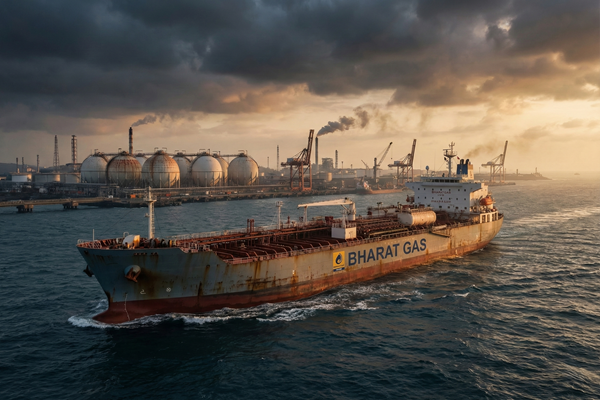
India is scrambling to secure liquefied petroleum gas (LPG) supplies from the United States after the closure of the Strait of Hormuz disrupted shipments from the Middle East, the country’s primary source of LPG imports.
While U.S. cargoes could partially offset the supply gap, analysts say the alternative comes with higher logistics costs and longer transit times, potentially increasing domestic fuel prices and pressuring the finances of India’s oil marketing companies (OMCs).
Heavy Dependence on Middle East LPG
India relies heavily on West Asian suppliers for LPG imports, with the region accounting for 85–90% of the country’s supply.
Most of these shipments pass through the 34-kilometer-wide Strait of Hormuz, one of the world’s most critical energy chokepoints.
According to Vortexa, the Middle East Gulf region — excluding Iran — supplied about 92% of India’s LPG imports in 2025, equivalent to roughly 720,000 barrels per day.
The blockade of the strait has therefore created immediate concerns about the availability of cooking gas supplies in the country.
US Cargoes May Only Partially Fill the Gap
Analysts believe the United States could step in as an alternative supplier, but only to a limited extent.
According to Anna Zhminko, associate market analyst at Vortexa, the U.S. Gulf Coast (USGC) could supply replacement cargoes if disruptions persist.
U.S. LPG exports reached a record 2.34 million barrels per day in January, supported by strong natural gas liquids production and expanded export infrastructure.
However, transporting LPG from the United States to India would take longer and involve higher freight costs.
The situation is further complicated by the weak Indian rupee against the U.S. dollar, which raises the cost of imported energy.
Shipping Disruptions and Price Volatility
Maritime consultancy Drewry expects that no LPG cargoes will be loaded from the Middle East in the near term, as vessels avoid the Strait of Hormuz due to security risks.
The consultancy forecasts that:
-
U.S. LPG exports to Asia will increase in the short term
-
Global LPG prices are likely to rise sharply
-
Shipping markets may experience short-term vessel shortages
Many very large gas carriers (VLGCs) operating near the strait have reportedly been idled or moved to safer locations.
Drewry also notes that nearly 40% of global LPG supply passes through the Strait of Hormuz, making any prolonged disruption highly disruptive for major importers such as India and China.
Household Energy Supply at Risk
The supply disruption is particularly concerning for India because LPG is the country’s primary cooking fuel.
Around 90% of LPG consumption is used by households, and India currently has approximately 33.08 crore active domestic LPG consumers.
This includes 10.51 crore beneficiaries under the government’s PM Ujjwala Yojana (PMUY) program, which provides subsidized cooking gas to low-income households.
India also lacks strategic LPG reserves, increasing the urgency of securing replacement cargoes.
Pressure on Oil Marketing Companies
Rising LPG import costs could significantly affect the profitability of India’s oil marketing companies, including Indian Oil, Bharat Petroleum, and Hindustan Petroleum.
Higher import prices would increase under-recoveries, the gap between retail prices and the actual cost of supplying LPG.
This financial pressure could force either government subsidies or price adjustments.
US Political Incentives
A senior government official noted that Washington also has strong incentives to stabilize energy markets.
With U.S. midterm elections scheduled this year, the Biden administration — and particularly President Donald Trump — is under pressure to prevent energy prices from rising.
Keeping global oil and gas markets stable is therefore in the political interest of the United States, which could support increased exports to Asia.
Outlook
If the Strait of Hormuz remains closed or partially disrupted, India may increasingly rely on U.S. LPG shipments, despite higher costs and longer supply routes.
However, analysts warn that replacement cargoes from the United States can only partially compensate for the massive supply volumes normally delivered from the Middle East, leaving India exposed to continued market volatility.