
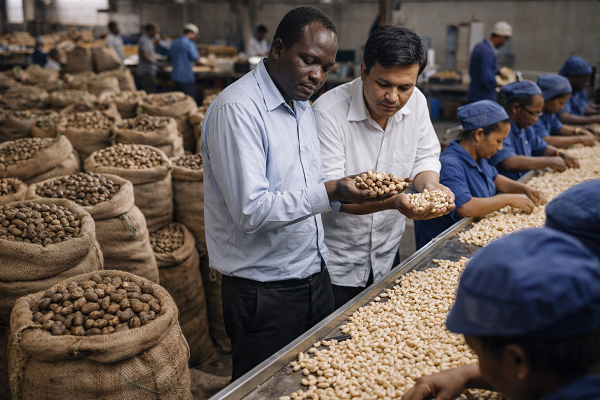
The global cashew market is facing rising uncertainty as weaker crop quality across several West African origins, elevated raw cashew nut (RCN) prices and escalating tensions in the Middle East continue to unsettle traders, processors and buyers.
According to the latest market updates, crop performance in many West African countries appears weaker than last season in both quantity and quality, while buyers in major kernel markets are slowing purchases as they assess the impact of freight disruptions, unstable currencies and uncertain demand.
Market participants say the Iran-Israel-US conflict is dampening sentiment across the trade, with concerns that higher freight rates, higher fuel costs and shipping disruptions could further pressure the already fragile balance between raw material costs and kernel selling prices.
West African crop outlook weakens
The latest cashew newsletter says that in almost all Western African countries, the new crop appears weaker than last season in both quality and quantity, a trend that is already influencing trader behaviour and procurement strategy.
In Issue 09, the report had already flagged quality concerns in origins such as Ghana and Côte d’Ivoire, while noting that some governments in West Africa had begun tightening export rules or imposing levies to protect local processing.
This means the global market is not only dealing with weather and harvest uncertainty, but also with policy actions that may restrict export flows or delay shipments.
Guinea-Bissau starts campaign with same farmgate price
The 2026 cashew marketing campaign in Guinea-Bissau is set to begin on March 12, with the minimum producer price for raw cashew nuts fixed at 410 CFA francs per kilogram, unchanged from the 2025 season. Production for the new campaign is estimated at 250,000 to 270,000 tons.
Harvesting has already started in the interior regions, and small-scale transactions have begun. However, traders are still uncertain about how the Middle East conflict could affect international cashew prices and buying activity, especially because the region remains an important consumer market for cashews.
Côte d’Ivoire faces lower outturn and quality concerns
In Côte d’Ivoire, processors remain very active in the market and have reportedly asked the government to postpone exports until the end of March so they can secure additional raw material for local factories. Early crop arrivals are showing lower outturn compared to previous years, and the second crop still remains uncertain.
The latest indications show export offers for RCN with KOR between 47 and 50 lbs and nut counts of 190–200 at around $1,500–$1,550 per metric ton CNF for shipment in late March or early April. Processor buying prices are reported at 470–500 FCFA per kg at factory level.
Issue 09 gave a similar warning, noting that local processors were the only active buyers on the ground and that delivered prices to Abidjan were around CFA 484 per kg, with moisture at 7–8%, outturn at 46–47 lbs, and nut count around 190/kg. It added that very hot weather was producing lighter kernels and reducing the outturn compared with previous crops.
Ghana second crop begins, but supply still limited
In Ghana, the second crop campaign is now underway across the Bono Region, with buying activity gradually returning to collection points. Farmgate prices in Techiman opened at GHS 10/kg, while cash-and-carry transactions were reported at GHS 11.50–12/kg. KOR levels were reported at 44–46 lbs with moisture around 17%.
In Wenchi, prices were similar, though available quantities remained limited. In Drobo and Sampa, farmgate prices were about GHS 12/kg and cash-and-carry trades were around GHS 13/kg, with KOR levels at 46–48 lbs and moisture improving to 15–16%.
Issue 09 had already highlighted that foreign buyers were highly active in Ghana, especially in Techiman, Kwameseikrom, Drobo and Sampa, where quality varied sharply by region and much of the trade was being pre-financed by foreign exporters.
Nigeria market active but exporters stay cautious
In Nigeria, the market appears active, but exporters remain cautious because current prices are considered too high for comfortable export economics. Dry RCN is being offered at around ₦1,500,000 per metric ton in Ilorin, ₦1,700,000 in Saki and ₦1,800,000 in Ogbomosho, while farmgate levels in Ogbomosho are around ₦1,650,000 per metric ton. KOR is generally between 47 and 49 lbs.
The first crop harvest is nearly over, with about 60,000 tons having arrived so far. The second crop is expected soon and could exceed 200,000 tons, with the overall 2026 crop currently estimated at 260,000–270,000 tons, below the normal range of 300,000–320,000 tons.
That lower crop estimate is one of the reasons exporters are hesitant to expect any major correction unless second-crop arrivals improve sharply.
Togo and Burkina Faso tighten market controls
Issue 09 also showed that Togo and Burkina Faso have introduced measures that could restrict trade flows. Togo launched its 2026 season with a farmgate floor price of 350 CFA per kg, down from 425 CFA/kg last year, and imposed an export levy of 100 CFA/kg on cashew nuts. It also introduced a four-week moratorium that restricts shipment from production zones to Lomé unless part of the volume is delivered to local processors.
In Burkina Faso, the government maintained the minimum farmgate price at 385 CFA/kg and temporarily suspended exports for 40 days from February 21 to April 1.
These policy steps add another layer of tightness to an already uncertain African supply picture.
Vietnam and Cambodia crop watched closely
In Asia, early indications suggest the crop is good in Cambodia, but the market remains worried about the second crop in both Vietnam and Cambodia because of recent early rainfall. If rains continue, the newsletters warn that crop quality and outturn could decline, kernel colour could be affected and insect development on trees could hurt raw seed quality. Market participants expect a clearer picture within two to three weeks.
Issue 09 had also noted that the harvest had started and that the first crop looked normal, but early rains were creating uncertainty for the main second crop. It said the staggered flowering pattern this season may spread supply more evenly, reducing the chance of a sudden seasonal price collapse.
RCN offers remain high despite weaker outturn
One of the biggest concerns in the market is that RCN offers are still elevated even though outturn is lower and crop quality is patchy. The latest Vietnam section reports the following indicative CNF HCM prices: IVC 48/200 at $1,520–1,550/MT, Benin (Shaki) 50/175 at $1,650/MT, Ogbomosho 50/175 at $1,650/MT, and Kankan (Conakry) 45/185 at $1,440/MT.
Issue 09 showed a similarly firm structure, with African offers such as IVC 48/200 at $1,550/MT, Benin (Shaki) 51/175 at $1,680/MT, Ogbomosho 51/170 at $1,680/MT, Kogi (Nigeria) 49/195 at $1,515/MT, Boke 50/200 at $1,600/MT, and Kankan 45/185 at $1,390/MT. It noted that at these raw material costs, implied kernel prices after processing were around 15–20 cents/lb above buyers’ workable levels.
That mismatch is one of the core reasons many processors and kernel buyers are reluctant to commit aggressively.
Kernel buyers wait as freight risk grows
The newsletters say many kernel buyers are currently in wait-and-watch mode. Buyers in the EU and the US do not expect prices to rise much further, even though they recognise that raw nut costs are high. At the same time, ongoing conflict in the Middle East has made ocean freight rates unstable, and both buyers and sellers are closely monitoring the war’s impact on logistics and final prices.
Issue 09 had already reported that kernel trade improved after Tet, led mainly by North American demand, while Europe and Australia returned more slowly and China remained relatively quiet. It also said current offers were 3–5 cents/lb higher week-on-week because processors were resisting lower bids after having bought costly raw material.
Cashew kernel prices stay firm
Current export kernel indications from the latest newsletter are: W180 at $3.88–4.15/lb, W210 at $3.60–3.70/lb, W240 at $3.20–3.40/lb, W320 at $3.00–3.25/lb, SW/LBW320 at $2.60–2.80/lb, WS at $2.52–2.65/lb, LP at $1.95–2.10/lb and SP at $1.40–1.45/lb.
Issue 09 showed similar price bands, confirming that the kernel market has remained broadly firm even as buyers turn more selective.
The chart section in both newsletters also shows that Vietnam FOB kernel prices for W240 and W320 have been relatively steady in recent weeks, while lower grades such as LP and WS remain firm.
Vietnam trade data shows stronger flows
Vietnam’s export-import data also points to strong activity. In February 2026, Vietnam’s cashew kernel exports totalled 24,231 tons at an average price of $6,485 per ton, while in the first two months of 2026 kernel exports reached 74,888 tons at an average of $6,857 per ton. Vietnam’s RCN imports during February totalled 154,906 tons at an average price of $1,641 per ton, and cumulative RCN imports for the first two months reached 285,975 tons at an average price of $1,633 per ton.
Issue 09 had similarly reported stronger early-2026 flows compared with the same period a year earlier, reinforcing the view that processors are still buying and shipping despite the difficult margin environment.
India market remains steady but rupee weakness adds pressure
In India, the rupee has weakened sharply, and the newsletter says it touched an all-time low of 92.53 against the dollar before settling around 91.93 for the week ended March 6. The report warns that the rupee may remain under pressure because of the Middle East war, rising crude oil prices and foreign investor selling.
This matters because imported RCN becomes more expensive when the rupee weakens. The newsletter says current imported RCN offers for India are around $1,510–1,520 per ton CNF for IVC 48 lbs and $1,560–1,570 per ton CNF for Nigerian 48 lbs. Local Indian RCN prices remain in the range of ₹155 to ₹175 per kg across Kerala, Goa and Maharashtra.
Issue 09 added that local arrivals in India were expected to increase significantly in coming weeks and that prices could soften by the first half of April if supply improves.
Domestic kernel prices mostly stable
Domestic kernel prices in India remain mostly stable, though some markets are softer and demand is described as slow to normal depending on region. According to the production-centre table in the latest issue, Kollam prices were ₹992/kg for W180, ₹860/kg for W210, ₹816/kg for W240 and ₹772/kg for W320, while Panruti quoted ₹980/kg for W180, ₹920/kg for W210, ₹840/kg for W240 and ₹790/kg for W320. In Palasa, W180 was ₹900/kg, W210 ₹830/kg, W240 ₹780/kg, and W320 ₹730/kg.
At the Mumbai terminal market, the newsletter shows W180 at ₹1,300/kg, W210 at ₹1,080/kg, W240/S240 at ₹960/860, W320 at ₹860 and SWP at ₹720/kg.
U.S. cashew imports fall sharply
The newsletter also highlights weaker U.S. demand. It says the United States ended 2025 with a 28.72% decline in cashew kernel imports, with total imports falling to 125,753 MT from 176,423 MT in 2024. Vietnam remained by far the largest supplier with 110,802 MT, accounting for 88.11% share.
That decline in U.S. imports is another reason why exporters are cautious about assuming strong global demand can absorb high raw nut prices indefinitely.
Freight and shipping risks continue to dominate sentiment
One of the biggest missing pieces in normal price discovery right now is freight. The newsletters repeatedly warn that the Middle East conflict may push up freight rates and fuel costs and undermine buying confidence if trade routes remain disrupted. Issue 09 explicitly said shipping rates may spike because of rerouting and longer transit times.
The latest issue goes further, saying the Strait of Hormuz is closed for operations and that most shippers are skipping the route in favour of alternatives, while crude oil has spiked sharply.
For the cashew trade, that means higher logistics costs may arrive at the same time that raw material costs are already elevated and buyers are still resisting higher kernel offers.
Market outlook
The global cashew market is now caught between tight and uncertain raw material supply, firm but fragile kernel prices, cautious buyer behaviour, and geopolitical freight risk. West African crop quality remains under scrutiny, Vietnam and Cambodia still need clearer weather conditions, and importers are waiting for a better read on both demand and shipping costs.
Unless African arrivals improve meaningfully or freight conditions stabilise, traders expect the market to remain volatile in the near term. At the same time, if buyers continue delaying purchases for too long while crops underperform, the market could quickly tighten again.