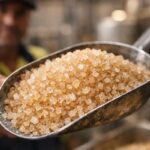
Indian sugar and jaggery prices in Muzaffarnagar are firming on thin arrivals and strong seasonal demand from the wedding season, while European refined sugar offers in EUR remain broadly stable with a mild upward bias.
Across north India, the peak wedding calendar is tightening the availability of jaggery and supporting sugar prices just as sugarcane crushing winds down, giving mills more pricing power. In contrast, recent offers for refined sugar in Europe are steady in a narrow EUR 0.43–0.57/kg range, suggesting that current Indian firmness is driven more by domestic seasonality than by a structural global supply squeeze.
[cmb_offer ids=996,997,995]
📈 Prices & Local Market Tone
In Muzaffarnagar, jaggery laddoo prices rose by about $0.30–$0.35 per 40 kg to roughly $21.58–$21.89 per 40 kg, while chakka grade held at $19.52–$21.28 per 40 kg and Rajkot-origin jaggery traded near $20.40–$20.52 per 40 kg. Sugar prices in the same wholesale market firmed by $0.18–$0.30 per 100 kg, reaching around $21.40–$21.57 per quintal, as mills maintained firm offers and resisted discounting.
Arrivals of jaggery are estimated at only about 3,000 quintals, a thin flow for a key hub like Muzaffarnagar. This tight physical availability interacts with robust festival and wedding-season demand, producing outsized price reactions to even small shifts in supply. Market participants report that buyers have limited room to negotiate, with both sweet-makers and traders accepting higher levels to secure coverage.
🌍 Supply, Demand & Seasonality
The main driver is a classic seasonal demand spike: the north Indian wedding season sharply lifts consumption of dairy-based sweets and confectionery, which rely heavily on both sugar and jaggery. At the same time, demand for liquid milk and processed dairy products has jumped, indirectly supporting sugar usage through the sweets value chain and tightening overall sweetener balances at the local level.
On the supply side, Muzaffarnagar is approaching the tail end of the sugarcane crushing season, leading to reduced jaggery production and weaker arrivals. With fewer fresh lots entering the market, jaggery manufacturers and sweet-makers are actively competing for available stocks. This competition, against a backdrop of firm mill selling behavior in sugar, underpins the current firmness and limits downside risk in the immediate term.
📊 Link to Global & European Sugar Market
India remains the world’s largest sugar producer, and domestic price patterns are closely watched by global traders. However, the current firmness in Muzaffarnagar stems primarily from a well-known seasonal demand pulse and localized supply tightness, not from an abrupt structural deficit. Government-administered pricing mechanisms and export policies still dominate India’s broader sugar balance and international trade flows.
In Europe, refined sugar offers in late April show a stable to slightly firmer pattern. Representative FCA offers in the EU and UK cluster around EUR 0.43–0.47/kg for ICUMSA 32–45 granular sugar from Lithuania, Czech Republic, Ukraine and the UK, with premium German origin around EUR 0.57/kg. This indicates relatively calm physical conditions in Europe, with incremental price increases but no sign of a sharp supply shock filtering through from India.
| Region / Origin | Product | Location | Price (EUR/kg, FCA) | 1-week change (EUR/kg) |
|---|---|---|---|---|
| EU (LT) | Sugar granulated ICUMSA 45 | Mirijampole | 0.43–0.44 | ≈ 0.00 |
| EU (CZ/UA/DK) | Sugar granulated ICUMSA 45 | Vyškov / Vinnytsia | 0.44–0.47 | +0.01 to +0.02 |
| EU (DE) | Sugar granulated ICUMSA 45 | Berlin | 0.57 | +0.02 |
| UK (GB) | Sugar granulated ICUMSA 32–45 | Norfolk | 0.46 | ≈ 0.00 |
📆 Short-Term Outlook
Over the next two to four weeks, jaggery and sugar prices in Muzaffarnagar are likely to remain firm. The wedding season demand window is still in full swing, and sugarcane crushing is winding down, so arrivals should stay relatively thin. Unless mill selling behavior turns more aggressive or government policy changes pricing or trade parameters, the market is biased toward consolidation at elevated levels rather than a quick correction.
A meaningful downside adjustment in jaggery would likely require a pronounced rebound in arrivals, perhaps from stock releases or unexpectedly extended production. For sugar, a policy-driven move on ex-mill prices or export availability would be the main trigger for softer domestic levels. For now, local fundamentals are aligned in favor of sellers, especially in premium jaggery grades used intensively by confectioners.
🧭 Trading & Procurement Recommendations
- Indian buyers (wholesale & retail): Consider covering near-term jaggery and sugar needs promptly, as continued wedding-season demand and tight arrivals reduce the likelihood of short-term price relief.
- Jaggery and sweet manufacturers: Prioritize inventory planning for the next 2–4 weeks; staggered purchases may help manage cash flow, but waiting for lower prices carries clear upside risk in the current environment.
- European industrial users: Use the relative stability of EUR-denominated refined sugar offers to lock in a portion of Q2–Q3 requirements, while monitoring Indian policy signals rather than day-to-day seasonal moves in Muzaffarnagar.
- Traders and risk managers: Treat the current Indian firmness as a seasonal feature rather than a structural bullish signal, but stay alert to any shift in Indian export policy or mill pricing that could tighten global availability later in the year.
📍 3-Day Directional Outlook (in EUR terms)
- Muzaffarnagar, India (domestic equivalent): Jaggery and sugar prices expected to hold firm with a mild upward bias as wedding-season demand persists and arrivals stay light.
- Continental Europe (FCA refinery/ex-warehouse): Refined sugar likely to remain in the EUR 0.43–0.47/kg band for mainstream origins, with premiums such as German origin stable to slightly firmer around EUR 0.57/kg.
- UK & nearby markets: Offers around EUR 0.46/kg are expected to stay broadly unchanged over the next few days, barring currency or freight shocks.
[cmb_chart ids=996,997,995]