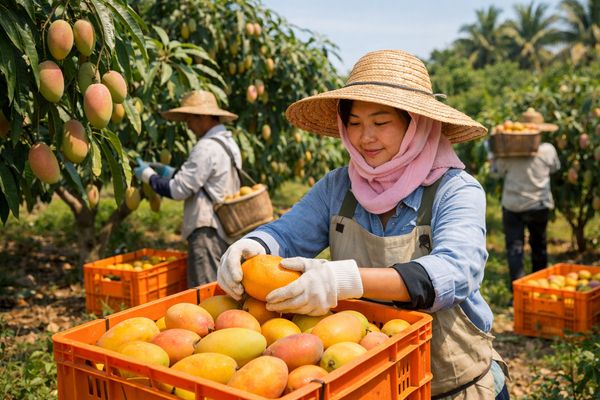
Tainan’s 2026 mango campaign centers on direct sea-shipped Irwin mangoes to Japan and a new ultra-sweet “champagne mango” for Taiwan, reinforcing the city’s position in premium, provenance-driven fruit. Near-term price impact is modest, but differentiation and shorter supply chains strengthen Taiwan’s competitiveness in Japan’s high-value mango segment.
Taiwan’s Yujing District in Tainan is leveraging its status as a key mango hub to deepen ties with Japanese consumers and retailers. A pre-order model via Breeze Super consolidates demand and allows a single, cost-efficient sea shipment, with Yamato Transport handling final-mile delivery in Japan. At the same time, the domestically focused champagne mango, with higher sugar levels and a terroir story, seeks to command a premium in Taiwan and potentially open future export channels. Against a backdrop of firm Japanese demand for traceable high-quality fruit, this strategy tilts the balance toward value growth rather than sheer volume.
Exclusive Offers on CMBroker

Mango dried
chunks: : 2 – 3 cm. Thickness: 2 mm. – 15 mm MOISTURE 13 – 19 %
FOB 5.60 €/kg
(from VN)

Mango dried
slices: 5 – 9 cm. Chunks: : 2 – 3 cm. Thickness: 2 mm. – 15 mm
FOB 5.80 €/kg
(from VN)

Mango dried
normal sugar, 8-10 mm
FCA 4.55 €/kg
(from NL)
📈 Prices & Premium Positioning
The current Tainan initiative targets premium fresh mango rather than bulk commodity trade, so no direct price benchmarks were disclosed. However, the sea-freight model to Japan should support more competitive retail pricing versus air-freighted alternatives while preserving freshness. The champagne mango’s higher Brix and labor-intensive cultivation justify a price premium in domestic channels.
In processed segments, dried mango offers from Vietnam and Thailand remain broadly stable, providing a floor to global mango valuations. Indicative offers for dried mango currently cluster between roughly EUR 4.5–5.8/kg FCA/FOB, underlining that the main upside in the Tainan strategy lies in fresh premium branding rather than bulk price moves.
| Product | Origin | Location / Terms | Latest Price (EUR/kg) | 1–3 Week Change (EUR/kg) |
|---|---|---|---|---|
| Dried mango, chunks | Vietnam | Hanoi, FOB | 5.60 | 0.00 |
| Dried mango, slices/chunks | Vietnam | Hanoi, FOB | 5.80 | 0.00 |
| Dried mango, normal sugar | Thailand | Dordrecht, FCA | 4.55 | +0.05 |
🌍 Supply & Demand Dynamics
Yujing District remains a core production base, supplying Irwin mangoes that are already well known in Japan. The pre-order channel through Breeze Super shifts demand planning upstream: only fruit with confirmed Japanese buyers is consolidated, reducing over-production risk and post-harvest losses. This direct linkage helps secure a steady, repeatable export flow in the 2026 season.
On the domestic front, the champagne mango introduces a new premium sub-segment rather than expanding total supply. Its extended ripening period and higher sugar content effectively spread the harvest window by 10–30 days, smoothing supply and reducing peak-season gluts. Over time, this could stabilize farmgate prices and allow growers to capture higher unit margins domestically while still supporting export volumes of standard Irwin fruit.
📊 Fundamentals & Quality Differentiation
The new champagne mango variety is designed explicitly for differentiation. With average sweetness around 15° Brix versus 12–13° for standard mangoes, it clearly fits the high-end category. Growers allow fruit to ripen and fall naturally on the tree, then secure each mango in net pouches to avoid ground damage, while reflective panels boost uniform coloration.
These practices are labor-intensive but align closely with Japanese and Taiwanese consumer preferences for visually perfect, traceable fruit. The cooperative’s direct model, backed by city-level relationships with Japanese prefectures, ensures transparent provenance and strengthens the branding narrative. This positions Tainan mangoes against other premium suppliers such as the Philippines, Thailand, and Pakistan not on price alone, but on quality, terroir, and controlled cultivation.
🌦️ Short-Term Outlook (30–90 Days)
In the coming 1–3 months, the 2026 pre-order sea shipment to Japan will gauge whether repeat demand has strengthened after three years of operation. The streamlined logistics via Breeze Super and Yamato Transport reduce intermediaries, improving freshness and customer satisfaction—key metrics for sustaining premium price points in Japan.
Domestically, the champagne mango launch should generate marketing buzz around terroir and sweetness levels, potentially lifting average prices for branded Tainan mangoes. Because the variety extends the harvest window, local markets may see a more evenly distributed flow of premium fruit rather than short, oversupplied peaks, limiting downward price pressure during the main season.
📆 Medium-Term Outlook (6–12 Months)
Over the next 6–12 months, the central question is scalability without quality erosion. The net pouch system, natural ripening, and reflective panels all require skilled labor and close field oversight. If the cooperative manages to scale these practices economically, champagne mangoes could become a flagship example of premium tropical fruit differentiation in Taiwan.
A successful domestic rollout also creates optionality for future export trials of champagne mangoes, especially into Japan’s gift and premium retail channels. With Japanese consumer demand steadily shifting toward traceable, origin-certified produce, Tainan’s model of city-to-city agricultural diplomacy and direct supply chains appears well aligned with structural demand trends rather than short-lived fads.
🧭 Trading & Procurement Outlook
- Fresh importers in Japan: Monitor performance of the 2026 Tainan pre-order shipment. If consumer feedback and sell-through are strong, be prepared for tighter availability and firmer offer levels for premium Irwin mangoes in subsequent seasons.
- Retail buyers in Taiwan: Use champagne mangoes as a category anchor for premium tropical fruit, building narratives around terroir, Brix, and cultivation methods to justify higher shelf prices.
- Industrial and dried-mango buyers: Expect relatively stable raw material availability; current dried mango prices around EUR 4.5–5.8/kg suggest no immediate cost shock, but premium fresh campaigns may gradually redirect top-quality fruit away from processing.
- Producers in competing origins: Consider adopting stronger provenance and traceability branding to defend share in Japan’s high-value mango segment against Tainan’s increasingly structured model.
📉 3-Day Market Indication
- Japan (premium fresh Irwin, retail): Stable to slightly firm in EUR terms, supported by direct shipment and quality positioning.
- Taiwan (domestic premium segment): Firm tone as champagne mango launch underpins high-end pricing and extends premium availability.
- Dried mango (Vietnam, Thailand to EU/Asia): Sideways within roughly EUR 4.5–5.8/kg FCA/FOB over the next three days; no major supply shocks signaled.