
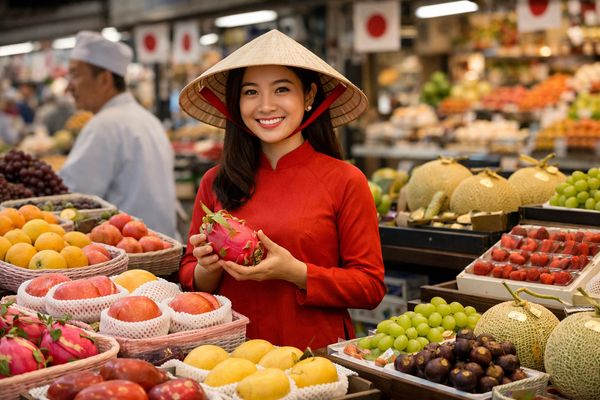
Vietnam is accelerating its push to grow fruit exports to Japan by prioritising strict quality standards, supply reliability, and deeper integration into Japanese value chains, aiming for quality-led rather than volume-driven growth. The strategy targets one of the world’s most demanding but high-value food markets.
Japan’s combination of high income, heavy reliance on food imports, and exacting consumer expectations is reshaping how Vietnamese exporters organise production, post-harvest handling, and branding. The current shift goes beyond simple market access: it is about aligning with Japan’s supply chain diversification, tapping into Japanese investment in Vietnam, and building long-term, trust-based relationships with buyers. The outcome will likely be a more structured, certification-based export model that favours consistent performers, potentially widening the gap between well-capitalised, quality-focused exporters and smaller, less standardised operators.
📈 Market Context & Demand
Japan remains a top-tier consumer market, with around 125 million people and high per capita income supporting sustained demand for premium imported fruit. Roughly 60–65% of Japan’s food consumption is supplied from overseas, ensuring structural import demand and stable long-term opportunities for foreign suppliers.
Within this environment, Vietnamese fruit already has a foothold but competes with established exporters such as those from Latin America, Oceania, and other Asian origins. The key differentiator is shifting from price to reliability and perceived quality, as Japanese buyers favour partners who can provide consistent, traceable, and well-branded products over time.
🌍 Supply, Quality & Supply Chain Strategy
Vietnamese exporters are increasingly restructuring supply chains around Japanese requirements, with emphasis on post-harvest handling, cold chain, and packaging tailored to retail expectations. Investments focus on reducing damage, extending shelf life, and maintaining uniform product appearance and taste to meet strict retail and consumer standards.
Certification and traceability systems are becoming central, as Japanese buyers scrutinise production processes, pesticide management, food safety controls, and documentation. Exporters that can provide transparent, verifiable supply chains and stable volumes are best positioned to secure long-term contracts and premium positioning.
📊 Trade Relations & Investment Fundamentals
Bilateral trade between Vietnam and Japan exceeds USD 51 billion, underpinned by strong political and economic ties. Japan is also one of Vietnam’s largest investors, with over 5,000 companies operating across sectors, increasingly including agriculture and food-related supply chains.
New investment trends favour integrated production systems—linking farms, packing houses, logistics, and distribution—for smoother compliance with Japanese standards. As Japanese firms diversify sourcing away from traditional regions, Vietnam is being positioned as a reliable, cost-competitive and quality-upgradable origin for both fresh and processed fruit.
🤝 Market Access, Promotion & Long-Term Positioning
Vietnam’s Trade Office in Japan is actively supporting exporters via trade fairs, business matching, and technical guidance on regulations. These activities help bridge knowledge gaps, connect Vietnamese suppliers with Japanese importers, and align expectations regarding quality, packaging, and delivery performance.
However, sustained success in Japan is framed as a long-term endeavour requiring ongoing investment in production systems, certifications, and relationship-building. Beyond formal regulatory compliance, exporters must cultivate trust and brand reputation, demonstrating year-on-year consistency in quality and supply.
📆 Outlook & Key Risks
Vietnam’s fruit export strategy to Japan is clearly pivoting toward quality-driven growth and deeper supply chain integration. In the medium term, this supports firmer price realisations for compliant exporters and encourages consolidation around more professional, standards-focused producers.
Key risks include failure to maintain uniform standards at scale, potential supply disruptions, and reputational damage from any food safety incidents. Conversely, successful alignment with Japanese expectations could secure Vietnam a stable and gradually expanding share of a high-margin market segment.
📌 Trading & Strategy Takeaways
- Exporters: Prioritise investment in post-harvest technology, certification, and traceability to meet Japanese requirements and justify premium pricing.
- Growers: Align farm practices with integrated supply chains and formal quality schemes, as buyers will increasingly favour certified and contract-based production.
- Importers/Distributors in Japan: Explore longer-term contracts with Vietnamese partners who can demonstrate stable volumes and credible quality management systems.
- Investors: Focus on integrated models (farm–packhouse–cold chain) that link directly to Japanese retail channels, leveraging strong bilateral trade relations.
📉 Short-Term Price & Market Tone (Next 3 Days)
No sharp price shocks are expected in the very short term; the market remains fundamentally driven by structural quality and reliability rather than immediate spot volatility. For premium-grade Vietnamese fruit targeting Japan, the tone is steady to mildly firm, reflecting strong demand for compliant, well-branded products.
Over the next three days, price indications in EUR for Japan-bound, high-quality Vietnamese fruit are expected to remain broadly stable, with any incremental firming concentrated in lots backed by robust certification and proven supply consistency.
Related posts:
 Vietnam dried red dragon fruit holds steady as export demand stays soft
 Vietnam Dried Passion Fruit FOB Hanoi: Margins Intact as Weather Risks Build
 Vietnam Dried Guava FOB Hanoi Holds Flat as Fruit Sector Stays Buoyant
 Vietnam Red Dragon Fruit Exports Rebound as Demand Shifts Beyond China
 Superplum’s InstaTrace™ Elevates India’s Fruit Traceability Standards, Recasting Compliance and Premium Market Access
 Vietnam Dried Passion Fruit Prices Hold Steady Amid Heatwave Risk