
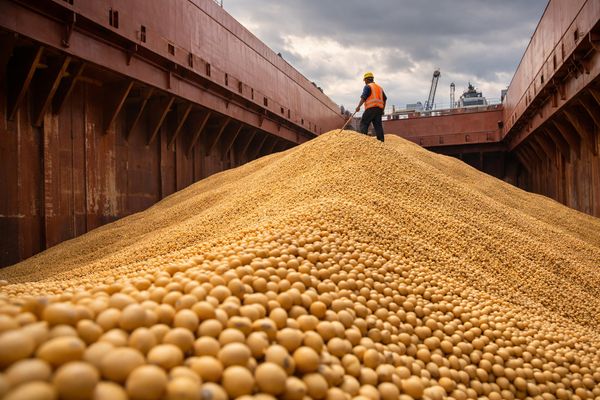
India’s soybean market has broken sharply higher, with domestic prices posting the strongest single‑session gains in weeks as traders reprice demand amid an ambitious national ethanol blending plan and surging crude oil costs. The policy‑driven move is building a new demand floor under oilseeds, even as Chicago soy oil futures soften on speculative selling.
India’s wholesale hubs in Madhya Pradesh and Maharashtra saw broad-based gains in both beans and refined soy oil, supported by the prospect that soybean oil could be drawn into large-scale biofuel production. At the same time, Brent crude’s spike above $125/bbl on geopolitical tensions is reinforcing the government’s push for energy import substitution, anchoring a structurally more bullish outlook for domestic oilseeds through Q2 2026.
Exclusive Offers on CMBroker

Soybeans
No. 2
FOB 0.59 €/kg
(from US)

Soybeans
sortex clean
FOB 0.97 €/kg
(from IN)

Soybeans
FOB 0.33 €/kg
(from UA)
📈 Prices & Market Moves
India’s soybean complex is leading the oilseed space higher, closely tracking mustard seeds after the announcement of a 100% ethanol blending policy. At Indore and Manasa in Madhya Pradesh, soybeans gained about $1.18 per quintal, lifting spot ranges to $75.33–$76.80 and $71.91–$72.50 per quintal respectively. Maharashtra markets followed suit, with Jalgaon at $71.91–$72.50, Akola at $70.73–$71.32 and Nagpur at $68.92–$70.14 per quintal, each up by $0.59–$1.18 on the day.
Refined soybean oil at Kandla port rose by roughly $1.18 to $172.60 per quintal, while Madhya Pradesh wholesale refined soy oil traded at $173.19–$174.37 per quintal, underlining the strength on the value‑added side. By contrast, Chicago soy oil futures eased on speculative selling, highlighting a temporary decoupling between Indian policy‑driven strength and global futures signals.
📊 International Reference Prices (FOB, converted to EUR)
| Origin | Grade | Location | Price (EUR/kg) |
|---|---|---|---|
| US | No. 2 | Washington D.C., FOB | ≈0.55 |
| India | Sortex clean | New Delhi, FOB | ≈0.91 |
| Ukraine | Standard | Odesa, FOB | ≈0.31 |
| China | Yellow | Beijing, FOB | ≈0.69–0.77 (conventional vs organic) |
(EUR values are approximate, converted from recent USD-equivalent quotations.)
🌍 Supply, Demand & Policy Drivers
The central driver of the current rally is India’s decision to pursue petrol blending with up to 100% ethanol, a major structural policy shift aimed at cutting crude oil import dependence. Although the government has not yet specified which crops will be prioritised as feedstock—after earlier pivots from maize to rice—the possibility that soybean oil could enter the biofuel chain at scale is enough to reprice future demand for domestically grown oilseeds.
This policy backdrop coincides with elevated geopolitical risk in energy markets. Brent crude briefly moved above $125 per barrel following a partial naval blockade at the Strait of Hormuz, through which about one quarter of global crude flows. For India, which imports roughly 85% of its crude, this combination of high prices and logistical risk reinforces the political and economic case for rapid biofuel expansion, indirectly tightening the forward balance sheet for soybeans, mustard and other oilseeds.
Externally, Malaysian palm oil futures for July have risen by over 1% to around 4,620 ringgit per tonne, adding global edible oil support. Meanwhile, non‑edible castor oil—also partly linked to biofuel and industrial demand—remains firm at $165.05–$166.23 per quintal, underscoring broad-based buying interest in the oil and bio‑based feedstock complex. Processors are closely watching crush margins as soy refined oil and soy acid oil at port hold in the $111.74–$112.33 per quintal band.
📊 Fundamentals & Margin Dynamics
For crushers, the recent spike in bean prices is a double‑edged sword. On one side, stronger refined oil and by‑product prices support crush economics and encourage higher utilisation. On the other, a rapid run‑up in raw material costs, driven more by policy expectations than by immediate physical scarcity, raises the risk of margin compression if downstream demand underperforms or if policy timelines slip.
Speculative money is increasingly active across the soybean value chain as the market anticipates clearer signals on ethanol feedstock prioritisation. Chicago soy oil’s modest pullback amid this Indian rally suggests that local policy and regional demand are currently more decisive than the global futures curve. European buyers of Indian soy meal, soy flour and refined soy oil should therefore expect a pricing environment driven less by Chicago benchmarks and more by India’s domestic policy and crude oil dynamics through at least Q2 2026.
📆 Short-Term Outlook (2–4 Weeks)
Over the next two to four weeks, soybean prices in India are likely to remain firm to higher, with the ethanol blending roadmap serving as the principal directional catalyst. As long as Brent crude stays elevated and geopolitical tensions around key shipping lanes persist, the political incentive to fast‑track biofuel adoption will continue to underpin a higher floor for oilseed prices.
Downside risk is concentrated in the energy complex: a sharp, sustained decline in crude prices or a rapid easing of tensions at the Strait of Hormuz could reduce the urgency of aggressive ethanol expansion, prompting some profit‑taking in soybeans and mustard. Conversely, any formal government statement explicitly naming soybeans or mustard as preferred ethanol feedstocks could trigger a fresh leg up, inviting additional speculative inflows and extending the current rally.
💡 Trading & Procurement Strategy
- Importers & European buyers: Advance cover for Q2 2026 requirements in soy meal and refined soy oil, as policy momentum and high crude are skewing price risk to the upside.
- Indian crushers: Hedge part of bean input costs while keeping some flex for further upside, as crush margins could tighten if policy implementation lags but prices stay firm.
- Producers & stockholders: Consider staggering sales to benefit from potential further gains tied to ethanol feedstock announcements, but protect against a sharp crude reversal via modest downside hedges.
- Speculative participants: Maintain a cautiously bullish bias with tight risk controls, as market direction is highly sensitive to geopolitical and policy headlines.
📍 3‑Day Price Indication & Directional View (Key FOB Origins, in EUR)
| Origin | Current Indication (EUR/kg) | 3‑Day Bias | Comment |
|---|---|---|---|
| US (No. 2, FOB) | ≈0.55 | Sideways to slightly firm | Tracking global oilseed sentiment; less directly exposed to Indian policy. |
| India (Sortex clean, FOB) | ≈0.91 | Firm | Policy‑driven demand floor; local rally likely to stay supported. |
| Ukraine (FOB Odesa) | ≈0.31 | Sideways | Competing origin for price‑sensitive buyers; less influenced by Indian ethanol news. |
Overall, the near‑term risk profile for soybeans is tilted to the upside, anchored by India’s evolving ethanol policy and tightness across the global edible oil complex.
Related posts:
 Soybeans edge higher as oil leads gains while meal softens
 Indian Soybean Supply Shock Lifts Global Soy Complex and Meal Values
 Soybeans firm as CBOT meal rallies and oil tracks crude higher
 Crude Oil Rally Steepens: Sharp Backwardation and Rising Risk Premiums
 Soybeans Edge Lower as Oil Weakens and Meal Firms, While FOB Basis Holds
 Crude Oil Rally Steepens: Backwardation, Risk Premiums and Tight Products