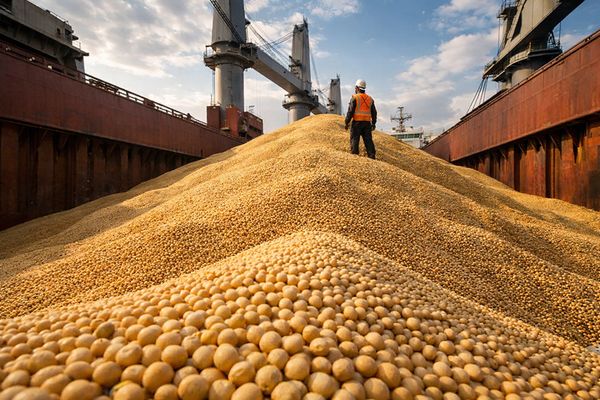
India’s soybean market has flipped into a sharp, supply‑driven bull run, with spot prices far above official support levels and further upside likely before the October harvest. Tight seed availability and strong soymeal export demand are squeezing crushers and helping to underpin the broader global soy complex.
Soybean prices at key Indian mandis have climbed from a season low around EUR 35–36 per 100 kg to roughly EUR 56–57 per 100 kg, while processing plants in Rajasthan and Madhya Pradesh now pay about EUR 59–60 per 100 kg. With four or more months until new‑crop arrivals and farmer stocks largely exhausted, buyers are competing aggressively for limited supplies. European feed and protein buyers face sustained strength in Indian soymeal offers and should plan coverage accordingly.
Exclusive Offers on CMBroker

Soybeans
yellow, organic
99.8%
FOB 0.82 €/kg
(from CN)

Soybeans
yellow
99.5%
FOB 0.74 €/kg
(from CN)

Soybeans
No. 2
FOB 0.59 €/kg
(from US)
📈 Prices
Wholesale soybean prices in central India have surged from roughly EUR 35–36 per quintal (100 kg) earlier in the season to about EUR 56–57 per quintal at key mandis. Ex‑plant prices in Rajasthan and Madhya Pradesh are even higher, at approximately EUR 59–60 per quintal, with the Datia–Shujalpur line trading only marginally lower. Market levels now stand around EUR 5–6 above the government’s raised Minimum Support Price (about EUR 50–51 per quintal for 2025–26), a clear reversal from the early season when beans traded below the floor.
In the by‑product market, soya de‑oiled cake (DOC) has more than doubled from a low near EUR 250 per tonne in the Neemuch belt to about EUR 460–470 per tonne ex‑plant in the Kota line. Export‑grade DOC with 45–48% protein is changing hands at Indian ports around EUR 480–485 per tonne, and domestic forecasts point to potential gains toward roughly EUR 575–580 per tonne. Soybean seed itself is projected to test levels near EUR 66–67 per quintal if current tightness persists.
| Product | Market | Latest level (EUR) | Trend vs season low |
|---|---|---|---|
| Soybeans (seed) | India, mandis | ≈ 56–57 / 100 kg | +55–60% |
| Soybeans (ex‑plant) | India, MP/Rajasthan | ≈ 59–60 / 100 kg | Multi‑year high |
| Soya DOC (domestic) | Kota ex‑plant | ≈ 460–470 / t | +70–80% |
| Soya DOC (export, 45–48% protein) | Indian ports | ≈ 480–485 / t | Strongly higher |
| Soybeans FOB CN (conv.) | Beijing | ≈ 0.68 / 100 kg | Slightly firmer m/m |
| Soybeans FOB US No.2 | US Gulf (ind.) | ≈ 0.55 / 100 kg | Stable to softer |
🌍 Supply & Demand
India’s current soybean crop is estimated at only 9.0–9.2 million tonnes, down sharply from 13.0–13.5 million tonnes in each of the last three seasons. Persistent rainfall from sowing through harvest, capped by unseasonal October–November storms, caused extensive field losses. Major producing districts such as Shivpuri, Datia, Shujalpur, Neemuch, Dahod, Kota, Akola and Jalgaon all report significant damage and below‑normal arrivals.
Arrivals in the Neemuch line are running about 42% below last year, with the Datia–Shujalpur belt showing stocks roughly 40% lower. Rajasthan and Maharashtra mandis together are 35–36% under normal stock levels. At the same time, solvent extraction plants must secure seed at elevated prices to maintain crush, while export demand for high‑protein DOC from India remains robust. Exports of soymeal from Rajasthan, Madhya Pradesh and Maharashtra are 28–29% ahead of last year’s kharif season, intensifying the domestic supply squeeze.
📊 Fundamentals & Policy
The Indian government has raised the Minimum Support Price for soybeans by about EUR 4 per quintal to roughly EUR 50–51 per quintal for the 2025–26 season, but market prices have run well ahead of that level. Active state procurement in Madhya Pradesh earlier in the season helped clear farmer stocks, reducing the volume now available to private buyers. With government-backed buying largely completed and farmers well sold, merchants and crushers are increasingly dependent on thin residual stocks and inter‑state movements.
Internationally, soymeal prices remain elevated, keeping India competitive in export markets even at higher domestic seed values. This external pull, combined with structurally tight local balances, has shifted bargaining power decisively toward farmers and stockholders in remaining surplus regions. Traders see any short‑term price dips as opportunities to rebuild coverage, reinforcing the uptrend.
🌦️ Weather & New‑Crop Outlook
At least four months remain before new‑crop soybeans from the next kharif cycle start to arrive, leaving the market highly sensitive to monsoon expectations. If pre‑monsoon forecasts for major soy‑growing states such as Madhya Pradesh, Maharashtra and Rajasthan turn uncertain, the current tightness could easily extend and support the projected push toward around EUR 66–67 per quintal. Conversely, early signs of a normal, well‑distributed monsoon would cap upside but are unlikely to trigger a deep correction until physical supplies improve.
For now, with old‑crop availability constrained and crushers already operating on reduced seed stocks, the balance of risk for Indian prices remains skewed to the upside. Importers and feed compounders dependent on Indian soymeal should monitor both weather updates and planting intentions closely over the coming 6–8 weeks.
📆 Trading Outlook & Recommendations
- Feed & livestock buyers (EU/Asia): Lock in a portion of Q3–Q4 soymeal needs now, using dips as opportunities; Indian DOC offers are likely to stay firm given tight seed supply and strong exports.
- Crushers in India: Maintain cautious crush rates and build seed coverage on any pull‑backs; upside toward roughly EUR 66–67 per quintal remains plausible before October.
- Merchandisers: Consider origin diversification between India, US and Black Sea for beans and meal, while recognizing that India will likely price at a premium as long as domestic stocks remain 30–40% below normal.
- Speculative participants: Bias remains to the long side in Indian soy and soymeal curves, with weather‑related volatility around monsoon forecasts offering tactical trading opportunities.
📉 3‑Day Price Direction (Indicative)
- India (mandis & ex‑plant): Sideways to mildly higher; tight stocks and strong crush demand should limit downside.
- FOB India soymeal: Firm; export demand and domestic seed scarcity keep offers well supported.
- Global benchmarks (US, CN, Black Sea): Mixed to slightly firmer, with India’s supply shock adding a supportive undercurrent to the broader soy complex.