
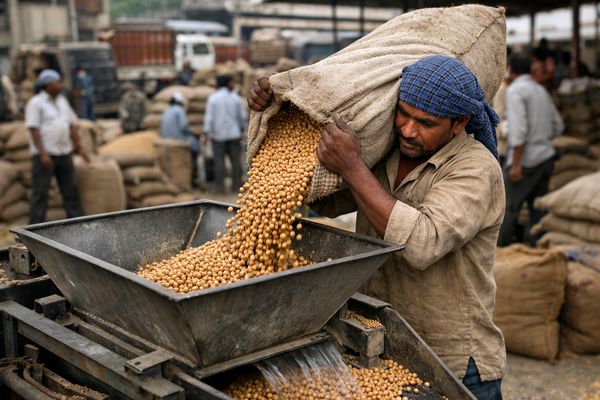
Indian chickpea prices are trading below the government’s Minimum Support Price (MSP) in early May 2026, signalling a soft domestic market underpinned by heavy state procurement and comfortable buffer stocks. For European buyers, this translates into competitive export offers and a favourable, though time‑limited, procurement window.
With India’s rabi harvest now largely in the market and arrivals still robust, wholesale prices in key producing states remain under pressure despite scaled‑up government buying. Maharashtra alone has lifted its MSP procurement ceiling for gram to roughly 8.19 lakh tonnes, underscoring the severity of farm‑gate price distress and the authorities’ willingness to defend incomes.
Exclusive Offers on CMBroker

Chickpeas dried
count 75-80, 8 mm
FOB 0.79 €/kg
(from MX)

Chickpeas dried
count 42-44, 12 mm
FOB 1.20 €/kg
(from MX)

Chickpeas dried
count 58-60, 9 mm
FOB 0.93 €/kg
(from IN)
📈 Prices & Key Benchmarks
Domestic chickpea (gram) prices across Indian mandis are currently a meaningful step below MSP, prompting the Price Support Scheme to operate at scale. The 2026 MSP for chickpeas is about the equivalent of EUR 6.10–6.30 per 100 kg, while prevailing wholesale levels are hovering modestly under this threshold, reflecting ongoing post‑harvest pressure and only moderate near‑term demand.
Export quotations mirror this softness. Recent Indian offers from New Delhi for standard kabuli grades are clustered around EUR 0.80–1.00/kg FOB, while Mexican origins sit higher, near EUR 1.10–1.25/kg FOB depending on calibre. The narrow price spreads over the last three weeks indicate that the earlier downward correction has largely played out and that MSP procurement is helping to stabilize the market floor rather than allowing a deeper slide.
| Origin / Grade | Specification | Location & Terms | Current Price (EUR/kg) |
|---|---|---|---|
| India | Chickpeas, 42–44 ct, 12 mm | New Delhi, FOB | ≈ 0.99 |
| India | Chickpeas, 58–60 ct, 9 mm | New Delhi, FCA | ≈ 0.81 |
| Mexico | Chickpeas, 42–44 ct, 12 mm | Mexico City, FOB | ≈ 1.20 |
| Mexico | Chickpeas, 75–80 ct, 8 mm | Mexico City, FOB | ≈ 0.79 |
🌍 Supply & Demand Balance
The current soft price environment in India is rooted in comfortable supply. The rabi 2025–26 chickpea harvest has delivered solid volumes, with steady arrivals into mandis since March. This has coincided with structurally stable but not rapidly accelerating domestic consumption, meaning incremental output cannot clear at MSP levels without policy support.
On the policy side, New Delhi has expanded MSP operations aggressively. Maharashtra’s increased procurement cap of about 8.19 lakh tonnes and extended purchase window to late May highlight both abundant availability and the government’s resolve to prevent distress sales. At a national level, India holds sizeable buffer stocks of pulses, with chickpeas forming the largest single component, signalling that authorities see no near‑term supply risk that would justify allowing prices to move sharply above MSP.
Import policy is another headwind for prices. Continued low or zero‑duty access for selected pulse imports maintains competitive pressure on domestic varieties, indirectly capping chickpea values as buyers can arbitrage between local and imported pulses. For export markets, however, this policy mix translates into reliable supply and attractive price points from India, especially while arrivals remain seasonally high.
📊 Fundamentals for European Buyers
For European food manufacturers and traders, India’s current market configuration is favourable. Export prices typically track domestic mandis plus processing and logistics margins, so sub‑MSP wholesale levels are feeding through into competitive FOB offers for kabuli chickpeas used in hummus, canning, snacks and flour. Compared with Mexican origin, Indian product currently offers a clear cost advantage on most standard calibres.
In addition, India’s ample buffer stocks of pulses and active procurement programme reduce the risk of sudden supply disruptions. This underpins confidence in executing larger forward purchases or multi‑shipment contracts from Indian shippers over the next one to two months. Nevertheless, any unexpected surge in regional demand from the Middle East or Southeast Asia could quickly absorb surplus exportable supply and narrow today’s discounts.
🌦️ Short-Term Outlook & Weather
Over the next two to four weeks, prices are unlikely to rise sustainably above MSP as long as government procurement remains in the market and domestic demand trends remain steady. Post‑harvest arrivals will gradually taper through May, easing some physical pressure, but the weight of comfortable stocks and buffer holdings should keep the upside capped in the near term.
Weather risks are more relevant beyond this immediate horizon. The upcoming kharif season’s monsoon performance will influence sowing decisions for pulses that compete with chickpeas in rotations, and, indirectly, the planting outlook for the next rabi chickpea crop from October onward. Any major monsoon disruption or shift in policy around pulse imports could alter the balance for the 2026–27 marketing year, but these risks sit outside the immediate trading window now open to European buyers.
📆 Trading Outlook & Recommendations
- European buyers: Use the current sub‑MSP price environment in India to secure coverage for at least 2–3 months’ requirements, especially for standard kabuli grades where Indian offers undercut Mexican origin.
- Importers and distributors: Stagger purchases over the coming 3–4 weeks while monitoring the pace of MSP procurement; a sharp slowdown in government buying or indication of buffer stock offloading would remove part of the current price floor.
- Risk management: Avoid over‑extending coverage beyond the immediate quarter, as weather‑driven risks and potential import‑policy changes into India could shift market sentiment later in the year.
📉 3-Day Directional Price View (EUR)
- India, New Delhi FOB kabuli (9–12 mm): Sideways to slightly firm; MSP procurement and easing arrivals suggest a stable floor with only minor upward bias.
- Mexico, Gulf FOB kabuli (large calibres): Largely steady; global competition from India caps upside, with modest premium over Indian origin likely to persist.
- CIF Northwest Europe, standard food‑grade chickpeas: Stable; freight and logistics dominate near‑term moves, while origin price differentials favour increased Indian share in import mixes.
Related posts:
 Indian Moong and Global Lentils: Soft Undertone, Buyer-Friendly Window
 Chickpeas Edge Higher as Indian MSP Buying Tightens Near-Term Supply
 Chickpea Prices Steady in India and Mexico as Procurement and Weather Support Floors
 Indian Chickpea Prices Ease Slightly as Heat Builds Into May
 Indian Chickpea Squeeze Sets Bullish Tone for Global Market
 Indian Moong Surplus Weighs on Global Lentil Complex but Opens Buying Window
 Mexican Chickpea FOB Prices Ease Slightly as India Trades Sideways
 Indian Chickpea Prices Edge Higher as Heatwave Looms Over North India