
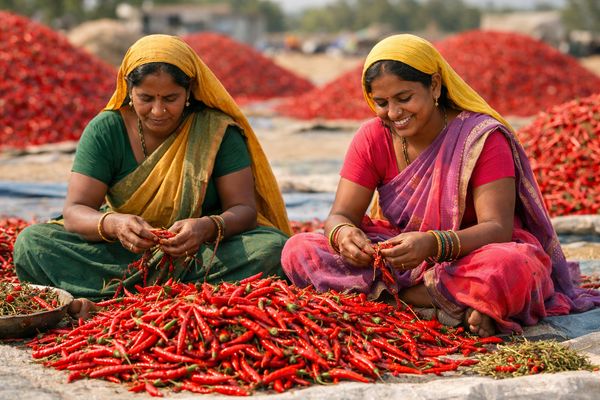
Indian chilli prices are stabilising with a mild upside bias as weather‑driven production losses curb arrivals at key mandis, while quality issues delay a full-scale export-led rally.
Arrivals at Guntur and Warangal have dropped sharply as the impact of adverse kharif weather in Andhra Pradesh and Telangana translates into both lower volumes and weaker grade profiles. Domestic stockists and inter-market traders are currently providing the main buying support, triggering a modest price recovery of about 500 rupees per quintal across key grades. However, exporters remain cautious amid below-normal quality, even as strong export growth so far in 2025–26 and a structural 30% crop decline argue for tighter availability and firmer international prices into late 2026.
Exclusive Offers on CMBroker

Chilli dried whole
bird eye, grade a
FOB 4.65 €/kg
(from IN)

Chilli dried
powder, grade a
FOB 4.40 €/kg
(from IN)

Chilli dried
flakes, grade a
FOB 4.35 €/kg
(from IN)
📈 Prices & Arrivals
Fresh chilli arrivals at Guntur have fallen from nearly 100,000 bags per day at the recent peak to around 70,000 bags, while Warangal volumes are down to roughly 20,000–25,000 bags. This tightening in physical supply has produced a broad 500‑rupee per quintal recovery in spot prices across major grades.
At Guntur, teja-grade chilli has firmed by 500 rupees to roughly EUR 204–210 per quintal, while grade 334 is quoted around EUR 204–231 and grade 341 about EUR 194–231 per quintal. In Warangal, teja has recovered to approximately EUR 205–226 per quintal, and devnoor-grade is trading near EUR 199–215 per quintal. Delhi’s wholesale spice market reports that grades 334 and 341 are holding steady after recent 500‑rupee gains, at around EUR 241–262 and EUR 258–273 per quintal respectively.
FOB offers from Andhra Pradesh and New Delhi show a broadly steady to slightly firmer undertone. Organic dried chilli powder, flakes and whole bird’s eye are currently indicated at about EUR 4.35–4.65/kg, while conventional stem and stemless whole grades are around EUR 2.15–2.16/kg, broadly unchanged over the last weeks.
| Product | Location / Term | Latest Price (EUR) |
|---|---|---|
| Dried chilli, whole stemless, non-organic | Andhra Pradesh, FOB | ≈ 2.16 €/kg |
| Dried chilli, with stem, non-organic | Andhra Pradesh, FOB | ≈ 2.15 €/kg |
| Dried chilli flakes, organic | Andhra Pradesh, FOB | ≈ 4.35 €/kg |
| Dried chilli powder, organic | Andhra Pradesh, FOB | ≈ 4.40 €/kg |
| Dried chilli whole bird’s eye, organic | New Delhi, FOB | ≈ 4.65 €/kg |
🌍 Supply, Quality & Export Dynamics
The key driver of the current market is weather damage to the 2025–26 kharif chilli crop. During flowering and fruiting in Andhra Pradesh and Telangana, adverse conditions reduced both yields and the share of marketable grade material. Current estimates point to a roughly 30% year‑on‑year production decline, tightening the structural balance and limiting downside risk.
While the fall in arrivals is now supporting prices, traders emphasise that quality deterioration is the more serious challenge. Exporters seeking specification-grade material for high-value overseas buyers are largely on the sidelines, given uneven colour, size and physical condition. In contrast, domestic stockists and inter-market traders (disavaris) are actively purchasing, absorbing available supply and underpinning the recent price recovery.
Export performance nonetheless remains robust in aggregate. Between April and January of the current financial year 2025–26, India exported about 572,757 tonnes of chilli worth roughly 81.5 billion rupees, up 18% in volume and 3% in value year‑on‑year. This suggests strong underlying international demand that could reassert itself once quality in fresh arrivals improves.
📊 Fundamentals & Weather Outlook
Fundamentals are tightening: a structurally smaller crop, reduced arrivals and firm underlying export demand together create a constructive medium‑term backdrop. Near‑term, however, the market is navigating a quality overhang that tempers export participation and caps the speed of any rally.
In the short run, domestic and intra‑Indian trade flows are the main sources of demand support. Should stockist interest fade before export buyers re‑enter, prices could drift within the current band despite the smaller crop. Conversely, even a partial return of export demand for higher grades could quickly translate into another leg up, given the 30% production shortfall.
Weather conditions in the main producing regions are currently hot and seasonally dry to partly cloudy, with daytime highs around 36–38°C and limited rainfall forecast over the next three days in Andhra Pradesh and Telangana. This is broadly neutral for harvested stocks and drying, but does little to change the already‑locked‑in production losses from earlier in the season.
📆 Market Outlook (Next 4 Weeks)
Traders expect chilli prices to trade in a relatively narrow range in the immediate term as mandis adjust to fluctuating arrivals and demand. The structural production decline makes a prolonged bearish phase unlikely, but the quality constraint prevents an immediate surge to new highs.
A key catalyst for the next meaningful upward move will be the return of export buyers once better-quality lots arrive and grading improves. Market participants currently see this as a realistic prospect within the next three to four weeks, especially if overseas buyers move early to secure volumes for late‑2026 delivery in anticipation of tighter global availability.
💼 Trading Recommendations
- European importers and food manufacturers: Use the current range‑bound phase to extend coverage modestly into Q4 2026, focusing on higher grades where availability is already tightening.
- Indian stockists: Maintain core long positions but avoid aggressive chasing; wait for clearer signals on export re‑entry before adding significant length.
- Industrial buyers in Asia and MENA: Consider staggered purchases over the next month, diversifying across origins but recognising India’s central role and potential for firmer prices later in 2026.
📍 3‑Day Directional Outlook (Indicative)
- Guntur physical market: Mildly firm bias; limited arrivals and steady stockist demand likely to keep prices at the upper end of the current range.
- Warangal physical market: Sideways to slightly firmer; thinner volumes and similar quality issues to Guntur.
- FOB Andhra Pradesh / New Delhi: Largely stable in EUR terms, with a slight upward risk if domestic prices strengthen further and exporters begin selective buying.
Related posts:
 Indian Saunth Surge Tightens Global Ginger Supply for EU Buyers
 Indian Dry Ginger Market Firms on Tight Fresh Supply and Solid Demand
 Indian Chilli Market Pauses After Rally as Quality Issues Hit Exports
 Weather Shock Tightens Cardamom Supply and Lifts Prices
 Indian Coriander Market Firms on Tight Stocks and Rising Futures
 Turmeric Market Firms on Tight Indian Arrivals and Active Speculation
 Indian Chilli Prices Hit Records as Tight Supply Meets Firm Export Demand