
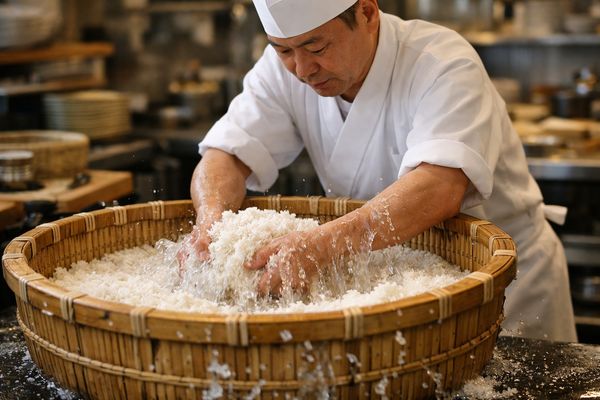
India’s record rice procurement and aggressive stock offloading are keeping domestic and export rice prices broadly stable to mildly soft, but rising ethanol offtake from public stocks is slowly tightening future export flexibility. Importers should view today’s calm price environment as an opportunity to extend coverage before policy shifts or weather risks test this balance.
India has already procured nearly 50 million tonnes of rice in the first seven months of the 2025–26 marketing year, running 6% ahead of last season and pushing state storage close to capacity. At the same time, a record volume of rice is being diverted into ethanol, structurally reducing what is available for open-market sales and exports later in 2026. Against this backdrop, FOB offers from India and Vietnam in early May point to a slightly softer tone in EUR terms, but the downside appears increasingly limited.
Exclusive Offers on CMBroker

Rice
all golden, sella
FOB 0.86 €/kg
(from IN)

Rice
all steam, pr11
FOB 0.37 €/kg
(from IN)

Rice
al ısteam, sharbati
FOB 0.51 €/kg
(from IN)
📈 Prices & Market Tone
Indian FOB export offers converted into EUR suggest a modest easing over the past three weeks. For New Delhi FOB:
- All steam, PR11: about EUR 0.34/kg, down roughly 5% from mid-April.
- 1121 steam: about EUR 0.67/kg, down around 6% over the same period.
- Organic white basmati: about EUR 1.50/kg, easing slightly as export demand from the Middle East pauses.
In Vietnam, long white 5% rice trades near EUR 0.35–0.36/kg FOB after conversion, broadly steady to slightly softer compared with April, in line with reports of relatively stable export prices despite higher costs. Overall, the global rice complex is range-bound, with India effectively setting the price floor through abundant stocks.
| Origin | Type | FOB Price (EUR/kg) | Trend vs mid-April |
|---|---|---|---|
| India, New Delhi | PR11 steam | ~0.34 | ⬇ |
| India, New Delhi | 1121 steam | ~0.67 | ⬇ |
| India, New Delhi | Organic basmati | ~1.50 | ⬇ |
| Vietnam, Hanoi | Long white 5% | ~0.35–0.36 | ➡/⬇ |
🌍 Supply, Demand & Policy Signals
From October 2025 to April 2026, India’s government rice procurement reached 49.86 million tonnes, versus 47.02 million tonnes a year earlier, and is now very close to the full-season target of 56.66 million tonnes. Storage capacity is under pressure, forcing accelerated stock offloading via ethanol producers, food distribution channels, and open-market operations.
India’s Ministry of Agriculture projects record kharif rice output of 123.93 million tonnes and higher rabi output of 16.72 million tonnes for 2025–26, reinforcing a clear domestic surplus. On March 1, 2026, public rice stocks stood at about 73.9 million tonnes, more than five times official peak norms, underlining how dominant Indian supply remains for global trade.
At the same time, policy is tilting structurally toward using surplus rice for ethanol. Of the record 10.8 million tonnes already sold from government buffers, 5.2 million tonnes went to distilleries, up sharply year on year and aligned with India’s drive to deepen ethanol blending. This reduces the pool available for discretionary exports, even if headline production and procurement point to abundance.
📊 Regional Dynamics & Trade Flows
Procurement patterns within India show shifting regional weight. Rabi-season buying has risen in Telangana, Andhra Pradesh, Odisha, Madhya Pradesh and in Uttar Pradesh, while traditional heavyweights Punjab and Haryana report lower procurement, reflecting both agronomic stress and policy efforts to diversify away from water-stressed regions. This rebalancing does not change the national surplus but may impact logistics and quality mixes reaching export channels.
Globally, Vietnam is expanding rice market diversification through free trade agreements and shifting towards higher-value segments. Yet export values are under pressure as prices soften in early 2026 despite steady volumes, illustrating how a supply-heavy global balance limits upside. Recent commentary also highlights that Vietnam and other Asian exporters face higher freight and input costs, even as FOB rice prices stay broadly flat, compressing margins but still encouraging competitive offers into Africa and the Middle East.
For 2026, India is expected to retain roughly a 40% share of world rice trade, with exports around 24 million tonnes, implying that any future adjustment in India’s stock policy or export stance will quickly ripple through global prices.
🌦️ Weather & Short-Term Risk Factors
With the 2025–26 kharif crop already harvested and rabi rice entering markets, immediate weather risks to Indian supply are limited. The focus now shifts to monsoon onset expectations for June–September 2026; early forecasts will be key for planting decisions but are not yet a price driver.
More immediate risks stem from policy and logistics rather than the weather. Any decision by India to slow open-market sales to relieve storage pressure, or a renewed wave of logistics disruptions and freight cost spikes linked to geopolitical tensions, could quickly tighten export availabilities and lift FOB prices from current soft levels.
📆 Outlook & Trading Recommendations
Near term, the domestic Indian rice market is likely to remain stable to mildly soft, with large government stocks capping rallies and aggressive offloading through ethanol, welfare schemes, and open-market operations preventing tightness. However, the structural diversion of rice into ethanol subtly tightens the balance for exportable supplies into late 2026, particularly if demand from key buyers recovers.
- Importers in Europe and Asia: Use current price softness to extend coverage into Q4 2026, especially for Indian non-basmati and Vietnamese long-grain, while avoiding over-reliance on a single origin.
- Traders: Favor buying on dips rather than chasing further downside, as policy or freight shocks could prompt a quick EUR 0.02–0.03/kg rebound in premium grades.
- Industrial users & ethanol-linked buyers: Monitor India’s ethanol allocation policies closely; further incentives for grain-based ethanol would reduce rice availability for food and export channels.
🔭 3-Day Price Indication (Directional)
- India, New Delhi FOB (non-basmati, parboiled/steam): Stable to slightly softer in EUR, with government stocks acting as a ceiling.
- Vietnam, Hanoi FOB (long white 5%): Mostly stable; minor downside risk if export demand remains subdued.
- Premium & organic basmati (India): Slightly soft but downside limited; watch for renewed Middle East buying that could firm offers.
Related posts:
 US winter wheat stress and tight stocks quietly underpin global prices
 Inquiry-Led Rally in Indian Basmati Rice Tightens Window for EU and Middle East Buyers
 India’s Corn Rally Tightens Global Feed and Ethanol Balances
 Ukrainian Millet Prices Flat as Cool Weather Caps Field Work
 Wheat Rallies on US Drought Fears While EU Faces Heavy Stocks
 Indian Procurement Drive Tightens Wheat Market Despite Larger Crop
 Basmati Under Pressure: Export Lull Knocks Indian Rice Prices Lower