
Global Grain Shift: Falling Asian Rice Prices Meet Rising African Import Demand
CMB News | Global Grain Markets | March 2026
Global grain markets are entering a new phase of shifting trade flows. While rice prices in Southeast Asia are weakening due to intense export competition, rising consumption and production challenges in Africa are increasing demand for imported grain.
The contrast highlights a structural change in global food markets: supply pressure in Asia is coinciding with growing import demand in Africa.
Asian Rice Market Under Pressure
Rice prices in Thailand softened in early 2026 as exporters faced stronger competition from Vietnam and India.
Several factors contributed to the weaker market:
-
a stronger Thai currency reduced export competitiveness
-
buyers delayed purchases expecting lower global prices
-
seasonal demand slowed around the Lunar New Year
As a result, many importers are postponing purchases in anticipation of further declines in global rice prices.
For exporters, this means intensifying competition across Asian rice markets.
Nigeria’s Grain Demand Expands
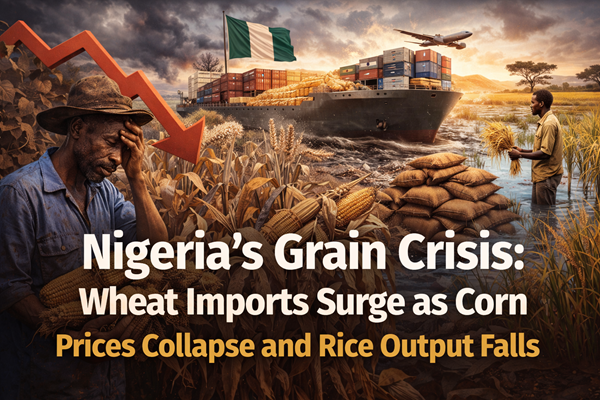
At the same time, Nigeria — Africa’s most populous country — is increasing its dependence on imported grain.
Wheat consumption is expected to reach roughly 6.8 million tons, while imports may rise to around 7.2 million tons as domestic production remains limited.
Urbanization and improving purchasing power are driving stronger demand for wheat-based foods such as:
-
bread
-
noodles
-
pasta
-
semolina
Bread alone accounts for the majority of wheat flour consumption in the country.
Corn Market Faces Structural Pressure
Nigeria’s corn sector is facing a severe price-cost squeeze.
Farmgate prices dropped by more than 50 percent during 2025, leaving many farmers trapped between sharply falling revenues and rising production costs.
Input costs for fertilizer, fuel, herbicides and labor have increased significantly in recent years.
As a result, corn production is expected to decline to around 10.9 million tons, while imports are likely to increase sharply to compensate for the supply gap.
Rice Production Weakens
Rice production in Nigeria is also expected to decline as high production costs discourage farmers from expanding planting areas.
Many producers report selling their harvest below production costs, while some are switching to alternative crops such as:
-
sesame
-
soybeans
-
black cumin
Meanwhile, cheaper imported rice entering through neighboring countries continues to put pressure on domestic prices.
Sorghum Gains Importance
While corn and rice struggle, sorghum production is expanding.
Output is expected to reach approximately 7 million tons, supported by strong demand from the brewing industry and the animal feed sector.
Sorghum is also increasingly used as a lower-cost substitute for wheat and corn.
Market Implications
The global grain market is witnessing a shift in supply and demand dynamics.
Key trends include:
-
stronger competition in Asian rice exports
-
growing grain import demand in Africa
-
structural pressure on domestic producers in some markets
-
rising importance of alternative crops such as sorghum
With its rapidly growing population and expanding food demand, Nigeria is emerging as one of the most important demand centers for global grain exporters.
For wheat exporters in particular, the country is likely to remain a key growth market in the years ahead.
Source: USDA