
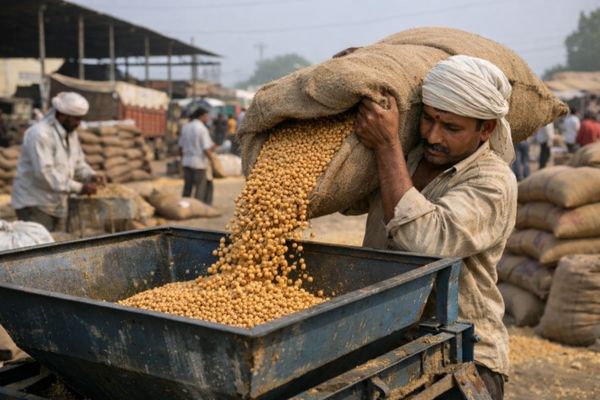
Indian chickpea export prices from New Delhi are broadly stable after early‑April volatility, with large Kabuli calibres near the top of their recent range and smaller sizes trading at a consistent discount. Weather is turning hot in North India, but immediate crop stress is limited; the main risk now is a potentially below‑normal 2026 monsoon, which could tighten pulses balances later in the year.
In the last week, New Delhi Kabuli chickpea offers have stabilised in euro terms, reflecting a better‑supplied domestic market but still firm consumer demand. Mandis in producing states such as Madhya Pradesh report steady to slightly higher modal prices for Kabuli, helped by improved buying after earlier lows. At the same time, macro signals around Indian food inflation and government sensitivity to pulses prices suggest any sharp upside will likely trigger policy intervention through stock releases or import facilitation. Early‑summer heat and monsoon uncertainty are being watched closely, but for now they are more of a medium‑term risk than an immediate price driver.
Exclusive Offers on CMBroker

Chickpeas dried
count 60-62, 8 mm
FOB 0.87 €/kg
(from IN)

Chickpeas dried
count 42-44, 12 mm
FOB 1.20 €/kg
(from MX)

Chickpeas dried
count 75-80, 8 mm
FOB 0.79 €/kg
(from MX)
📈 Prices & Spreads
FOB New Delhi offers for Indian Kabuli chickpeas are currently clustered in a narrow band, with larger 12 mm lots at the top and 8–9 mm sizes at a notable discount. Recent domestic mandi data from central India show Kabuli modal prices around INR 6,600–6,800 per quintal (≈EUR 0.78–0.80/kg), aligning with stable export values. Mexican Kabuli quotations remain at a premium to Indian origin, but this spread has been relatively steady in the last fortnight.
| Origin & Size | Location / Term | Current Level (EUR/kg) | WoW Trend |
|---|---|---|---|
| India Kabuli 12 mm | New Delhi, export | ≈0.89–0.91 | Flat to slightly firmer |
| India Kabuli 10–11 mm | New Delhi, export | ≈0.83–0.88 | Flat |
| India Kabuli 8–9 mm | New Delhi, export | ≈0.67–0.78 | Flat |
| Mexico Kabuli 12 mm | Mexico FOB | ≈1.22–1.25 | Stable |
Indian New Delhi prices are broadly in line with independent trade reports noting that premium 12 mm Kabuli is trading near the upper end of its recent range, while smaller calibres retain a modest but steady discount.
🌍 Supply, Demand & Policy Drivers
Fresh rabi chickpea arrivals continue into mandis, especially in Madhya Pradesh and Maharashtra, helping cap any aggressive spot rallies after the early‑April bounce. Trade sources highlight that Maharashtra Kabuli, which had been at multi‑month lows, has recently recovered to around USD 75–77 per quintal (≈EUR 0.68–0.70/kg), signalling improved demand at lower levels.
On the policy side, the central government has reiterated its focus on pulses self‑reliance, urging states to align bonus schemes for pulses and oilseeds and sustaining higher MSP and support programmes. With food inflation still politically sensitive, the chickpea market assumes that any sharp upside in prices would trigger interventions such as accelerated public stock releases or additional imports, tempering speculative buying. Futures trade in chana on domestic exchanges remains active but does not indicate a disorderly rally at present.
🌦 Weather & Monsoon Risk (India)
Weather in New Delhi and much of North India has turned seasonally hot, with forecasts pointing to maximum temperatures near 40°C around 15 April and continuing above normal through mid‑week. This pattern reflects the typical onset of the pre‑monsoon summer and is not, by itself, expected to materially damage the freshly harvested chickpea crop, which is already moving through the marketing chain.
The more significant risk factor comes from updated seasonal outlooks indicating the likelihood of a below‑normal southwest monsoon in 2026, with national rainfall potentially around 94% of the long‑period average. While chickpeas are primarily a rabi (winter) crop and less directly dependent on southwest monsoon rains than kharif pulses, a weak monsoon could still influence pulse acreage decisions, soil moisture recharge and feed‑through inflation, underpinning prices for the next production cycle.
📊 Market Fundamentals
Government estimates still point to solid overall rabi production, with pulses benefiting from earlier policy pushes and bonus incentives, suggesting that domestic supplies of chickpeas in 2025‑26 are adequate but not burdensome. Private trade commentary describes the current chickpea market as being in a phase of “shifting dynamics”, with the earlier glut in some Kabuli segments easing as demand improves and low prices attract export interest.
Speculative appetite remains constrained by memories of past interventions, including stock limits and subsidised distribution when pulses prices spiked. At the same time, chatter about potentially deficient monsoon rains and wider food‑inflation risks is keeping a floor under prices, as neither farmers nor traders are eager to sell aggressively at discounts ahead of clearer weather signals.
📆 Short-Term Outlook & Trading Ideas
Over the next three days, weather in the New Delhi region is set to stay hot, with some indications of thunderstorms or a shift to more unsettled conditions later in the week as a western disturbance interacts with the northern plains. This should not materially alter short‑term physical flows but may affect logistics and mandi arrivals if localised storms develop.
🔎 Trading Outlook (Next 1–2 Weeks)
- Export buyers: Use current flat conditions in New Delhi to secure coverage for 1–2 months on 10–12 mm Kabuli, as the combination of monsoon concerns and any policy shifts could lift values modestly later in Q2.
- Importers in price‑sensitive markets: Indian origin remains cost‑competitive versus Mexico; consider favouring Indian 10–11 mm where quality specs allow, keeping some flexibility to switch origins if Indian government signals tighter export controls.
- Domestic traders: Avoid aggressive short positions; with monsoon risk tilted to the downside and policy very focused on pulses, the skew is towards a gently firmer bias rather than a deep correction.
📍 3‑Day Directional Price Indication (EUR, India Focus)
- New Delhi Kabuli 12 mm export (FOB): Sideways to slightly firmer; expected range ≈EUR 0.88–0.92/kg.
- New Delhi Kabuli 10–11 mm export (FOB): Largely stable; expected range ≈EUR 0.82–0.88/kg.
- New Delhi Kabuli 8–9 mm export (FOB): Steady; expected range ≈EUR 0.66–0.78/kg, with discounts vs. large calibres maintained.