
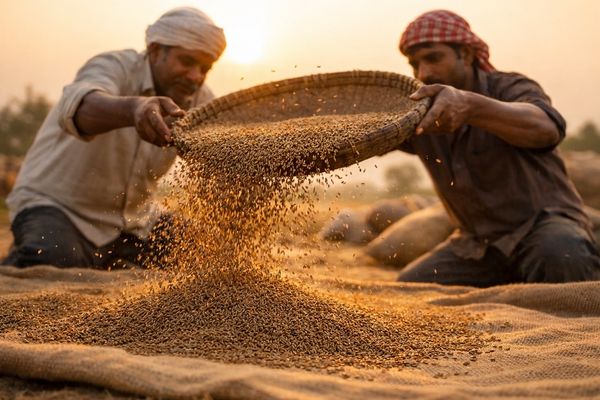
Indian cumin prices are easing modestly from recent highs as heavy new-crop arrivals in Gujarat and Rajasthan meet still-firm domestic and export demand. Futures and spot benchmarks remain elevated historically but have slipped 1–3% over the last few days, while Egyptian FOB offers continue to trade at a premium, keeping a cap on further upside.
Global buyers see a window for short-term coverage as Indian export-grade cumin (FOB/FCA) edges slightly lower in EUR terms, even as mandi prices in Unjha and Rajasthan hover near ₹20,000–22,000 per quintal. Recent assessments peg India’s 2026 cumin crop only modestly below last year but still sufficient to sustain exports. Over the next three days, prices in India are expected to trade soft-to-sideways, tracking NCDEX jeera futures and steady overseas competition rather than any abrupt weather or supply shock.
Exclusive Offers on CMBroker

Cumin seeds
99,9%
FOB 4.15 €/kg
(from EG)

Cumin powder
grade - A
FOB 3.37 €/kg
(from IN)

Cumin seeds
black, grade - A
FOB 2.00 €/kg
(from EG)
📈 Prices & Spreads
Based on recent wholesale and export indications, benchmark Indian cumin values remain high but are off early-April peaks. All-India jeera averages were around ₹21,660/quintal on 11 April 2026, down about 2% on the day and below early-March levels, signalling a mild correction as fresh crop arrivals build. Mandis in Rajasthan (e.g. Barmer) reported modal prices near ₹20,000/quintal on 13 April, with a ₹19,500–20,500/quintal range, confirming strong but slightly softer spot sentiment.
NCDEX jeera futures for near-month contracts continue to trade close to ₹21,500–22,000/quintal, reflecting elevated but consolidating market expectations. Export-grade Indian cumin offers in EUR terms have eased marginally, while Egyptian FOB maintains a noticeable premium according to recent trade commentary. This narrows, but does not eliminate, India’s competitiveness advantage for bulk buyers in Europe and the Middle East.
| Market/Origin | Product | Indicative Level (EUR/mt) | Trend vs 3–5 days ago |
|---|---|---|---|
| India (Unjha/New Delhi) | Cumin seeds, export grade | ≈ €2,550–2,650 | ⬇️ soft by ~1–3% |
| India (Unjha/Rajasthan mandis) | Domestic jeera | ≈ €2,450–2,550 (spot equivalent) | ⬇️ from early April highs |
| Egypt (FOB) | Cumin seeds, 99–99.9% | Premium to Indian by ~€150–250 | ➡️ broadly stable |
| EU (Netherlands) | Syrian origin, FCA | ≈ €3,200–3,900 (retail/wholesale mix) | ➡️ flat |
🌍 Supply, Demand & Trade Flows
Fresh analysis of the 2026 seed-spice balance indicates Indian cumin production in the low-to-mid 500,000-tonne range, modestly below last year but well above the tight 2023 crop, ensuring a comfortable exportable surplus. New-crop arrivals from Gujarat and Rajasthan have been strong in recent sessions, with reports of robust inflows into key markets such as Unjha and Rajasthan’s district mandis.
Despite this supply wave, demand remains active. Domestic consumption is steady and export inquiries from traditional buyers in the Middle East, Europe and North Africa are described as firm but price-sensitive, encouraging buyers to pace purchases and negotiate harder on offers. Egyptian and Syrian origins continue to compete in higher-value segments, but India retains a clear cost advantage at current EUR levels, especially for bulk industrial and food-service use.
📊 Fundamentals & Weather (Region: India)
Fundamentals are shifting from a tight, rallying market to a more balanced one as arrivals peak. Recent market reports highlight that while production is slightly lower year-on-year, the combination of good carry-in stocks and large March–April harvest inflows is easing immediate supply concerns. This explains the mild price softening observed across mandis and export quotes since early April.
Short-term weather in the cumin belt (Gujarat and Rajasthan) is seasonally warm and largely dry, with no major rainfall or storm systems expected over the next three days according to regional forecasts. For a harvested or near-harvest crop like cumin, this pattern is broadly neutral to slightly supportive for quality and drying, and is unlikely to create immediate bullish supply risks before the next planting cycle.
📆 3‑Day Price Outlook (Region: IN)
Recent market guidance points to soft-to-sideways price action in the main Indian centres over 15–17 April 2026, as heavy arrivals cap rallies and cautious export demand limits downside. Futures on NCDEX are expected to track this consolidation, with limited fresh directional triggers in the very short term.
| Market | Product | Directional Bias (next 3 days) | Comment |
|---|---|---|---|
| Unjha (Gujarat) | Cumin seeds (jeera) | Soft ➝ Sideways | Arrivals strong; bids resistant above recent highs |
| New Delhi | Export-grade cumin | Sideways | EUR offers tracking NCDEX; modest discounting ongoing |
| Rajasthan mandis | Jeera | Sideways | Ranges near ₹19,500–20,500/quintal seen holding |
🧭 Trading Outlook & Recommendations
- Exporters (India): Use the current soft-to-sideways phase to lock in forward sales on firm enquiries, but avoid aggressive price hikes; consider incremental hedging on NCDEX to protect against further mild easing.
- Importers (EU/MENA): The recent pullback from early-April highs offers a tactical buying window for nearby and early Q3 coverage, particularly from Indian origin, which remains more competitive than Egyptian FOB at current EUR spreads.
- Large users (blenders/packers): Stagger purchases rather than going fully long; fundamentals are no longer as tight, and continued strong arrivals could keep a lid on prices through the near term.