
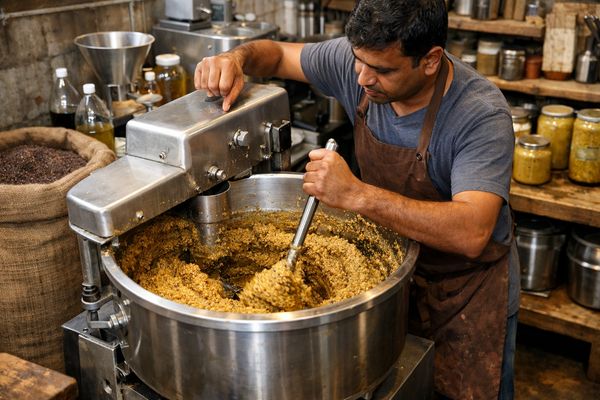
Indian mustard seed export offers out of New Delhi are fractionally softer week‑on‑week, tracking larger new‑crop arrivals but underpinned by steady crusher and export demand. The short‑term price tone is mildly bearish, with limited downside as markets watch procurement in key producing states and evolving vegoil spreads.
Indian physical mandis are trading close to the mustard MSP, with some stronger centers in central India, indicating balanced near‑term fundamentals rather than stress selling. New‑crop harvesting and active procurement in states such as Haryana point to ample spot availability, while a hotter, mostly dry outlook across parts of Rajasthan and northwest India should help wrap up remaining fieldwork without adding weather risk to the seed itself. Overall, FOB values may drift slightly lower or move sideways over the next few days rather than stage a decisive move in either direction.
Exclusive Offers on CMBroker

Mustard seeds
yellow, micro, sortex
99.95%
FOB 0.89 €/kg
(from IN)

Mustard seeds
yellow, bold, sortex
99.95%
FOB 0.99 €/kg
(from IN)

Mustard seeds
brown, micro, sortex
FOB 0.79 €/kg
(from IN)
📈 Prices & Market Tone
New Delhi mustard seed FOB values for conventional, non‑organic, 99.95% purity lots have eased by roughly 1% versus the previous week, in line with reports of slightly weaker export offers as of 11–12 April 2026. Domestic mandi prices across India are mostly clustered around the MSP zone, with recent reports citing a typical range of about ₹2,200–10,000 per quintal and many markets stabilising near ₹6,200 per quintal. This reflects a market that is well supplied but not under acute pressure.
In eastern markets such as Gaya (Bihar), recent wholesale mustard prices around ₹5,650 per quintal suggest moderate discounts to the higher‑priced central Indian hubs, reinforcing a broadly steady but regionally differentiated price structure. Export parity from New Delhi remains competitive versus imported vegoils, keeping a floor under high‑quality 99.95% sortex seed, although the immediate direction into late week is slightly softer as more new‑crop volumes clear into trade channels.
🌍 Supply, Demand & Procurement
Indian mustard seed markets are currently digesting a sizable 2025/26 rapeseed–mustard harvest, with recent commodity commentary flagging a larger national crop year‑on‑year alongside strong rabi production more broadly. This is corroborated by government assessments of robust rabi output for 2025‑26, which, while focused on wheat, imply generally favourable conditions for oilseeds as well.
On the demand side, crushers and exporters are reported to be actively covering nearby oil requirements, helping to absorb new arrivals and preventing a sharper break in prices. State‑level procurement is also important: Haryana, for example, has seen record rabi arrivals of wheat and mustard at procurement centres up to 12 April, underlining the strength of supply pipelines into official channels. This combination of sizeable production, healthy procurement and steady industrial demand supports a mildly bearish but orderly near‑term price environment.
🌤 Weather Outlook (IN Mustard Belt)
With mustard now largely in the post‑harvest or final harvest stage, short‑term weather mainly affects logistics and late‑cut fields rather than yields. The latest national‑scale forecast highlights a new Western Disturbance bringing some rain and thunderstorms to parts of northwest India, including Delhi NCR and sections of Rajasthan, around 15 April. Local forecasts for Rajasthan further point to a rapid warming trend, with temperatures in districts such as Jodhpur and Bikaner expected to rise toward 42–44°C around 17–18 April, indicating an early onset of hot, dry conditions.
For the mustard supply chain, this pattern is broadly neutral to slightly supportive: intermittent storms may temporarily disrupt transport in a few locations, but the emerging hot and mainly dry regime across the core belt (Rajasthan, Haryana, Delhi region) should ease drying and facilitate stock movement. No significant weather‑driven production risk is currently visible for seed already in storage or market channels.
📊 Fundamentals & Vegoil Context
India’s rapeseed–mustard complex is entering the 2025/26 marketing year with comfortable seed availability following successive years of expansion in mustard area across states such as Rajasthan, Uttar Pradesh, Madhya Pradesh and Gujarat. Record or near‑record rabi sowing in Gujarat, where mustard has covered close to 2.8 lakh hectares this season, further emphasises the structural increase in oilseed plantings.
At the same time, domestic mustard oil remains one component of a broader vegoil basket that includes imported palm and soft oils. Current commentary suggests that, while global vegoil benchmarks remain sensitive to weather and policy headlines, India’s mustard seed export and crush markets are functioning smoothly, with only modest week‑on‑week price slippage and no sign yet of aggressive downside. This leaves Indian FOB mustard pricing closely tied to incremental shifts in domestic arrivals, procurement pace and relative oil spreads in the immediate term.
📆 Trading Outlook (Next 1–2 Weeks)
- Short‑term bias: Mildly bearish to sideways for New Delhi FOB mustard seed, with additional small downticks possible if arrivals stay heavy and mandi prices hover near MSP levels.
- Producers: Where local mandi prices are at or just above MSP, staggered selling into strong demand centres and procurement channels is preferred over bulk liquidation; retain flexibility in case export inquiries firm.
- Crushers & exporters: Use current 1–2% softening in FOB offers to extend near‑term coverage, particularly for high‑purity lots, while monitoring vegoil spreads and any procurement policy changes.
- Import‑parity users: Continue to benchmark Indian mustard oil against palm and other soft oils; current orderly conditions reduce urgency to chase nearby coverage but favour gradual buying on dips.
📍 3‑Day Regional Price Indication (Direction, EUR/mt)
Indicative directional view for 15–17 April 2026, based on New Delhi export parity and recent mandi trends (prices converted to EUR at ~₹90 = 1 EUR for reference):
| Region / Market | Segment | Indicative Level (EUR/mt) | 3‑Day Bias |
|---|---|---|---|
| New Delhi (FOB) | Mustard seed, 99.95% sortex, yellow | ≈ 950–1,000 EUR/mt | Slightly softer to flat |
| Rajasthan / MP mandis | Domestic mustard seed, average quality | ≈ 620–700 EUR/mt (near MSP equivalent) | Mostly stable |
| Eastern India (e.g., Gaya) | Domestic mustard seed | ≈ 600–650 EUR/mt | Stable to slightly firmer |
No sharp moves are anticipated over the next three days unless there is a sudden shift in government procurement pace or an unexpected break in international vegoil prices.