
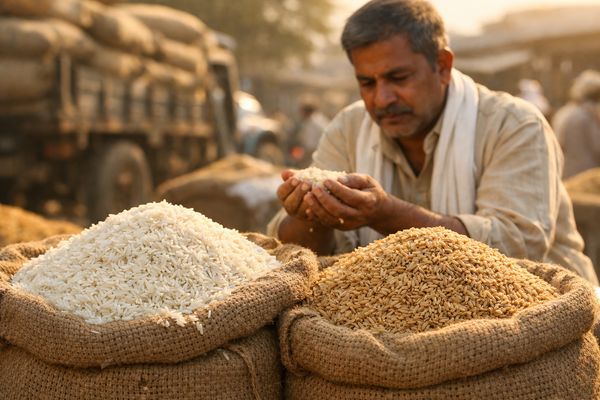
India’s basmati rice market is caught between softening export prices and sharply rising geopolitical and logistics risks, with the APEDA export levy further eroding already thin margins. Exporters warn that without swift policy relief, India’s price competitiveness versus Pakistan could weaken and smaller players may be pushed out of the market.
India’s basmati exporters are navigating one of their toughest periods in years. The conflict in West Asia, especially involving Iran, has stranded significant volumes, delayed payments, and driven up freight, insurance and war-risk surcharges, while retail demand in key Middle Eastern markets remains price-sensitive. At the same time, FOB offers from India, Vietnam and other Asian suppliers have been easing since March, reflecting abundant exportable supplies and softer global benchmark indices.
Exclusive Offers on CMBroker

Rice
all golden, sella
FOB 0.86 €/kg
(from IN)

Rice
all steam, pr11
FOB 0.37 €/kg
(from IN)

Rice
al ısteam, sharbati
FOB 0.51 €/kg
(from IN)
📈 Prices & Market Tone
FOB basmati and non-basmati prices in India and long-grain quotes in Vietnam have drifted lower in EUR terms over the past four weeks, signalling a softer but still volatile market backdrop. Indian basmati and sella values in New Delhi are down roughly 2–3% since late March, while Vietnamese long white 5% has eased by a similar magnitude, in line with recent global rice price index declines reported for early April.
| Origin / Type | Location | Delivery | Latest price (EUR/kg) | 1–3 week change (EUR/kg) |
|---|---|---|---|---|
| IN basmati, organic white | New Delhi | FOB | 1.72 | -0.02 |
| IN non-basmati, organic white | New Delhi | FOB | 1.41 | -0.02 |
| IN 1121 steam | New Delhi | FOB | 0.79 | -0.02 |
| VN long, white 5% | Hanoi | FOB | 0.41 | -0.02 |
The easing in export quotations reflects ample global supplies and intense competition among major exporters. Recent international rice market updates note 2–3% price declines in India, 5% drops in Thailand and modest weakening in Vietnam in early April, illustrating a broad soft-to-range-bound pattern across Asia.
🌍 Supply, Demand & Geopolitics
India remains the dominant basmati supplier globally, with over 6 million tonnes shipped annually, much of it into highly price-sensitive Middle Eastern markets. The current Iran–US–Israel conflict has severely disrupted this flow: industry sources estimate several hundred thousand tonnes of basmati stranded in transit or at ports, with payment delays reaching tens of thousands of crore rupees.
Exporters face blocked or delayed payments from Iranian buyers, cargo rollovers, diversions and returns, compounding working-capital stress. This comes on top of sharply higher freight rates, emergency re-routing costs around the Strait of Hormuz, war-risk premia and higher marine insurance, all of which lift per-tonne export costs. The sector’s exposure is significant as Iran and the wider Gulf region together account for a large share of India’s premium basmati demand.
📊 Policy & Cost Structure: The APEDA Levy
Against this backdrop, the ₹70 per tonne (around €0.80/t) export contract registration levy collected for the Basmati Export Development Foundation has become a focal point of industry concern. Including GST, the effective burden rises to roughly ₹82.60 per tonne, adding a non-trivial fixed cost to every shipment at a time when FOB prices are under pressure and buyers resist any increase in final prices.
At an annual export volume above 6 million tonnes, total levy collections exceed ₹42 crore (around €4.5 million) per year, excluding GST, underscoring the systemic nature of the charge. For an exporter handling 50,000 tonnes, the levy plus GST amounts to approximately ₹41.3 lakh (about €460,000), while a 200,000-tonne exporter faces around ₹1.65 crore (roughly €1.8 million). These costs directly squeeze working capital and net margins, especially for small and mid-size exporters with limited access to cheap financing.
With basmati prices in key destinations already constrained by soft global benchmarks and heightened competition from Pakistan, any incremental cost risks being absorbed by Indian exporters rather than passed through. Industry bodies therefore argue that the levy effectively undermines India’s price advantage, particularly in tenders or large-volume contracts where a few euros per tonne can determine the outcome.
🌦 Weather & Production Outlook
Short-term weather in India’s core basmati-growing belt (Punjab, Haryana, western Uttar Pradesh, Jammu & Kashmir, Uttarakhand and Himachal Pradesh) is transitioning from late-winter rains to a drier, warmer pre-monsoon pattern. Recent forecasts highlight unseasonal rains and hail in early April over parts of northwest India, followed by a return to dry, warming conditions.
As of mid-April, these anomalies are more relevant for rabi crops and logistics than for the next kharif basmati planting, which will depend primarily on the June–September monsoon. Current international outlooks point to record or near-record global rice production and consumption in 2025/26, with India expected to maintain a large exportable surplus, implying that the main near-term risk for basmati lies on the demand and logistics side rather than on domestic supply.
📌 Key Risks & Drivers
- Geopolitical risk: Escalation or prolongation of conflict around Iran and the Strait of Hormuz would keep freight, insurance and war-risk costs elevated, further eroding export margins.
- Policy risk: Continuation of the APEDA/BEDF levy during a period of soft prices and weak demand could accelerate market share loss to Pakistan and other competitors in the premium segment.
- Credit & liquidity: Large pending payments from Iranian and other Middle Eastern buyers heighten liquidity stress, particularly for smaller exporters reliant on bank limits.
- Price competition: Abundant global supplies and recent 2–5% price declines among major exporters increase pressure to discount, limiting the ability to recover higher costs from buyers.
📆 Trading & Hedging Outlook
- Exporters: Prioritise contract structures that share freight and insurance cost risks with buyers (e.g. FOB vs CFR negotiations) and consider shorter-tenor contracts until Middle East logistics normalise.
- Buyers/importers: Use current softening in Asian rice benchmarks to secure forward cover for Q2–Q3, but maintain flexibility on origin to arbitrage differences between India and Pakistan.
- Policy-sensitive strategy: Monitor signals from APEDA and the Indian government on potential levy suspension; confirmation could quickly improve Indian basmati’s offer competitiveness and narrow discounts.
- Risk management: Given the high linkage between energy and freight costs, participants should integrate crude oil and bunker fuel scenarios into pricing and hedging decisions for new-season contracts.
📉 3‑Day Directional Outlook (EUR, FOB)
- India – New Delhi basmati & sella: Bias mildly soft to sideways in EUR terms as exporters continue to discount to move delayed cargoes; any policy hint on levy relief would be modestly supportive.
- Vietnam – Hanoi long white 5%: Sideways to slightly weaker, tracking abundant supply and subdued import demand in Asia.
- Premium basmati segment (export parity): Range-bound with downside risk if Middle East disruptions intensify or if India delays policy support to exporters.