
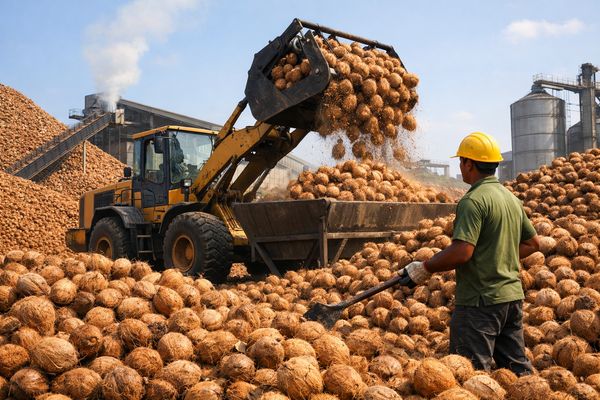
India’s dominant production, firm government backing and diversified end-use demand are keeping the global coconut market well supplied, while prices for desiccated and flaked coconut in Europe remain broadly stable in early April 2026.
Supported by strong rural linkages and upcoming policy measures, the medium‑term outlook is moderately bullish on value-added products rather than on raw nut prices.
India underpins the current market balance. With about 30.4% of global output, 2.39 million hectares under coconut and annual production of roughly 21.37 million tonnes, India remains the key anchor for world supply. Around 30 million people are linked to the sector and 10 million farmers rely directly on coconut cultivation, making policy support and productivity gains structurally important drivers rather than short-term noise.
Exclusive Offers on CMBroker

Coconut dried
flakes
FOB 4.67 €/kg
(from VN)

Coconut dried
flakes
FCA 3.12 €/kg
(from NL)

Coconut dried
flakes
FCA 2.72 €/kg
(from NL)
📈 Prices
Recent spot and offer indications for value-added coconut products in EUR suggest a sideways market over the last month.
| Product | Origin | Location / Terms | Latest Price (EUR/kg) | 1‑Month Trend | Last Update |
|---|---|---|---|---|---|
| Coconut dried, flakes, non-organic | Vietnam | Hanoi, FOB | 4.65 | Stable | 10 Apr 2026 |
| Coconut dried, flakes, organic | Philippines | Dordrecht (NL), FCA | 3.10 | Stable | 10 Apr 2026 |
| Coconut dried, flakes, non-organic | Philippines | Dordrecht (NL), FCA | 2.70 | Stable | 10 Apr 2026 |
| Coconut dried, desiccated | Indonesia | Dordrecht (NL), FCA | 2.00 | Stable | 10 Apr 2026 |
| Coconut dried, desiccated medium grade | Indonesia | Dordrecht (NL), FCA | 1.95 | Stable | 10 Apr 2026 |
Across these key export lines, quotations have been flat since at least 19 March 2026, indicating good availability and the absence of acute weather or logistics shocks along the main Asian–EU supply routes.
🌍 Supply & Demand
On the supply side, India’s scale and structural improvements are the central story. The country leads global coconut production with just over 30% market share and continues to expand cultivation, backed by a sizeable rural labour force and strong integration into agro-based industries.
Government plans to roll out a National Coconut Development (or Promotion) Scheme from the 2026–27 fiscal year, with a proposed allocation of about USD 42 million, aim squarely at raising productivity and competitiveness. This includes better planting material, modern agronomy and support for processing, which should lift yields and quality over time and underpin exportable surpluses.
Demand is broad-based and resilient. Food and beverage applications (fresh nuts, desiccated coconut, coconut milk and water), edible oil, cosmetics, personal care and coir/fibre industries all draw on the same raw material base, providing multiple demand pillars. Globally, desiccated coconut and virgin coconut oil continue to benefit from plant-based and ‘natural ingredient’ trends, particularly in Europe and North America, which helps absorb India’s and Southeast Asia’s output.
📊 Fundamentals & Policy Drivers
The sector is in a gradual transition from traditional to more intensive and technologically supported cultivation. Adoption of improved varieties, modern cultivation techniques and better farm management is gaining traction, though significant productivity gaps still exist between leading and lagging regions within India.
Key structural supports include:
- Forthcoming national schemes focused on coconut productivity and value addition, which should encourage replanting, input use and processing investments.
- Stable to firm domestic Indian demand that helps put a floor under farm-gate prices even when export markets soften.
- Increasing integration into value chains for edible oil, processed foods and personal care, which boosts the value captured per nut compared with raw exports.
Challenges are not negligible. Limited uptake of modern techniques in some regions, lagging replanting, and the need for more sophisticated processing and branding restrict the sector’s ability to fully capitalize on global demand. Disease pressure and weather variability in key Indian states add a layer of production risk, making the planned modernization drive particularly relevant.
🌦️ Weather & Short-Term Outlook
As of mid‑April 2026, no major acute weather disruptions in India’s main coconut belts have been reported in the very recent period. Trees are perennial, so short-lived weather anomalies have a more muted impact than for annual crops, but prolonged drought or severe cyclones would remain key watchpoints.
Given the absence of fresh weather shocks and the strong underlying production base, short‑term coconut availability from India and Southeast Asia is expected to remain comfortable. This aligns with the observed stability in European desiccated and flake price indications.
📆 Market & Trading Outlook
Short term (next 1–3 months), production is expected to stay stable to strong, and domestic demand in India continues to support local price levels. Internationally, steady supply from India, Indonesia, the Philippines and Sri Lanka suggests a broadly balanced market for desiccated and flaked products.
Over the longer term, the combination of government support, expanding applications and rising global demand points to gradual growth in both volumes and value-added segments. The main upside risk for prices lies in potential weather or disease events in India’s key producing states; the main downside risk is possible overcapacity in processing if demand growth underperforms expectations.
📌 Trading Recommendations
- Buyers (food & cosmetic industry): Use the current period of stable prices in Europe (around EUR 1.95–2.70/kg FCA for Indonesian/Philippine desiccated and flakes) to secure medium-term contracts, especially for high-volume formulations.
- Producers & exporters: Focus on upgrading quality and certification (organic, sustainability) to capture better margins rather than betting on a strong price rally in raw material. Prepare to leverage India’s upcoming productivity schemes to lower unit costs.
- Traders: Maintain a neutral to mildly long stance in value-added products, watching closely for any weather or policy headlines from India that could tighten supply and create brief price spikes.
📉 3‑Day Directional Price View (EUR)
- EU (Dordrecht, NL) desiccated/flake coconut: Sideways; prices expected to hover near EUR 1.95–3.10/kg FCA.
- Vietnam FOB dried coconut flakes: Sideways; offers likely to remain close to EUR 4.65/kg FOB.
- Overall coconut complex: Stable, with low short-term volatility expected barring unforeseen weather or logistics shocks.