
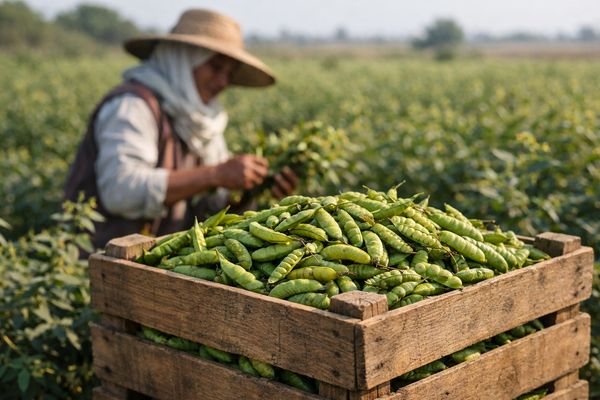
Pigeon pea prices in India are stabilizing after a sharp correction, with domestic values now trading below the official support level but still clearly under import parity. Tight local supply and costly overseas offers give prices room to recover modestly over the next 2–4 weeks, even as short‑term sentiment at mills remains cautious.
After weeks of heavy selling and weak dal mill demand, Delhi wholesale prices have found a floor in the low‑$90s per quintal, well under India’s Minimum Support Price but also far below equivalent import costs from Myanmar and East Africa. At the same time, last season’s significant production shortfall and high ocean freight linked to tensions around the Strait of Hormuz are restricting competitively priced imports. For European buyers, this means limited cheap Indian export availability and a window where local green and marrowfat pea prices in Europe remain broadly stable but with upside risk if Indian pigeon pea strengthens.
Exclusive Offers on CMBroker

Peas dried
green
FOB 1.02 €/kg
(from GB)

Peas dried
marrowfat
FOB 1.33 €/kg
(from GB)

Peas dried
green
98%
FCA 0.34 €/kg
(from UA)
📈 Prices & Spreads
In India’s physical market, pigeon pea prices dropped from about EUR 90.7/quintal to EUR 83.6/quintal over roughly six weeks before stabilizing around EUR 84.2–84.8/quintal early this week. Fresh lemon‑grade pigeon pea is now quoted near EUR 85.3/quintal, signalling that the earlier correction has exhausted itself and that mills are no longer willing to sell forward at deep discounts.
By contrast, Myanmar’s new‑crop pigeon pea has moved up to roughly EUR 75.5–76.9 per 100 kg equivalent (around USD 820–835 per metric ton CNF), translating to more than EUR 94–95 per quintal landed in India once freight and costs are included – well above current domestic quotes. Even slightly softer lemon‑grade offers for May–June shipment around USD 795 per ton at Chennai still imply a domestic equivalent comfortably above today’s wholesale levels, while Mozambique’s white pigeon pea near USD 640 per ton CNF also prices above many Indian spot deals when converted. Recent market updates confirm that Myanmar and African CNF values have eased only marginally in the last few days, leaving domestic India clearly below import parity.
In Europe and the Black Sea, dried pea prices remain relatively steady. Recent offers show UK green peas FOB London around EUR 1.02/kg and marrowfat peas near EUR 1.33/kg, while Ukrainian green peas FCA Odesa trade close to EUR 0.34/kg and yellow peas around EUR 0.26/kg. These flat price curves reflect that the immediate pressure point in the global pea complex is on pigeon peas in India rather than on European feed and food peas.
| Market | Product | Indicative Price (EUR) | Note |
|---|---|---|---|
| Delhi (India) | Pigeon pea, lemon grade | ~85/quintal | Below MSP; near recent floor |
| Chennai (India) | Imported pigeon pea, May CNF | >94/quintal equiv. | Import parity well above domestic |
| London (GB) | Dried green peas, FOB | 1.02/kg | Stable week-on-week |
| Odesa (UA) | Dried green peas 98%, FCA | 0.34/kg | Flat vs late April |
🌍 Supply, Demand & Trade Flows
India’s supply balance is fundamentally tight. Last season’s pigeon pea output of about 5.4 million tons has fallen to an estimated 4.2 million tons this season – a drop of roughly 22%, driven by reduced sowing and rainfall damage across both kharif and rabi cycles. In key producing belts like Neemuch, roughly 78% of available crop has already been absorbed by dal mills, while other corridors such as Gaya, Nagarutari and Nagar Pattu are seeing aggressive mill procurement into Muzaffarpur–Patna. In major Maharashtra markets, workable arrivals are scarce and split dal is actually trading at a discount to raw grain, underlining how little free stock is left at origin.
On the demand side, mill sentiment has pivoted from defensive to cautiously supportive. Processors that previously liquidated forward positions at low prices are now struggling to re‑cover volumes at acceptable landed costs, discouraging further panic selling. Meanwhile, steady but not excessive imports from Myanmar and East Africa continue. Myanmar’s old‑crop stock is essentially exhausted, and while recent reports indicate softer FOB values amid weaker Indian buying interest, CNF levels remain high enough that new import contracts add cost rather than relief to Indian supply. Competition from African origins is visible, but volumes have yet to surge enough to fully offset India’s production shortfall.
For Europe, this constellation means that low‑priced Indian pigeon pea and toor dal will be less freely available in coming weeks. At the same time, European and Ukrainian pea markets are comfortably supplied and decoupled from India’s immediate tightness, giving European buyers some flexibility to switch between pigeon pea and other peas where product specifications allow.
📊 Fundamentals & External Drivers
The fundamental backdrop remains supportive for prices despite the recent correction. Import parity is clearly above domestic Indian levels, and the production deficit is sizable. With India’s Minimum Support Price set around EUR 87–88 per quintal, current wholesale values near EUR 85 leave only limited downside before policy and grower resistance begin to bite. Mill procurement competition in deficit belts and the high share of crop already moved into processing hands add to the sense that free on-farm stocks are thin.
External cost push is another key driver. Ocean freight has risen amid severe disruptions in and around the Strait of Hormuz, which is inflating delivered prices for bulk commodities and fertilizers into South Asia. While pulses are not the primary focus of these disruptions, higher bunker and freight rates effectively raise the floor for CNF pigeon pea offers into India, reinforcing the price gap with domestic physical markets.
Weather risks are building but not yet decisive. In India, earlier rainfall damage has already been accounted for in this season’s smaller crop, and short‑term weather will mostly affect the next kharif sowing. In Myanmar and East Africa, recent assessments suggest no acute disruption to export logistics from weather in the last few days, though El Niño concerns for mid‑2026 could tighten future supplies if sowing or yields falter.
📆 Short-Term Outlook (2–4 Weeks)
The balance of evidence points to a cautious recovery in Indian pigeon pea prices over the next two to four weeks. With domestic quotes below MSP, structural production deficits, and import parity comfortably above local levels, prices have a credible case to rebound by roughly EUR 4–5 per quintal as mills compete more actively for limited free stock. The main risk to this scenario would be a sudden, material softening of Myanmar CNF prices or a wave of African arrivals that sharply widens the import–domestic spread.
For European buyers, this suggests a narrowing window to secure pigeon pea and toor dal at current levels. While local green and marrowfat pea prices in the UK and Black Sea have been flat, they are indirectly capped by India’s current weakness; any recovery in Indian values, particularly if combined with weather concerns for the next Indian crop, could spill over into higher global pea and pulse pricing over the summer.
🧭 Trading Outlook & Recommendations
- Indian dal mills: Consider shifting from pure hand‑to‑mouth procurement to modest forward coverage, especially in belts where arrivals have slowed sharply. With prices below MSP and import parity, downside is limited relative to upside risk from tighter logistics or policy changes.
- Importers into India: Be cautious about new high‑cost CNF bookings from Myanmar or Africa unless domestic spot prices move closer to parity. Monitor freight markets closely; any further escalation around Hormuz could quickly reprice landed costs upward.
- European buyers of pigeon peas and split dal: Use the current few‑week window to cover short‑term needs (1–3 months) at still‑favourable levels, but avoid over‑extending far forward until there is better visibility on India’s kharif sowing and monsoon progression.
- Growers in India and East Africa: Given the mismatch between MSP and physical prices, Indian farmers with storage capacity may delay sales in anticipation of a rebound. African exporters should prepare for potentially firmer demand in late Q2/Q3 if India’s structural deficit tightens further.
📍 3-Day Indicative Price Direction (EUR)
| Market | Product | 3-Day Bias | Comment |
|---|---|---|---|
| Delhi (India) | Pigeon pea, lemon grade | ⚖️ to 🔼 | Floor established; mild recovery likely as mills restock selectively. |
| Chennai (India) | Imported pigeon pea, May–Jun CNF | ⚖️ | CNF offers steady; freight risk tilted higher but short-term quotes stable. |
| London (GB) | Dried green & marrowfat peas, FOB | ⚖️ | European pea prices flat; limited near-term linkage to Indian volatility. |
| Odesa (UA) | Dried green & yellow peas, FCA | ⚖️ | Comfortable Black Sea supply; no immediate weather or logistics shock. |
Related posts:
 Pigeon Pea Market Under Pressure as Myanmar Imports Weigh on Indian Prices
 Pigeon Peas Under Pressure: India’s Buyer’s Market Caps Global Pea Prices
 Pigeon Peas Under Pressure: India’s Buyer’s Market Supports Soft, Rangebound Prices
 Pigeon Peas Under Pressure: India’s Quiet Tug-of-War Caps Global Pea Moves
 Indian Pigeon Peas Under Government Floor While EU Pea Prices Ease
 Pigeon Peas: Indian Market Stabilises as Imports Lose Competitiveness
 Indian Pigeon Peas Edge Higher, But Imports Keep a Lid on Prices